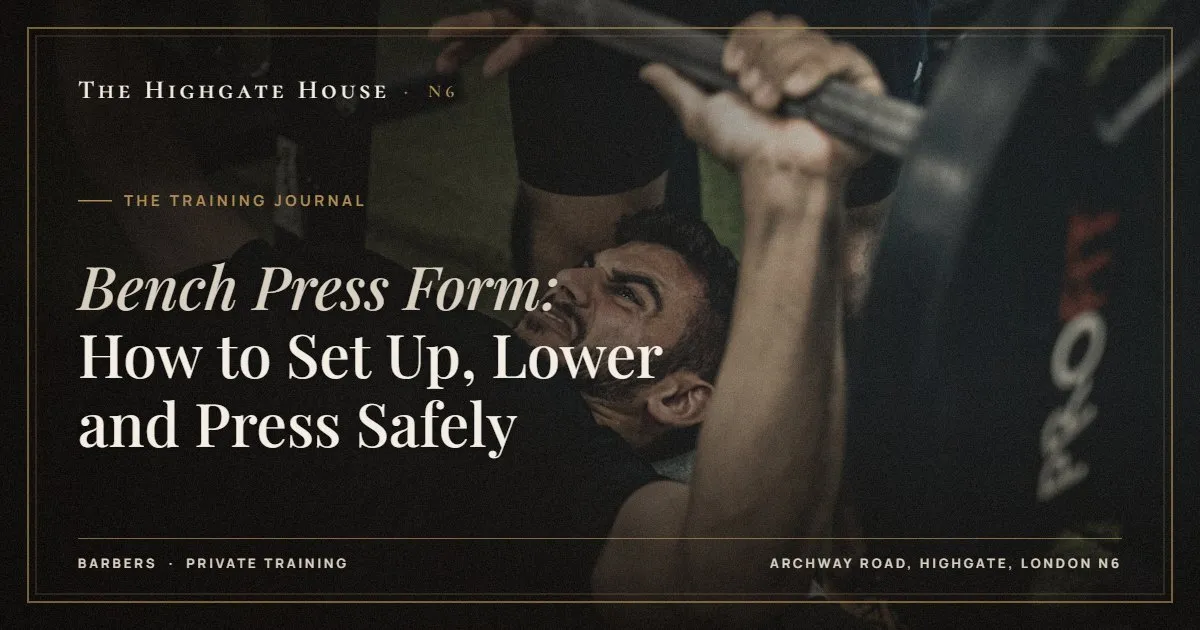
Bench Press Form: How to Set Up, Lower and Press Safely
Good bench press form comes down to five things: eyes roughly under the bar, shoulder blades pulled back and down into the bench, feet planted firmly, a grip that puts your forearms vertical at the bottom, and a controlled descent to the lower chest with the elbows slightly tucked rather than flared out to the sides. Then press up and slightly back towards the rack. Most bench press problems, including sore shoulders, are set before the bar leaves the hooks. And for safety: never bench heavy without either a spotter or safety arms set just below chest height.
Before anything else: safety
The bench press is the one big barbell lift where a failed rep can pin you under the weight. That is a solvable problem, but it needs solving before you start, not halfway through a hard set.
- Use safeties. If you bench inside a squat rack, set the safety arms just below the height of your chest at the bottom of the rep, with your back arched as you would lift. A failed rep then rests on the arms, not on you.
- Or use a spotter who knows what they are doing, standing at your head with hands near, not on, the bar.
- Skip the collars only if you have no safeties and no spotter, so you can tip the plates off one side in an emergency. Better still, do not put yourself in that position.
- Never use a thumbless grip. It is sometimes called the “suicide grip” for a reason: the bar can roll off the palms onto your chest or neck.
If you are new to barbells, how to use a squat rack safely explains J-hooks and safety arms in more detail.
Setting up: the part that matters most
- Bar height. Set the J-hooks so you can unrack with nearly straight arms. If you have to press the bar off the hooks from bent elbows, they are too low. If you have to reach up and lose your shoulder position, they are too high.
- Position on the bench. Lie down with your eyes roughly under the bar. Too far towards the feet and you will hit the hooks on every rep. Too far back and you have a long, awkward journey to the start position.
- Grip. Take the bar with a full grip, thumbs wrapped. For most people, a width where the forearms are close to vertical when the bar touches the chest is right, which usually puts the index fingers somewhere around the rings on a standard Olympic bar. The bar should sit low in the palm, over the forearm bones, not up near the fingers where it bends the wrist back.
- Shoulder blades. Squeeze them together and pull them down towards your back pockets, then press them into the bench. This gives you a stable platform and keeps the front of the shoulder out of a vulnerable position.
- Arch. A modest natural arch in the upper and middle back follows from step four. Your bottom stays on the bench, always. You do not need an extreme arch for general strength training.
- Feet. Plant them flat, roughly under or slightly behind the knees, and push into the floor as if sliding yourself up the bench. This is leg drive, and it keeps your whole body tight.
The unrack and the descent
Take a breath, brace, and press the bar off the hooks. Move it forward until it sits over your shoulders, with arms straight and wrists stacked over elbows. Pause for a second. If you have a spotter, a lift-off from them is fine.
Now lower the bar under control, taking around two seconds:
- Bar path: it travels down and slightly towards your feet, landing around the lower chest or bottom of the breastbone. It is not a vertical line.
- Elbows: tucked somewhere between 45 and 75 degrees from your body, depending on your build. Not pinned to your sides, and not flared out at 90 degrees. Flared elbows put a lot of stress on the front of the shoulder.
- Touch: touch the chest lightly. No bouncing. A bounce shifts load onto the ribcage and hides the weakest part of the lift.
The press
Drive the bar up and slightly back, towards your face, so it finishes over your shoulders where it started. Keep the shoulder blades pinned the whole way. Keep your feet pressing. Breathe out near the top or between reps, not at the bottom when you need your brace most.
When the set is done, press to straight arms, then move the bar back until it hits the uprights, and only then lower onto the hooks. Aiming straight for the hooks is how people miss them.
The faults we fix most often
| Fault | What it causes | The fix |
|---|---|---|
| Elbows flared to the sides | Sore front of shoulder | Think “bend the bar” to tuck the elbows; lower to a lower point on the chest |
| Shoulders rolling forward at the top | Loss of stable base, shoulder strain | Reset the blades between reps; stop pressing as if to touch the ceiling |
| Bottom lifting off the bench | Lower back strain, uncontrolled bar | Feet further forward; push through heels into the floor, not up |
| Wrists bent back | Wrist pain, lost force | Bar lower in the palm, over the forearm |
| Bouncing off the chest | Rib and sternum irritation; false strength | Two-second descent; occasional paused reps |
| Uneven press | One side doing more work | Check grip is centred using the bar’s rings; add dumbbell work |
Barbell, dumbbells, or both?
The barbell lets you load heavily and progress in small, measurable steps. Dumbbells let each arm move more freely, which many people find kinder on the shoulders, and they expose any side-to-side imbalance. For most clients we use both across a training block. The trade-offs are covered in dumbbell vs barbell bench press.
How heavy, how often
For general strength, two pressing sessions a week is plenty, with the bench as one of them. Sets of five to eight reps, stopping with one or two good reps left in the tank, cover most goals. Add weight only when every rep of every set looks the same as the first. Small jumps are fine; there is no prize for big ones. For how to move numbers forward over months, see progressive overload explained.
If you have had a shoulder, elbow or chest injury, have high blood pressure or a heart condition, or are returning after a long break, check with your GP or physiotherapist before pressing heavy.
Learning it with a coach
The bench press looks simple, which is why so many people learn it badly from watching others. A few coached sessions usually sort out the setup, which fixes most of the problems above at a stroke. In our studio on Archway Road we have a squat rack with safety arms, a barbell and plates and a full dumbbell rack, and the room is booked to you alone, so you can take your time getting it right. More on private personal training in Highgate.
Questions we get asked
Should the bar touch my chest?
For most people, yes, lightly. Shortening the range is sometimes useful around an injury, but a full range is the default.
Why does my shoulder hurt when I bench?
Most often it is flared elbows, a lost shoulder-blade position, or too much volume too soon. Fix the setup and reduce the load. If pain persists, see a physiotherapist.
Should I lift my feet onto the bench?
It is not necessary and it makes you less stable. Keep them on the floor and use them.
Is the bench press necessary?
No single exercise is. But it is an efficient way to build pressing strength, and once learned properly most people find it rewarding. We cover how to fit it into a plan on our personal training page.
Book with The Highgate House
Ready to start training properly? Email us at [email protected] with the service and the day that suits you, and we will come back to you with times.
Visit The Highgate House · Private personal training
The Highgate House, Archway Road, Highgate, London N6.
