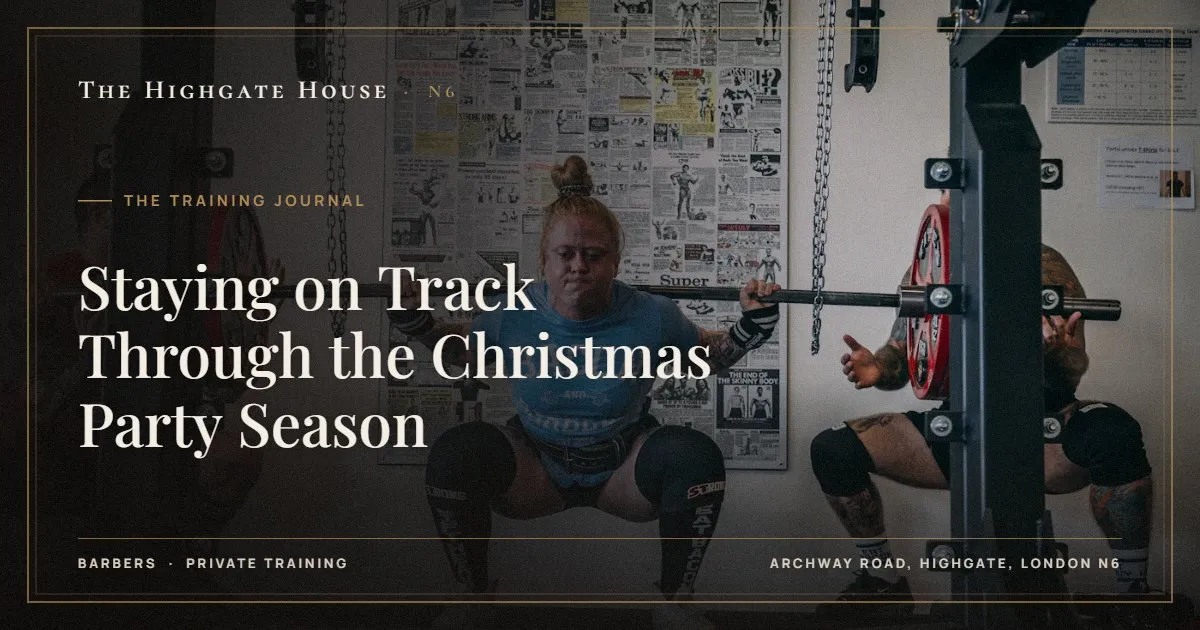
Staying on Track Through the Christmas Party Season
The way to stay fit through the Christmas party season is to stop treating December as a normal training month that keeps getting interrupted, and plan it as a different month with its own rules. Put your diary next to your training plan, protect two sessions a week on the mornings that are least likely to follow a late night, shorten them rather than skipping them, and decide your drinks plan before each event rather than at the bar. Most people who lose ground in December do it through missed sessions and broken sleep, not through any single party.
This post is about the stretch from late November to around the 23rd: the work dos, client drinks, team dinners and friends’ gatherings that cluster into three busy weeks. The Christmas break itself, with its long lunches and days on the sofa, is a different problem, and is covered in our post on not gaining weight over Christmas.
Why December goes wrong for organised people
The people we see struggle in December are rarely undisciplined. They are usually the opposite: organised, busy, and used to training at a set time. December breaks that because the late nights land unpredictably. You plan a 7am session on Thursday, then the team dinner on Wednesday runs to midnight. You skip Thursday, and because Friday has the client drinks, the week ends with no training at all. Two weeks like that and the habit has gone, not just the sessions.
The fix is to plan from the diary outwards.
Plan the month in ten minutes
- Write down every evening commitment from now to Christmas, including the ones you are only probably going to.
- Mark the mornings after each one as unreliable. Do not book hard training on them.
- Find two reliable slots a week. These are the mornings after quiet nights, or a lunchtime on a day with no evening plans. These become your protected sessions.
- Add one flexible slot that only happens if the week goes better than expected.
- Book the protected sessions as if they were meetings. If you train with a coach, book the whole month in one go now, before the diary fills.
Two sessions a week is a deliberate choice. It is enough to maintain strength and keep the habit alive, and it is realistic. The UK Chief Medical Officers’ guidelines set muscle-strengthening activity on at least two days a week as the baseline for adults, so you are still meeting the standard, not cutting corners.
Shorten sessions, do not skip them
A 30-minute session that happens beats a 60-minute one that does not. When time or energy is short, keep the heavy compound lifts and drop the rest. A December session might be:
- Five-minute warm-up on the air bike or rower.
- A squat or deadlift variation: three working sets.
- A press and a row paired together: three rounds.
- One carry or trunk exercise if there is time.
Keep the loads where they were in November, or slightly lighter. December is not the month to chase a personal best. If you hold your strength through to January, you have done well. Our 30-minute strength workout gives a full template you can use on short days.
Training the morning after
This is the question everyone actually wants answered. If you had a few drinks and a late night, should you still train?
It depends on how much and how late. A sensible rule:
| The night before | The morning |
|---|---|
| One or two drinks, in bed by 11 | Train as planned |
| A few drinks, in bed after midnight | Train, but drop the load and the last set; skip anything maximal |
| A big night, short sleep, feeling rough | Swap the session for a long walk and water; train the next day |
The reason is not moral. Alcohol disrupts sleep quality even when you sleep a normal number of hours, and it adds to dehydration. Lifting heavy when you are poorly coordinated and short of sleep is where people get hurt, and the session is unlikely to produce much anyway. A brisk walk up through Highgate Wood or around the Heath does more good than grinding through a bad workout. If you have any heart condition, do not try to sweat out a hangover with hard exercise.
A drinks plan you decide before you go
Decisions made at 9pm with a glass in hand are rarely good ones. Decide beforehand.
- Pick a number. Two, three, whatever it is. A number is easier to keep than “not too many”.
- Start with a soft drink. The first drink goes quickest, often on an empty stomach. Make it sparkling water and you have slowed the whole evening down.
- Alternate. A glass of water between each alcoholic drink is old advice because it works.
- Eat properly before you leave. A meal with protein before a standing reception makes the canapés and the late-night chips far less tempting.
- Have an exit time. The last two hours of a party are usually where the extra drinks and the 2am kebab live.
For context, the NHS advises adults not to regularly drink more than 14 units a week, spread over three or more days. A busy party week can pass that easily without anyone feeling they overdid it. Counting units for December is not a bad exercise.
Food: the days around the parties
The parties themselves are rarely the issue. It is the day after, when you are tired and reach for sugar, and the office tins of chocolates that sit on the desk from the first of the month. Two simple habits help:
- On party days, eat normally during the day with plenty of protein and vegetables. Do not starve yourself to “save calories” for the evening; you will arrive hungry and eat more.
- On mornings after, have a proper breakfast with protein before you go near the office treats.
Sleep is the real casualty
If you protect one thing in December, protect sleep on the nights that are not parties. Go to bed early on quiet evenings. A run of short nights affects appetite, mood and how well you recover from training far more than a single big dinner. Our post on sleep and weight loss explains why.
What a coach does in December
Much of December coaching is scheduling. A good trainer looks at your diary with you, moves sessions around the late nights, adjusts the day’s plan when you walk in looking grey, and keeps the habit alive until January. In private sessions on Archway Road that also means early slots before the working day, so training is done before any evening plans can get in the way.
Questions we get asked
Is it worth starting training in December, or should I wait for January?
Starting in December is usually better. You learn the basics during a quieter month for gyms and arrive in January with a routine already in place.
Does exercise cure a hangover?
No. Time, water, food and sleep do the work. Gentle movement may make you feel better, but hard training on a hangover is a poor idea.
How much fitness will I lose if I only train twice a week for a month?
Very little. Two sessions a week is enough for most people to hold their strength through a busy month.
Can I book a block of sessions for December?
Yes. Email us with the mornings that work around your diary and we will look at 1-1 training in Highgate for the month.
Book with The Highgate House
Ready to start training properly? Email us at [email protected] with the service and the day that suits you, and we will come back to you with times.
Visit The Highgate House · Private personal training
The Highgate House, Archway Road, Highgate, London N6.
