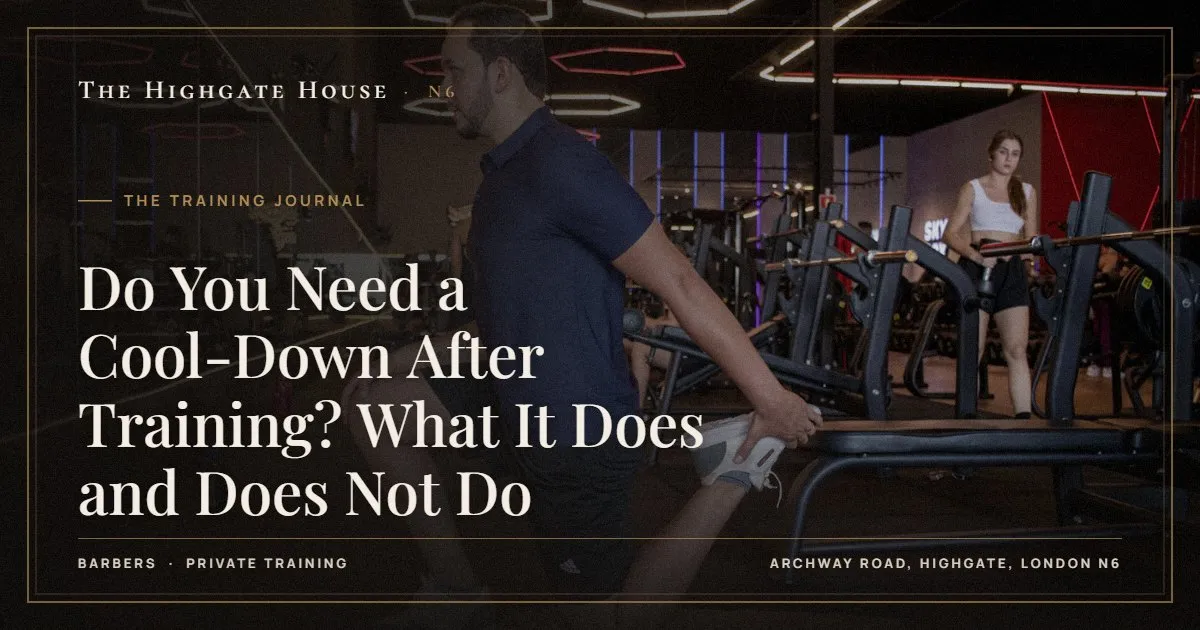
Do You Need a Cool-Down After Training? What It Does and Does Not Do
You do not need a formal cool-down after every session, but you do need one after hard conditioning work. A few minutes of easy movement lets your heart rate and breathing come down gradually, which avoids the light-headed, wobbly feeling some people get when they stop dead after a sprint. What a cool-down does not reliably do is prevent next-day muscle soreness, “flush out lactic acid” in any way that matters for tomorrow, or reduce injury risk in your next session. After a straight strength session, a slow walk and a minute of steady breathing is usually enough. The long stretching routine many of us were taught is optional, not essential.
That is the short answer. The useful detail is in knowing which situations call for more, and what to do with the five minutes if you take them.
What a cool-down actually does
During hard exercise your heart pumps a large volume of blood to working muscles, and those muscles help push it back by contracting. Stop suddenly, particularly while standing, and the muscle pump stops too. Blood pools briefly in the legs, blood pressure drops, and some people feel dizzy or even faint. This is the clearest, least disputed reason to cool down: it gives the circulation a gentle handover rather than a cliff edge.
The second benefit is psychological, and it is not trivial. A few minutes of easy movement and slower breathing marks the end of the session. People who rush from the last set to the shower to a meeting often carry that keyed-up feeling for a while. A deliberate downshift helps some people sleep and settle better after evening training, though this is individual.
What it does not do
It does not prevent soreness
Delayed onset muscle soreness, the stiffness that peaks a day or two after unfamiliar or harder work, is driven mainly by the training itself: new exercises, more volume, and especially lowering weights slowly. Studies comparing active cool-downs with simply stopping have generally found little or no difference in how sore people feel the next day. If you want less soreness, increase training load gradually. That works far better than any routine done afterwards.
It is not about lactic acid
Lactate produced during hard effort is cleared by the body within roughly an hour whether you cool down or sit on a bench. Easy movement may speed that slightly, which matters for athletes with another race or match the same day. For someone training at 7am and then going to work, it makes no practical difference.
It is not proven injury prevention
The warm-up has a stronger case for preparing you for the work ahead. The cool-down happens after the risk has passed. If you are worried about injury, put the time into a proper warm-up and sensible progression. Our guide to warming up before lifting weights covers the parts that matter.
When a cool-down is worth doing
| Session type | Cool-down? | What it looks like |
|---|---|---|
| Intervals, air bike sprints, circuits | Yes | 3 to 5 minutes of easy pedalling or walking until breathing is conversational |
| Heavy lower-body strength work | Light | A slow walk and a minute of steady breathing |
| Upper-body or moderate strength work | Optional | Whatever helps you settle; nothing is required |
| Long steady cardio | Yes | Taper the pace for the last few minutes rather than stopping abruptly |
The pattern is simple. The harder your heart and lungs were working at the end, the more the gradual handover helps. A session that ends with a set of curls does not need one; a session that ends with six all-out efforts on the air bike does.
A five-minute cool-down that earns its place
- Two to three minutes of easy movement. Pedal the bike against minimal resistance or walk. Keep going until you could hold a normal conversation.
- One minute of slow breathing. Sit or lie down, breathe in through the nose for about four seconds and out for about six. Longer exhales tend to help people feel calmer. Our piece on breathing for recovery goes into more techniques.
- One or two stretches you actually need. If your hips feel tight from desk work, a hip flexor stretch. If your chest is tight, a doorway stretch. Thirty seconds or so each side. Skip the full-body routine.
- Drink some water and note the session. Write down what you lifted and how it felt while it is fresh. That habit does more for next week than any stretch.
Where stretching fits
Stretching after training is fine and many people find it pleasant, but it is not what makes a cool-down work. Improving flexibility needs regular stretching over weeks, and it does not much matter whether that happens straight after lifting or in the evening in front of the television. If you prefer stretching afterwards because you are already warm and on the floor, that is a perfectly good reason. The debate is covered in more detail in our post on stretching before or after a workout.
What I would avoid is a ten-minute stretching routine that you do out of duty and that cuts into the time you could have spent on the main work. In a one-hour private personal training session, we would rather spend that time on strength and leave you with one or two targeted mobility drills to do at home.
Common mistakes
- Stopping dead after hard intervals and standing still. This is the one situation where people do feel faint. Keep moving, or sit down.
- Going straight into a hot shower after very hard cardio. Heat widens blood vessels further. Give yourself a few minutes first if you tend to feel light-headed.
- Using the cool-down as extra conditioning. If your “cool-down” leaves you out of breath, it is more training. Keep it genuinely easy.
- Expecting it to fix soreness. If you are crippled after every session, the programme is progressing too quickly. Adjust the training, not the aftercare.
Safety: when to take more care
If you have a heart condition, high blood pressure, are pregnant, take medication that affects heart rate or blood pressure, or are returning after a long break, check with your GP first before starting hard conditioning work, and always taper gradually rather than stopping abruptly. Any chest pain, unusual breathlessness, or dizziness that does not settle quickly with rest is a reason to stop and seek medical advice, not to push through. The NHS physical activity guidelines are a sensible baseline for how much activity most adults should aim for.
How we handle it in the studio
Sessions in the lower ground studio at The Highgate House end according to what we did. After air bike intervals, you keep pedalling easily until your breathing settles. After a heavy squat day, we walk, talk through the session and what changes next time, and that is usually enough. If you have a specific mobility limitation, you leave with one or two drills rather than a list you will not do. You can read more about how sessions are structured on the personal trainer page.
Questions we get asked
Is it bad to skip a cool-down?
After strength training, generally no. After hard cardio, skipping it is not harmful for most healthy people, but stopping abruptly can make you feel dizzy. A few easy minutes is a cheap insurance policy.
Does a cool-down reduce muscle soreness?
Not by much, if at all. Soreness depends mostly on how new or demanding the training was. Gradual progression is the real fix.
Is foam rolling a good cool-down?
It can feel good and may reduce the sensation of tightness for a short while. It is fine as a preference, but not necessary.
How long should a cool-down be?
Three to five minutes is enough for most sessions. Stop when your breathing and heart rate feel close to normal.
Book with The Highgate House
Ready to start training properly? Email us at [email protected] with the service and the day that suits you, and we will come back to you with times.
Visit The Highgate House · Private personal training
The Highgate House, Archway Road, Highgate, London N6.
