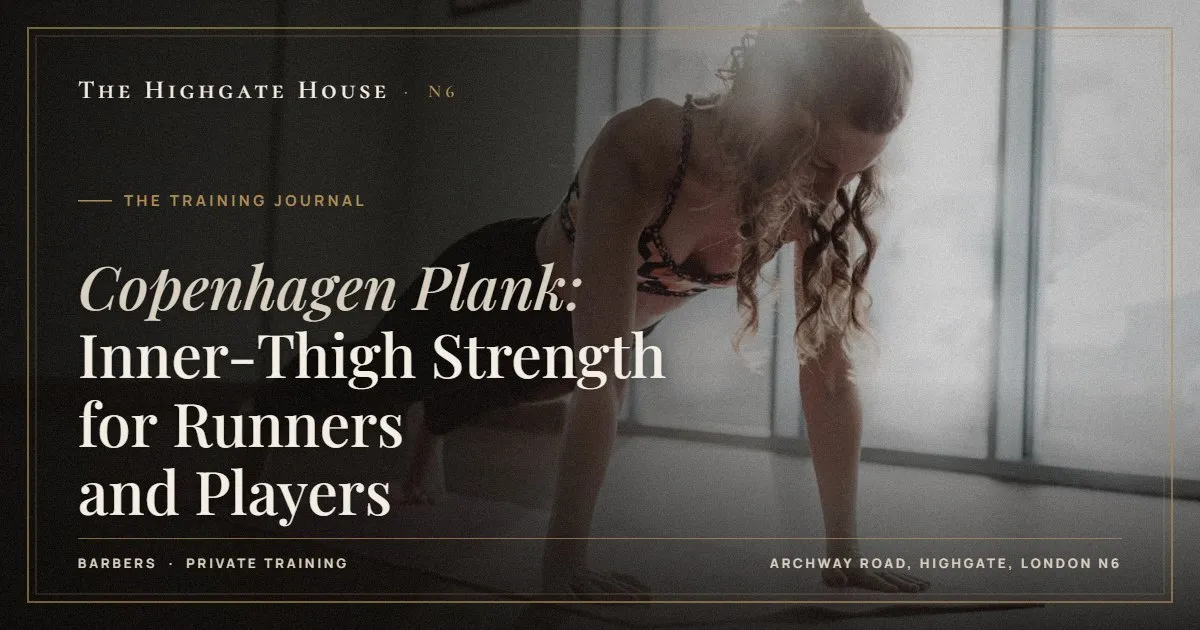
Copenhagen Plank: Inner-Thigh Strength for Runners and Players
The Copenhagen plank is a side plank with your top leg resting on a bench and your bottom leg hanging free, so the inner thigh of the top leg holds your body up. It is one of the few exercises that loads the adductors hard without any equipment beyond a bench, and it has a good research record for reducing groin problems in footballers. Most people should start with a short-lever version, knee on the bench, for 3 sets of 10 to 15 seconds a side, twice a week, and build to the full version over about six weeks. Here is how to do it, how to progress it and where it fits.
Why the adductors deserve their own exercise
The adductors are the muscles on the inside of the thigh. Their obvious job is pulling the leg towards the midline, but in practice they do far more: they help stabilise the pelvis when you stand on one leg, they decelerate the leg when you change direction, and they contribute to hip extension at the bottom of a squat or a sprint stride. Every footstep on a run is a brief single-leg balance, and every cut on a five-a-side pitch is a sudden sideways brake.
Ordinary gym training does load them to a degree. Deep squats and split squats get the adductors working. What they rarely do is load them at long length under a high, specific demand, which is exactly what a sliding tackle or a slip on wet grass does. That gap is where the Copenhagen plank earns its place.
The evidence is unusually specific for a single exercise. A randomised trial in Norwegian male football players, published in the British Journal of Sports Medicine in 2019, added a short Copenhagen adduction programme to normal training and found fewer groin problems over the season in the group that did it. That is footballers, not runners or recreational lifters, so treat it as a strong reason to include the exercise rather than a guarantee.
How to do the Copenhagen plank
You need a flat bench at roughly knee height. A sofa will do at home, but it is softer and less stable, so the hold will feel different.
- Set up side-on. Lie on your side next to the bench, propped on your forearm with the elbow directly under the shoulder.
- Place the top leg. Rest the inside of your top leg on the bench. For the full version, the bench sits under the ankle and lower shin. For the short-lever version, it sits under the inside of the knee.
- Lift. Press the top leg down into the bench and lift your hips until your body forms a straight line from head to feet. The bottom leg either hangs under the bench or, harder, lifts to meet the top leg.
- Hold the line. Hips stacked, not rolled forward. Ribs down. Breathe steadily through the nose if you can.
- Lower with control rather than dropping, then switch sides.
The most common fault is letting the hips sag and rotate forwards, which turns it into a wobbly side plank and takes load off the inner thigh. If you cannot hold the line, shorten the lever or the time before anything else.
Start with the right version
The full Copenhagen plank is genuinely hard. Putting the ankle on the bench creates a long lever and puts a lot of force through the adductor and the inside of the knee. Plenty of fit people, including regular runners, cannot hold it well for ten seconds on their first attempt. Start lower and you will progress faster.
| Level | Setup | Move on when |
|---|---|---|
| 1. Side plank from knees | Ordinary side plank, bottom knee on the floor | 3 x 30 seconds a side, hips square |
| 2. Short lever, bottom foot down | Knee on the bench, bottom foot lightly touching the floor for help | 3 x 20 seconds with little weight on the bottom foot |
| 3. Short lever, bottom leg free | Knee on the bench, bottom leg hanging | 3 x 20 to 30 seconds a side |
| 4. Full lever | Ankle on the bench, bottom leg hanging | 3 x 15 to 20 seconds a side |
| 5. Full lever, dynamic | Ankle on the bench, lift the bottom leg up to meet it for slow reps | Use as a maintenance option |
Most people begin at level 2 or 3. If you have had a groin strain in the past year, begin at level 1 for a couple of weeks even if it feels easy.
A six-week progression that works
Adductors respond well to progressive load, and they also complain when you rush them. Delayed soreness on the inner thigh after a first session is common, and it can make the next day’s run feel odd. This plan builds slowly enough to avoid that.
- Weeks 1 and 2: twice a week, 3 sets of 10 to 15 seconds a side at your starting level. Rest 30 to 45 seconds between sides.
- Weeks 3 and 4: twice a week, 3 sets of 20 seconds, or move up one level and drop back to 10 to 15 seconds.
- Weeks 5 and 6: twice a week, 3 sets of 20 to 30 seconds, or another level up.
- After that: once a week is usually enough to keep what you have built, especially if you also squat and lunge.
Stop each set when the line breaks, not when the clock says. A 12 second hold with clean hips is worth more than a 25 second hold where the last ten seconds are a sag. If you want a general rule on hold times and when planks stop being useful, we wrote that up separately in how long you should hold a plank.
Where it fits in a runner’s or player’s week
Put the Copenhagen plank after your main lifts, alongside other trunk work, or at the end of an easy run day. Avoid doing it the day before a race, a hard interval session or a match, at least until you know how your legs respond.
Runners. Pair it with single-leg work such as split squats, step-ups and calf raises. The combination covers the hip from three sides: glutes, adductors and the calf complex that absorbs each footstrike. If you are returning to running in your forties, our guide to getting back into running after 40 sets out the rest of the strength work worth doing.
Football, padel, tennis and hockey players. Change of direction is where groin problems tend to start, so the exercise is more directly relevant for you. Do it twice a week through the season, keeping it away from the 48 hours before a match where you can. Our piece on staying robust for weekend football covers the rest of a sensible weekly plan.
Lifters. If you squat and deadlift regularly and want stronger, more comfortable deep positions, the short-lever version is a useful accessory. It also tends to show left-right differences very clearly, which is useful information.
Mistakes that make it less useful
- Bench too high or too low. If the bench is well above hip height when you lie down, you are tilted and the load shifts. Aim for the top leg roughly level with the body.
- Elbow drifting. If the elbow is ahead of the shoulder, the shoulder takes strain. Stack it underneath.
- Holding your breath. A long held breath makes the plank feel easier for a few seconds and harder afterwards. Breathe.
- Only training it when something hurts. It works best as a routine part of training, not an emergency fix.
- Ignoring knee pain. The full version puts force through the inside of the knee. Any sharp pain there means go back to the short lever.
If you have an existing groin, hip or knee injury, or pain that has lasted more than a couple of weeks, check with your GP or a physiotherapist before loading it. The exercise is used in rehabilitation, but the right dose for an injured adductor is a clinical decision.
How we use it in the studio
In our private personal training studio in Highgate, the Copenhagen plank usually appears in the last ten minutes of a lower-body session, with the bench set up beside the squat rack. I will normally test both sides in the first week, note the level and hold time, and then progress it the same way as any other lift. For players and runners we also use the cable station for standing adduction work, which lets us add load in small steps. If groin niggles keep interrupting your running or your weekend games, 1-1 coaching can build this and the related work into a programme that fits your week.
Questions we get asked
Is the Copenhagen plank safe for beginners?
The short-lever version, knee on the bench, is suitable for most healthy adults. The full version is an intermediate exercise. Start lower than you think you need to.
Should I feel it in my groin?
You should feel a strong working effort along the inner thigh of the top leg. You should not feel sharp or pinching pain in the groin or the inside of the knee. If you do, stop and regress.
Can I do it every day?
There is no benefit to daily sets. Twice a week builds strength well, and once a week maintains it.
Does it help with inner-thigh fat?
No. It strengthens the muscle, but fat loss does not happen locally where you train.
Book with The Highgate House
Ready to start training properly? Email us at [email protected] with the service and the day that suits you, and we will come back to you with times.
Visit The Highgate House · Private personal training
The Highgate House, Archway Road, Highgate, London N6.
