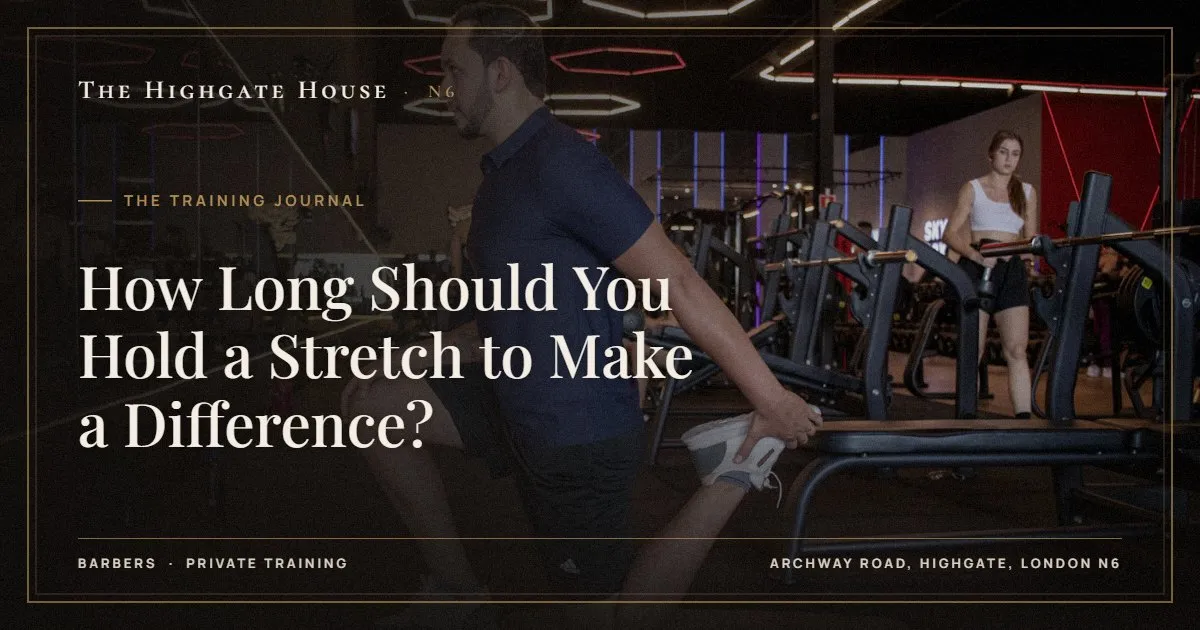
How Long Should You Hold a Stretch to Make a Difference?
For most adults, hold a static stretch for around 15 to 30 seconds, repeat it two to four times, and aim for roughly a minute in total per muscle. Do that on most days, or at least three days a week, and range of movement usually improves within a few weeks. Holding for longer than a minute at a time adds little for most people, and a quick ten-second hold before moving on does very little at all. The total time you spend in the stretch across a week matters more than any single heroic hold, and consistency beats intensity: a stretch should feel like firm tension, never sharp pain.
Why the total minute matters more than the single hold
When you hold a stretch, the first thing that changes is your tolerance of it. The nervous system becomes more willing to let the muscle lengthen, which is why the same stretch feels easier at the end of a set than at the start. Over weeks, repeated exposure builds that tolerance, and the muscle and connective tissue adapt to spending time at longer lengths.
That adaptation responds to accumulated time. Two holds of 30 seconds and four holds of 15 seconds both give you a minute, and for most people they produce similar results. So choose the version you will actually do. If 30 seconds feels like an age when your hamstrings are screaming, four shorter rounds with a breath or two between them is perfectly valid.
A simple prescription by situation
| Situation | Hold | Rounds | How often |
|---|---|---|---|
| General flexibility, younger adults | 15 to 30 sec | 2 to 4 | 3 to 7 days a week |
| Over 60s, or very stiff areas | 30 to 60 sec | 2 to 3 | Most days |
| Before lifting weights | Under 30 sec, or skip | 1 to 2 | Only areas that limit your position |
| After training or in the evening | 30 sec | 2 to 3 | Whenever convenient |
The longer holds for older adults reflect that tissues tend to respond more slowly with age. It is not a rule, just a sensible starting point.
Does holding a stretch before training make you weaker?
This worry comes from research showing that long static holds, typically a minute or more per muscle, can slightly and temporarily reduce how much force that muscle produces. In practice, the effect is small and largely disappears when shorter holds sit inside a proper warm-up that finishes with lighter sets of the lift you are about to do.
My approach before a strength session is simple. Warm up with movement first: a few minutes on the air bike, then dynamic drills and progressively heavier warm-up sets. Only use a short static hold if a specific stiffness stops you reaching a good position, for example tight calves limiting squat depth. Save the longer, deliberate stretching for after the session or a separate time of day. We go into the reasoning in stretching before or after a workout, and the warm-up itself in how to warm up before lifting weights.
How to hold a stretch so it actually works
- Get warm first. Stretching after a walk, a session or a hot shower is more comfortable than stretching cold first thing.
- Find the first point of firm tension. On a scale where 10 is unbearable, aim for about 5 to 7. If your face is screwing up, back off.
- Breathe slowly. Long exhales help the muscle relax. Holding your breath tends to make you brace against the stretch.
- Ease further as it releases. Around halfway through a hold, tension often drops. Move a little deeper, gently.
- Keep the position honest. A hamstring stretch done with a rounded lower back mostly stretches the back. Hinge from the hips with a long spine.
- Come out slowly. Then rest a few breaths and repeat.
How long until you notice a difference?
Within a single session you will usually feel looser, but much of that is temporary and fades within the hour. Lasting change takes regular practice. Most people who stretch a stubborn area most days notice it within two to four weeks, with clearer progress over two to three months. If you stop, range tends to drift back over a similar timescale, which is why a few minutes a day built into an existing routine works better than an hour once a fortnight.
Some areas respond poorly to stretching alone. Tight-feeling hamstrings, for example, are often weak or protective rather than short, and strengthening them through a full range can help more than another month of toe-touching. We cover that in hamstring flexibility.
Static holds are not the only option
Holding still is one way to improve range. There are others, and they suit different people:
- Loaded stretching. Exercises such as Romanian deadlifts, deep goblet squats or dumbbell flyes work through a long range under control. They build strength at the end of your range, which static stretching does not.
- Contract-relax. Stretch, gently push against the stretch for five or so seconds, relax, then ease deeper. Many people find it gets them further, faster, though it needs a little more attention to do well.
- Dynamic drills. Leg swings, arm circles and walking lunges prepare you for movement rather than building lasting flexibility, which makes them better before training.
For desk workers, the most useful combination is usually short static holds for hips, chest and calves in the evening, plus strength training that takes those same areas through a full range a few times a week.
Mistakes that waste stretching time
- Bouncing in and out of the stretch, which makes the muscle guard against it.
- Holds of five to ten seconds that never let tension settle.
- Pushing into pain, especially around the lower back, knees or shoulders.
- Stretching only the areas that feel tight, while ignoring the ones that limit how you move.
- Stretching hard once a week and expecting change.
If you have a recent injury, joint replacement, a hypermobility condition, or are pregnant, check with your GP or a physiotherapist first before starting a stretching routine. Stop and seek advice if a stretch causes pins and needles, numbness or pain that lingers.
How we use it in the studio
In private sessions in the basement studio, I check which positions actually limit you, such as a squat that stops short or a shoulder that will not reach overhead, then give you a handful of targeted holds rather than a generic list. Mobility work is built into the warm-up and the cool-down, so it gets done without adding time to your week. You can read how sessions are structured on the personal training page.
The UK Chief Medical Officers’ physical activity guidelines recommend strength work on at least two days a week, and flexibility and balance work for older adults. Stretching fits neatly alongside that, not instead of it.
Questions we get asked
Is it bad to hold a stretch for two minutes?
Not harmful if it is comfortable, but for most people it adds little over a few shorter holds. Older adults and very stiff areas may benefit from holds of up to a minute.
Should I stretch every day?
Daily stretching tends to give the quickest progress, but three or four days a week still works. Pick a slot you will keep, such as after brushing your teeth.
Does stretching prevent soreness after training?
The evidence suggests it makes little difference to next-day muscle soreness. Stretch for range of movement, not to avoid aches.
Can a personal trainer help with flexibility?
Yes, mainly by identifying what is actually limiting you and building it into your sessions. See private 1-1 training in Highgate for how it works and current prices.
Book with The Highgate House
Ready to start training properly? Email us at [email protected] with the service and the day that suits you, and we will come back to you with times.
Visit The Highgate House · Private personal training
The Highgate House, Archway Road, Highgate, London N6.
