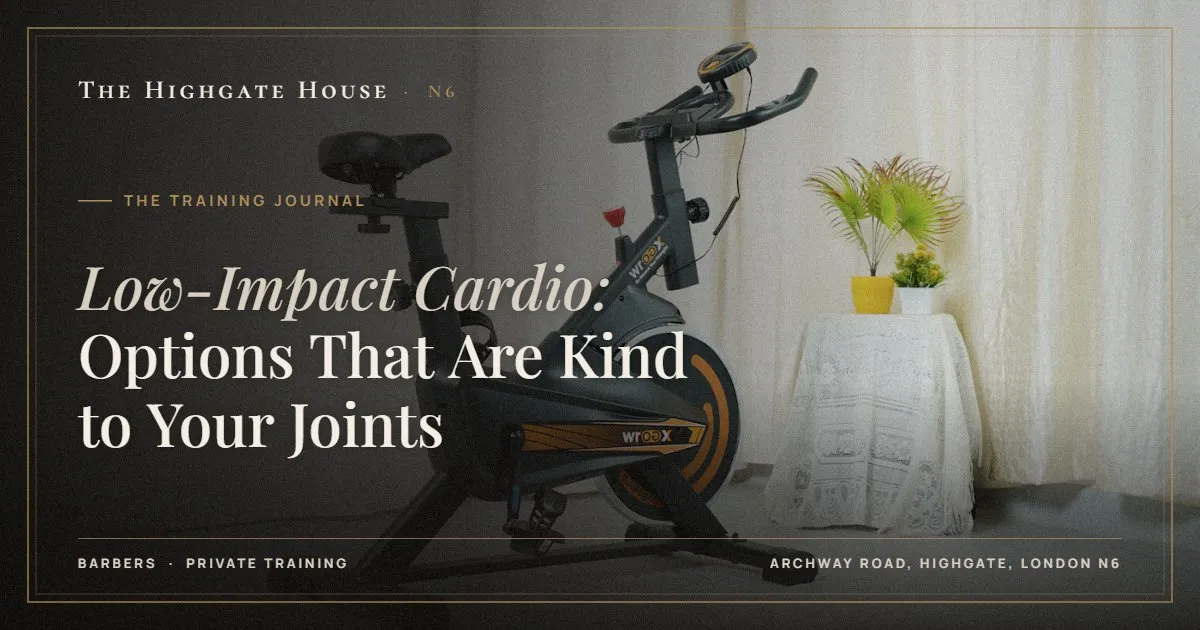
Low-Impact Cardio: Options That Are Kind to Your Joints
Low-impact cardio is any exercise that raises your heart rate without both feet leaving the ground at once, so your joints are not absorbing landing forces. The best options are cycling (outdoors, static or air bike), swimming, rowing, brisk or incline walking, the cross-trainer and the ski erg. Which suits you depends on which joint is complaining: cycling and swimming are usually kindest to knees, walking and the cross-trainer are often fine for backs, and swimming is the most forgiving overall. Low impact does not mean low effort. Done properly, all of these can be as demanding as running.
What “low impact” actually means
When you run, each stride is a small landing. Your ankles, knees and hips absorb a force several times your body weight, thousands of times per session. For many people that is perfectly fine, and bones and tendons adapt to it. But if you are carrying a knee niggle, have arthritic changes, are heavier than you would like, or simply hate running, you can get the same heart and lung benefits without the landings.
It is worth separating two ideas people often mix up. Low impact describes the forces on your joints. Low intensity describes how hard your heart is working. A hard interval on a bike is low impact and high intensity. A gentle walk is both low impact and low intensity. You need to choose the first and then set the second deliberately.
The main options, compared
| Option | Usually kind to | Watch out for | Easy to make hard? |
|---|---|---|---|
| Static or road cycling | Knees, ankles, feet | Poor saddle height can irritate knees; long sitting for stiff hips | Yes |
| Air bike | Knees, ankles | Very easy to overdo; shoulders work too | Very |
| Swimming | Almost everything | Technique limits effort; some strokes bother necks or shoulders | Only with good technique |
| Rowing machine | Knees, ankles | Lower back if you pull with your arms first and round over | Yes |
| Incline or brisk walking | Backs, hips, most knees | Steep downhills load knees more than uphills | Moderately, with hills or pace |
| Cross-trainer | Knees, hips, backs | Easy to coast on low resistance | Yes, with resistance |
Cycling
The default recommendation for sore knees, provided the bike is set up properly. Saddle height matters most: at the bottom of the pedal stroke your knee should be slightly bent, not locked straight and not deeply bent. Too low a saddle is a common cause of pain at the front of the knee. North London hills make road cycling a strong workout, though the descents on Highgate Hill and Muswell Hill deserve respect in the wet.
The air bike
The fan-resisted bike with moving arms. The harder you push, the harder it pushes back, which makes it superb for short intervals and brutally honest about effort. It is the conditioning tool in our studio. Its weakness is that it is so easy to go too hard too early. I wrote a separate guide on using the air bike for intervals without burning out.
Swimming
Water supports your body weight, which makes swimming the most forgiving option for painful joints. The catch is that the training effect is limited by technique. A weak swimmer gets breathless from inefficiency long before the heart and lungs are the limit. If you are not confident in the water, a few lessons will do more for your fitness than an extra length.
Rowing
Uses legs, back and arms together, so it gets your heart rate up quickly. The sequence is legs, then body swing, then arms, and the reverse on the way back. Most back complaints from rowing come from pulling with the arms first and slumping forwards at the catch.
Walking, especially uphill
Underrated. Brisk walking counts as moderate-intensity activity under UK guidance, and walking uphill raises the demand considerably without adding impact. Highgate is built for this: the climb from Archway up to the village, or a loop of Hampstead Heath with Parliament Hill in it, is real cardiovascular work. Walking down steep slopes, though, puts more load through the front of the knee than walking up.
How much do you need?
The UK Chief Medical Officers’ guidelines recommend at least 150 minutes of moderate-intensity activity a week, or 75 minutes of vigorous activity, or a mix, plus muscle-strengthening activity on at least two days. Every option in this post can count towards that. Moderate means you can talk but not sing. Vigorous means you can say only a few words before needing a breath.
Making low-impact cardio hard enough to count
The most common mistake I see is treating low impact as an excuse to coast. Twenty minutes on a cross-trainer at a level where you can read the news is pleasant, but not much of a training stimulus. Some ways to fix that:
- Use the talk test. For steady sessions, you should be able to speak in sentences but would rather not. That is roughly the “zone 2” territory covered in zone 2 cardio.
- Add resistance before speed. On a bike or cross-trainer, a higher setting at a steady cadence is usually kinder to joints than spinning faster.
- Use simple intervals once a week. For example, 30 seconds hard, 90 seconds easy, repeated six to eight times after a proper warm-up.
- Use hills. Walking uphill turns a stroll into vigorous work without a single jump.
- Track something. Distance in 20 minutes, average watts, or heart rate at a given pace. If it improves over weeks, you are getting fitter.
A sample low-impact week
- Two strength sessions, ideally covering legs, a push, a pull and some trunk work.
- Two steady sessions of 30 to 45 minutes: one bike or swim, one brisk hilly walk.
- One short interval session of 15 to 20 minutes on the bike, rower or air bike.
- Daily walking wherever you can fit it, including the commute.
That covers the national guidance with room to spare, and none of it involves running.
Why strength training belongs alongside it
If you have chosen low-impact cardio because a joint hurts, cardio alone rarely solves the underlying problem. Stronger thighs, hips and calves share the load around a knee. Stronger trunk and hip muscles help a back tolerate more. This is where a structured plan earns its keep. In private training sessions at our Highgate studio, the conditioning work on the air bike sits next to strength work chosen around whichever joint needs looking after. For the strength side specifically, see joint-friendly strength training.
When to check with your GP first
If you have a heart condition, chest pain or dizziness on exertion, uncontrolled blood pressure, are pregnant, or have a joint that is swollen, hot or getting worse, speak to your GP or a physiotherapist before increasing your training. The same applies if you are returning after a long break or an operation. Low impact reduces joint load. It does not remove the need for sensible medical advice.
Questions we get asked
What is the best low-impact cardio for bad knees?
Swimming and cycling are usually the most comfortable, with the bike set up so your knee is slightly bent at the bottom of the stroke. If both hurt, get the knee assessed before pushing on.
Is walking enough cardio?
Brisk walking counts as moderate activity, and hills make it harder. For many people it covers most of the weekly guidance. Add one harder session if you want fitness to keep improving.
Can low-impact cardio help with fat loss?
Yes, as part of overall energy balance across the week. It burns calories like any other activity, and being easier on joints often means you can do more of it consistently.
Is the air bike low impact?
Yes, there is no landing. It is not low effort, though, and is best kept to short intervals. Ask about it when you book 1-1 personal training at The Highgate House.
Book with The Highgate House
Ready to start training properly? Email us at [email protected] with the service and the day that suits you, and we will come back to you with times.
Visit The Highgate House · Private personal training
The Highgate House, Archway Road, Highgate, London N6.
