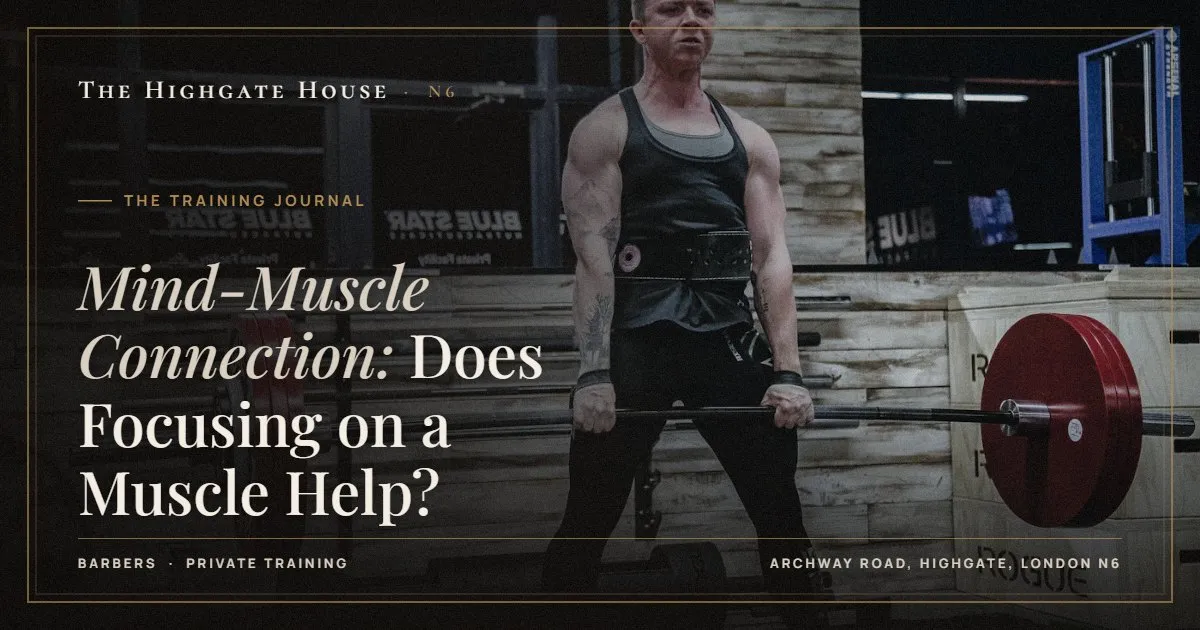
Mind-Muscle Connection: Does Focusing on a Muscle Help?
Sometimes, and it depends on what you are trying to do. Focusing on the muscle you are working, an “internal focus”, increases how much that muscle is activated and, in at least one well-designed study, led to more growth in the arms over eight weeks. But for heavy, technical lifts where the goal is moving the most weight well, focusing on the outcome, an “external focus” such as pushing the floor away, tends to produce better performance. So the practical rule is simple: think about the muscle on lighter isolation and accessory work, and think about the movement on your big lifts.
What “mind-muscle connection” actually means
The phrase comes from bodybuilding, but the idea has a proper name in sports science: attentional focus. When you lift, your attention has to go somewhere. It can be directed inward, to a body part (“squeeze your shoulder blade back”), or outward, to the effect of the movement (“pull the handle to your hip”, “drive the bar to the ceiling”).
Neither is right or wrong. They do different jobs. Internal focus tends to increase the electrical activity measured in the target muscle, which is why people report that they “feel it more”. External focus tends to make movement more efficient and automatic, which usually means more force, better coordination and less wasted effort. Most of what you hear about the mind-muscle connection is about the first, without mentioning the trade-off with the second.
What the research says
The best known study on this was run by Brad Schoenfeld and colleagues and published in the European Journal of Sport Science in 2018. Thirty untrained young men trained three times a week for eight weeks. One group was told to focus on squeezing the muscle; the other was told to focus on getting the weight up. Both did the same sets and reps. The internal focus group gained noticeably more muscle thickness in the elbow flexors (the biceps area). In the quadriceps, there was no meaningful difference between the groups.
That second finding is easy to skip, and it is the interesting one. On a simple single-joint movement like a curl, it is easy to feel and direct effort into one muscle. On a leg exercise involving several joints and large muscle groups working together, it is much harder, and focusing inward seems to add little. Separate research on attentional focus, much of it by Gabriele Wulf, has repeatedly found that an external focus improves performance in tasks requiring force and coordination, including jumping and lifting. A 2021 meta-analysis on attentional focus and muscular strength pulled this research together: an external focus came out ahead for strength within a single session, while the difference over weeks of training was much less clear.
The evidence base is still modest. Most studies are short, involve beginners and measure activation rather than growth. It is reasonable to draw a working rule from them, not a law.
When to focus on the muscle, and when not to
| Situation | Better focus | Example cue |
|---|---|---|
| Isolation work for size (curls, lateral raises, cable pushdowns) | Internal | “Feel the side of the shoulder lift the weight” |
| Learning to use a muscle you cannot feel (often lats or glutes) | Internal, at light loads | “Pull your elbow down into your back pocket” |
| Heavy squats, deadlifts, presses | External | “Push the floor away”, “bar to the ceiling” |
| Fast or explosive work, intervals | External | “Drive the pedals”, “throw the bar up” |
| Rehabilitation or regaining control after injury | Internal, under guidance | “Keep the knee over the middle toe” |
One reason internal focus can hurt heavy lifts is that it pulls attention away from the whole movement. If you are thinking hard about your glutes at the bottom of a heavy squat, you are not thinking about bracing, bar path or balance. For a beginner learning the lift, that can lead to sloppy technique. For heavy compound lifts, our guide to compound and isolation exercises explains where each type fits in a session.
How to build the connection: a practical method
Many people say they “cannot feel” their lats on a pulldown or their glutes on a hip thrust. That is common, it is not a sign of weakness, and it usually improves within a few sessions with a structured approach.
- Drop the load by 30 to 50 per cent. Heavy weights force your body to recruit everything it can. You cannot learn to bias one muscle when you are fighting the weight.
- Touch the muscle. Place a hand on the target muscle, or have a coach do it, before the set. Tactile cues are surprisingly effective at directing attention.
- Do a hard squeeze without weight. Contract the muscle as hard as you can for five seconds, three times. You are rehearsing the signal you want during the set.
- Slow the lowering phase. Take two to three seconds to lower. Slower reps give you time to notice what is working. Our post on tempo training covers how to use this deliberately.
- Pause at the hardest point. A one second hold at the top of a cable row or the bottom of a lateral raise makes the target muscle hard to ignore.
- Use one cue, not five. Pick a single instruction and stick with it for the set. A list of cues overloads attention and nothing improves.
- Bring the load back up gradually. Once you can feel the muscle working at a light weight, add load over the next few weeks while keeping the same sensation.
Cues that tend to work
- Lats (pulldown, row): “Elbows down to your hips”, not “pull with your hands”. Imagine your hands are hooks.
- Glutes (hip thrust, bridge): “Tuck your ribs down and push through your heels.” Many people arch their lower back and feel it there instead.
- Chest (press, fly): “Bring your upper arms together across your body”, rather than just pushing the handles away.
- Rear shoulders (face pull): “Pull the rope apart as you bring it to your face.”
Common mistakes
- Chasing a burn on every set. Feeling a muscle is not the same as training it well. A muscle can grow without a burn, and a burn does not guarantee growth. Progressive overload still matters.
- Using internal focus on maximal lifts. Thinking about your quads during a heavy squat is more likely to cost you reps than add growth.
- Going too light for too long. Light, slow, focused reps are a teaching tool. If the load never goes back up, you stop making progress.
- Confusing “feeling it” with “working it” in the wrong place. If you feel a row in your lower back or a lunge in your knee, that is information, not a connection to cherish. Fix the setup.
If you have an injury, ongoing joint pain, or are returning to training after a long break, check with your GP or a physiotherapist before working on single muscles under load.
Why coaching makes this faster
This is one of the areas where a coach in the room earns their place. A well-placed hand on the upper back, a single word at the right moment, or noticing that your elbow drifts forward on rep six does more than any number of videos. In a private studio it is also easier to concentrate: no music to compete with and nobody waiting for the cable station. If you want to know what a 1-1 personal training session at our Highgate studio looks like, it is set out on the service page, and you can find everything else about The Highgate House on the homepage.
Questions we get asked
Does the mind-muscle connection build more muscle?
For smaller muscles on isolation exercises, the evidence suggests it can help. For large compound lifts, there is little evidence that it adds much, and it may cost you performance.
Why can I not feel my back when I do pulldowns?
Usually the weight is too heavy and the arms are doing the work. Lighten it, think about driving your elbows down, and pause briefly at the bottom.
Should beginners worry about it?
Not much at first. Learn the movements and get consistent. Use internal focus as a teaching tool where a particular muscle is not switching on.
Is it just bro-science?
No. The term is gym slang, but attentional focus is a well-studied area. The evidence is mixed, which is why the answer depends on the exercise.
If you would like help learning to feel and train the right muscles, take a look at our private personal training in Highgate.
Book with The Highgate House
Ready to start training properly? Email us at [email protected] with the service and the day that suits you, and we will come back to you with times.
Visit The Highgate House · Private personal training
The Highgate House, Archway Road, Highgate, London N6.
