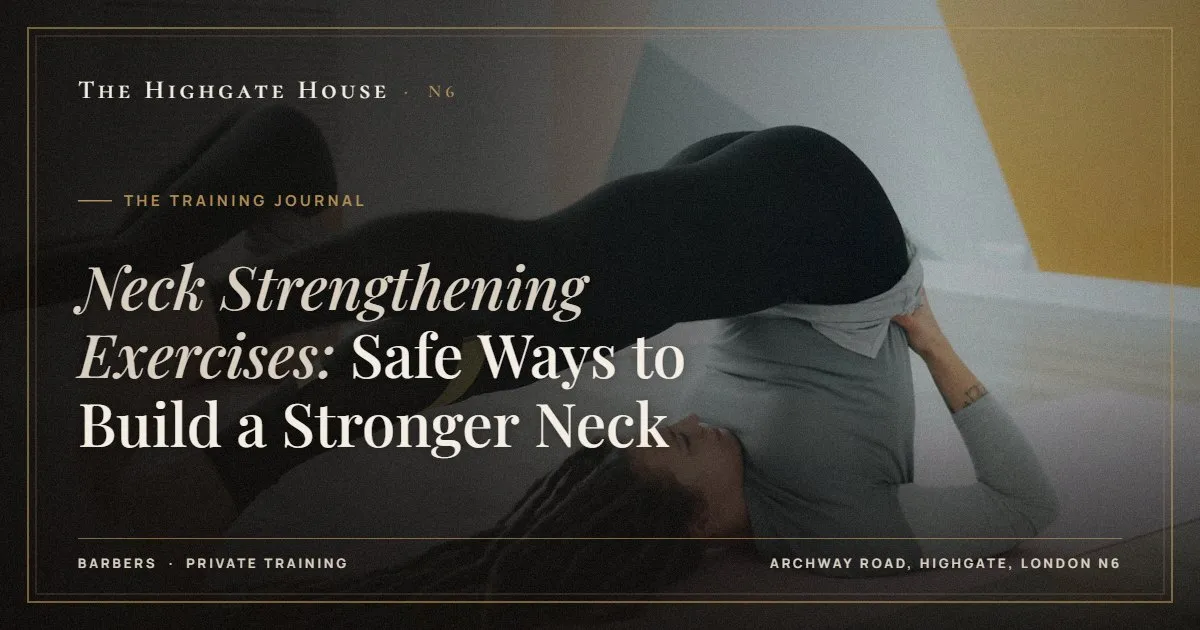
Neck Strengthening Exercises: Safe Ways to Build a Stronger Neck
The safest way to strengthen your neck is to start with isometric holds, where you press your head gently against your own hand without moving, in four directions: forwards, backwards and to each side. Hold each for 10 to 20 seconds at moderate effort, two or three times, two or three days a week. After a few weeks, add slow bodyweight movements lying on a bench, then shrugs and face pulls for the muscles around the neck. Progress gradually, never jerk the head, and stop if you feel sharp pain, tingling or dizziness. Start light: the neck adapts well, but it does not appreciate surprises.
Why train the neck at all?
Most people never train their neck directly, and most get by fine. There are still good reasons to add a little work:
- Desk posture. Hours with the head drifting forward over a screen leave many people with a neck that feels tired and stiff. Stronger muscles at the front and back of the neck can make holding a comfortable position easier, although training alone will not offset ten hours a day at a laptop.
- Contact sport and cycling. Neck training is a routine part of preparation in rugby, combat sports and motorsport. How much it reduces injury risk is still being studied, but it is widely used.
- Appearance. A neck that matches a trained upper body simply looks more in proportion. Collar sizes do change.
- Balance in your programme. If you already train the shoulders and upper back, a few minutes for the neck rounds things out.
Before you start
If you have current neck pain, a previous neck injury, arthritis in the neck, or pain, numbness or pins and needles that travels into the arm, check with your GP or a physiotherapist first. The NHS page on neck pain explains when you should get symptoms looked at. Stop any exercise that makes you dizzy, gives you a headache or causes symptoms in the arms.
Stage 1: isometric holds (weeks 1 to 4)
Isometrics are the safest place to begin because the head does not move, so you control the load completely with your own hand.
- Flexion. Sit tall. Place your palm on your forehead. Press your head gently forward into your hand while your hand resists, so nothing moves.
- Extension. Clasp your hands behind your head. Press back into them.
- Side bend, both sides. Place your palm above your ear. Press sideways into it.
Start at around 30 to 50 percent of your maximum effort. Hold 10 to 20 seconds, breathe normally, and do two or three rounds in each direction. After two weeks, increase the effort a little or the hold time to 30 seconds.
Add chin tucks alongside: sit or lie with your head supported, draw your chin straight back to make a double chin, hold for five seconds, release. Ten repetitions. This targets the deep muscles at the front of the neck that help you hold your head over your shoulders rather than in front of them. For more on that posture, see forward head posture and tech neck.
Stage 2: bodyweight movement on a bench (weeks 4 to 8)
Once isometrics feel easy, move through a range using the weight of your head alone.
- Lying neck flexion. Lie on your back on a bench with your head just off the end. Slowly lift your chin towards your chest, then lower under control to neutral. Do not let the head drop back past level.
- Lying neck extension. Lie face down with your head off the end. Lower your chin slowly, then raise your head until it is level with your body. Avoid cranking it upwards.
- Side-lying lateral raise. Lie on your side with your head off the end. Raise your ear towards your shoulder and lower slowly.
Two sets of 10 to 15 slow repetitions each, taking two to three seconds up and three seconds down. Smooth control is the whole point.
Stage 3: adding load carefully (after 8 weeks)
From here, small loads can be added: a folded towel with a light weight plate resting on the forehead for lying flexion, held with both hands, for example. Go up in tiny increments. The neck responds well to higher repetitions, so there is no reason to go heavy. Neck harnesses exist, but they are best introduced by a coach who can watch your form.
Train the muscles around the neck too
The upper trapezius, rear shoulders and upper back all support the neck and shoulders. In the studio these are usually the first exercises I add, because they are easy to load safely:
| Exercise | Kit | Sets x reps |
|---|---|---|
| Dumbbell shrug | Dumbbells | 3 x 10 to 15 |
| Face pull | Cable station with rope | 3 x 12 to 15 |
| Seated cable row | Seated row | 3 x 8 to 12 |
| Farmer’s carry | Heavy dumbbells | 3 x 30 to 40 metres |
Face pulls in particular are worth learning well. See face pulls for desk workers.
How often, and where it fits
Two or three short sessions a week is plenty. Put neck work at the end of a session so the muscles are not fatigued before heavy lifts that need a stable head position, such as squats and deadlifts. Five to eight minutes is enough. Muscles of the neck can feel sore for a day or two after the first sessions, which is normal; sharp or lingering pain is not.
Mistakes to avoid
- Neck circles with a heavy weight or fast, swinging repetitions.
- Head-supported bridges (“wrestler’s bridges”) without coaching. They place large loads on the neck and are not a beginner exercise.
- Pushing to maximum effort in the first weeks.
- Training the neck the day before a heavy squat session.
- Holding your breath through isometrics.
Getting it right with a coach
Neck work is simple on paper and easy to rush in practice. In a private session I check how your head and shoulders sit, pick a starting level and progress it with the rest of your programme. See how it works on the Highgate personal training page.
Questions we get asked
How long does it take to see a thicker neck?
Strength improves within weeks. Visible size takes months of consistent training, as with any muscle.
Can I train my neck every day?
Gentle chin tucks, yes. Loaded work is better two or three times a week with rest between.
Will neck training fix my neck pain?
It may help some people, but pain needs assessing first. Speak to your GP or a physiotherapist before training through it.
How much is personal training?
Prices are listed on our personal training page.
Book with The Highgate House
Ready to start training properly? Email us at [email protected] with the service and the day that suits you, and we will come back to you with times.
Visit The Highgate House · Private personal training
The Highgate House, Archway Road, Highgate, London N6.
