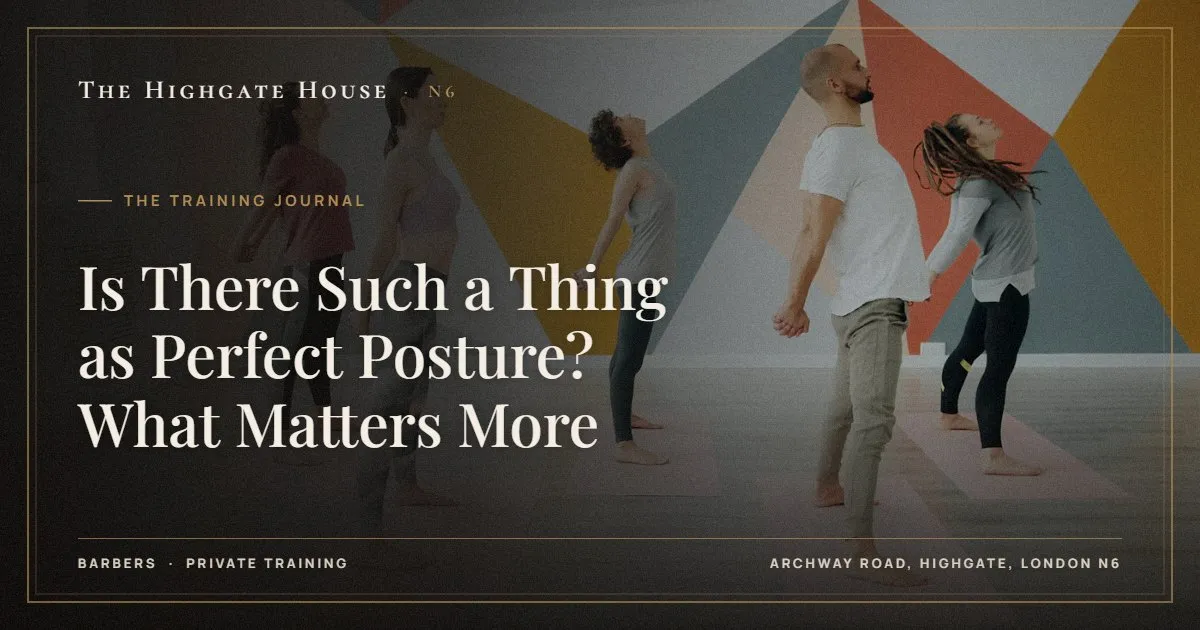
Is There Such a Thing as Perfect Posture? What Matters More
No, there is no single perfect posture. Healthy, pain-free people sit and stand in a wide variety of ways, and the link between any one posture and pain is much weaker than most of us were taught. What matters more is how long you stay in any position, how often you move, and how strong and fit your body is overall. A good posture is mostly one you are about to change. If your back or neck aches at your desk, moving more often and getting stronger will usually do more than forcing yourself to sit bolt upright.
Where the idea of perfect posture came from
Most of us grew up being told to sit up straight. The ideal was a stacked line from ear to shoulder to hip, chin tucked, shoulders back. It looks tidy and it photographs well, and for a long time it was assumed that drifting away from it caused damage and pain.
The trouble is that the evidence never lined up neatly behind it. When researchers compare people with and without back or neck pain, they do not find one posture that reliably separates them. People with “textbook” alignment get sore backs; people who slouch happily for decades do not. Your spine is not a stack of blocks that topples if it is not perfectly aligned. It is strong, adaptable and built to bend.
What actually seems to matter
Time in one position
Almost any position becomes uncomfortable if you hold it long enough. Sitting perfectly upright for two hours without moving can be as uncomfortable as slumping for two hours. The discomfort is often a signal to move, not a sign of damage.
Variety
Changing position regularly spreads the load across different tissues. Lean back, sit forward, stand for a call, walk to the kitchen. A body that moves through many positions in a day tends to feel better than one locked in any single “correct” one.
Overall fitness and strength
A stronger, fitter body tolerates long days better. The UK Chief Medical Officers’ guidelines recommend muscle-strengthening activity on at least two days a week and minimising long periods of sitting, breaking them up with activity where possible. That second point is about movement, not alignment.
Sleep, stress and general health
Pain is influenced by much more than position. Poor sleep, high stress and low activity all make aches more likely and more noticeable. A stressful week at work often shows up in the neck before it shows up anywhere else.
So does posture matter at all?
It does, in two ways. First, if a particular position hurts, changing it is a sensible, immediate response. That is comfort, not correction. Second, under heavy load, position matters a great deal. Lifting a heavy barbell with a rounded, uncontrolled back is a different matter from sitting at a laptop with one. In the gym we coach position carefully because the loads are high. At a desk the loads are tiny and the time is long, so movement matters more than precision.
A practical approach at your desk
Rather than chasing one perfect position, set up a workstation that is comfortable and makes moving easy.
- Screen at roughly eye level, so you are not craning down for hours. A laptop stand and separate keyboard make a large difference.
- Feet supported on the floor or a footrest.
- Chair adjusted so you can sit back and be supported, not perched on the edge.
- Things you use often within reach, so you are not twisting all day.
Then build movement in:
- Change position at least every 30 to 45 minutes, even briefly.
- Stand or walk for phone calls.
- Take the stairs and the longer route to the kitchen.
- Do two minutes of movement mid-morning and mid-afternoon: shoulder rolls, a few squats, reaching overhead, gentle back bends.
- Get outside at lunchtime, even for ten minutes.
If you are weighing up a standing desk, our piece on standing versus sitting desks covers what it can and cannot do. The short version: a standing desk helps mainly because it makes changing position easier, not because standing is inherently better.
What training adds
Strength training will not give you perfect posture. It gives you something more useful: a body with more capacity, so long days, heavy bags and awkward positions take less out of you.
| Area | Why it helps desk workers | Examples |
|---|---|---|
| Upper back | Better tolerance of long periods with the arms in front | Rows, face pulls, lat pulldown |
| Trunk | More control and endurance through the middle | Dead bugs, side planks, carries |
| Hips and legs | Counterbalances hours of sitting | Squats, hinges, split squats |
| General fitness | Lower overall fatigue and better recovery | Air bike intervals, brisk walking |
Our guide to exercises for desk workers sets out a simple routine, and if a specific area concerns you, anterior pelvic tilt looks at one of the most common posture worries in more depth.
Mistakes worth avoiding
- Forcing your shoulders back and holding them there all day. It is tiring and usually creates more tension in the neck.
- Buying posture correctors and braces as a fix. They may feel supportive briefly but they do not build strength.
- Believing that slouching is causing damage. That belief alone can make people more anxious about normal aches.
- Waiting for perfect posture before starting to train. Start now; strength helps.
When to get it checked
Check with your GP first if you have pain that is getting worse, does not improve after a few weeks, wakes you at night, or comes with numbness, tingling, weakness, or symptoms elsewhere in your body. The same applies if you have a history of significant back or neck injury and are starting a new training programme.
How this shapes our sessions
Most of my clients are busy professionals who spend long days at a desk. I rarely spend time trying to fix how they sit. Instead we build strength across the whole body, coach good positions under load in the studio, and set up simple habits to keep them moving between meetings. If you want that kind of plan, private personal training in Highgate is built around it, with the studio booked to you alone during your session.
Questions we get asked
What is the best sitting posture?
The one you change regularly. A supported, comfortable position is a good default, but movement matters more than the exact angle.
Can bad posture cause back pain?
It can contribute to discomfort when held for a long time, but the link is weaker than commonly believed. Activity, strength, sleep and stress all play a part.
Do posture correctors work?
They may remind you to move, but they do not build strength. Exercise and regular movement are more useful.
Can personal training improve my posture?
It can make you stronger and more comfortable in more positions, which is what most people actually want. See how 1-1 sessions work, or start at the homepage.
Book with The Highgate House
Ready to start training properly? Email us at [email protected] with the service and the day that suits you, and we will come back to you with times.
Visit The Highgate House · Private personal training
The Highgate House, Archway Road, Highgate, London N6.
