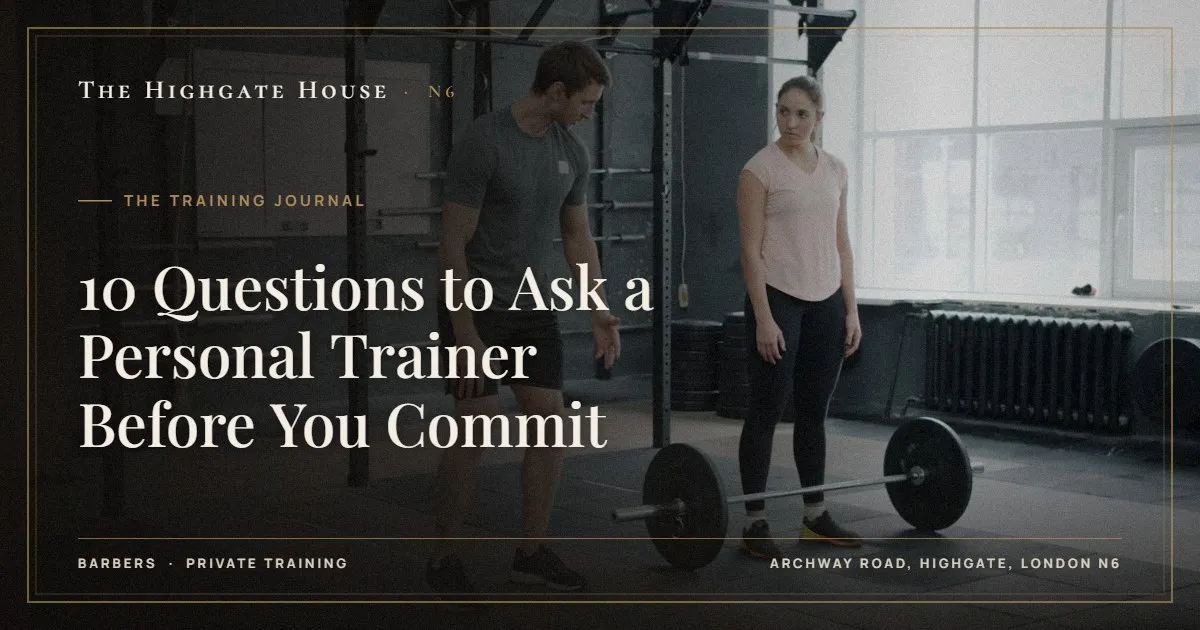
10 Questions to Ask a Personal Trainer Before You Commit
The most useful questions to ask a personal trainer are about how they will make decisions for you: how they assess you, how they plan and adjust the programme, how they measure progress, what happens between sessions and how they handle pain or injury. Qualifications and insurance matter, but they are the floor, not the decider. Below are ten questions I would ask if I were hiring a trainer myself, with what a good answer tends to sound like and the replies that should make you pause. Take them to a consultation and listen as much to how the trainer answers as to what they say.
Before you ask anything: what you are listening for
You are not trying to catch anyone out. You are trying to find out whether this person thinks clearly, explains plainly and will adapt to you. A good trainer welcomes these questions because they make the first few weeks easier for both of you. Vague, salesy or defensive answers tell you more than any certificate.
Keep the list on your phone, ask in whatever order feels natural, and make a note of the answers straight afterwards. If you are comparing two or three trainers, the notes will matter.
The ten questions
1. “What qualifications and insurance do you hold, and are you registered anywhere?”
In the UK, the usual baseline for a personal trainer is a Level 3 qualification, and many are registered with CIMSPA, the professional body for the sport and physical activity sector. Professional liability insurance should be a given. A good answer is short and specific. If you want to understand what the levels actually mean, see our guide to personal trainer qualifications in the UK.
Pause if: they are evasive, or lead with weekend certificates in place of the core qualification.
2. “Who do you usually work with?”
Trainers tend to be best with the people they see most. Someone who mainly coaches young athletes may not be the right fit for a 45-year-old with a stiff back and a busy diary, and vice versa. A good answer names a type of client and the problems they typically solve.
Pause if: the answer is “everyone”.
3. “What will you do in the first session?”
You want to hear about questions on your history, injuries and week, some form of movement assessment, and a first workout pitched below your limit. Testing how hard you can be pushed on day one is not an assessment.
4. “How will you decide what goes into my programme?”
This is the question that separates planners from session-fillers. A good answer links your goal, your starting point and your available time to a structure: how many days, which main lifts, how load will increase over time. Ask how they decide when to add weight. If the answer includes something like “when you complete all the reps with good form, we increase it”, you are dealing with someone who understands progression.
Pause if: each session seems to be invented on the day.
5. “How will we measure progress, and how often?”
Weight on the scales is one measure, and a noisy one. Better answers include strength on key lifts, a few photos or measurements, how you feel on the stairs, and possibly a body composition scan at sensible intervals. In our studio we have an InBody scanner, but it is a tool, not a verdict. Ask what they would do if the numbers stalled for three weeks.
6. “What happens between sessions?”
Most of your week is spent away from the trainer. Do they set work for the days you train alone? Do they check in? Do they expect a food log? There is no single right answer, but there should be a clear one. Our piece on what a good trainer does between sessions goes into this.
7. “How do you handle injuries or pain?”
The right answer involves modifying or swapping an exercise, asking questions, and referring you to a GP or physiotherapist when something is outside their scope. Trainers do not diagnose. If you have a heart condition, high blood pressure, a recent injury or operation, are pregnant, or have not exercised for a long time, check with your GP first before starting a programme, and tell the trainer what they said.
Pause if: they promise to “fix” a medical problem.
8. “What do you advise on food, and where do you stop?”
A good trainer can help with sensible, mainstream nutrition: enough protein, regular meals, a modest calorie deficit if fat loss is the goal. They should not prescribe medical diets or supplements for conditions. Clear boundaries here are a good sign.
9. “How often should I see you, and for how long?”
Listen for a plan that gets you more independent over time, not one that keeps you dependent. Two sessions a week is common at the start; some people move to one plus independent work once technique is solid. Ask what a realistic first commitment looks like and why.
10. “What are your terms: cancellations, packages and pauses?”
Ask about notice periods for cancelling a session, what happens if you are away for work, and whether packages expire. Get it in writing. Good trainers have clear, fair terms and do not mind explaining them.
A quick checklist for after the consultation
- Did they ask more questions than they answered? (Good sign.)
- Did they explain things without jargon?
- Was the plan specific to your week, not a generic template?
- Did they talk about safety and when they would refer you on?
- Were the terms clear and written down?
- Did you feel comfortable saying “I do not understand”?
If you tick most of those, you have probably found someone worth trying for a block of sessions. Choosing between two decent options is a different question, covered in how to choose a personal trainer.
Questions trainers should be asking you
A consultation is two-way. Expect a decent trainer to ask about your goal and why it matters now, past training, injuries and medication, sleep, stress, work hours, and what has made you stop before. If they do not ask much, they cannot plan much.
Be honest about the week you actually have, not the one you would like. A plan built for four sessions you will not make is worse than one built for two that you will.
How I answer these myself
I have coached for more than ten years and have trained since I was 15. Most of the people I work with are busy professionals over 30. Sessions run in a private basement studio in Highgate, booked to you alone, with a squat rack, barbell, dumbbells, a cable station and an InBody scanner. You are welcome to ask me every question above before you book anything. The details of 1-1 personal training in Highgate are on the service page.
Questions we get asked
Is it rude to interview a personal trainer?
Not at all. You are about to hand over time, money and trust. Good trainers expect it.
Should I ask for references or results?
You can ask how they track progress and what typical clients work on. Be wary of before-and-after photos as the main selling point; they say little about how the trainer will work with you.
How long should a consultation take?
Around 30 to 60 minutes is common. Shorter than that, and there is rarely time to ask about your history properly.
What if I do not know what my goal is?
That is fine. A good trainer will help you shape one, usually starting with how you want to feel and what you want to be able to do.
If you would like to put these questions to me directly, have a look at private sessions at the studio and get in touch.
Book with The Highgate House
Ready to start training properly? Email us at [email protected] with the service and the day that suits you, and we will come back to you with times.
Visit The Highgate House · Private personal training
The Highgate House, Archway Road, Highgate, London N6.
