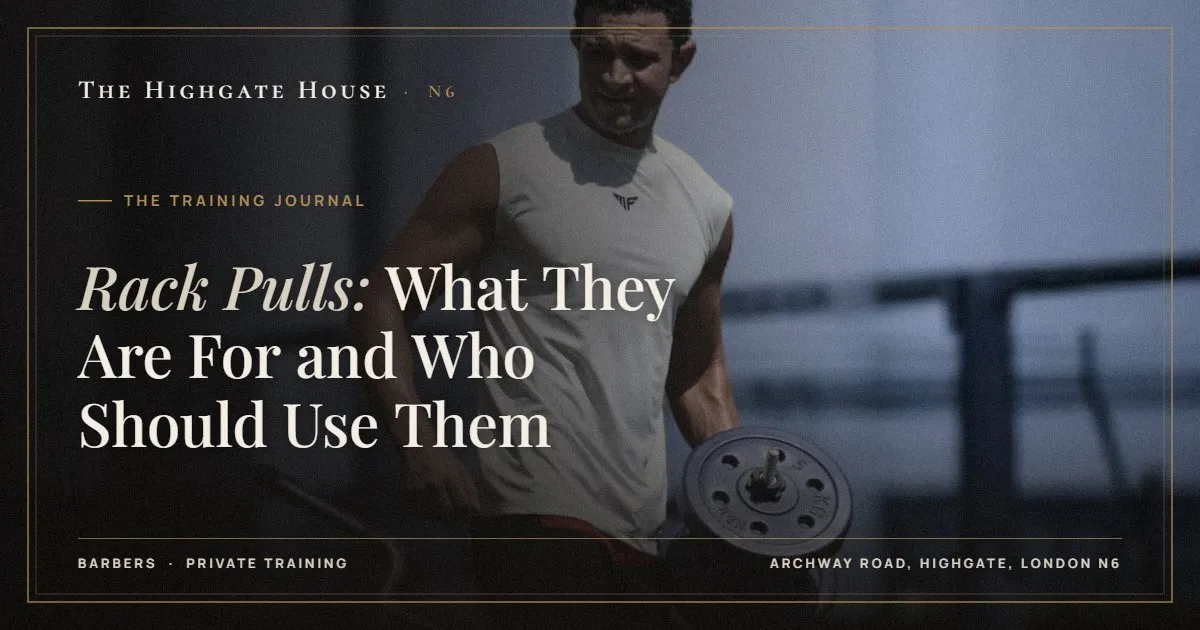
Rack Pulls: What They Are For and Who Should Use Them
A rack pull is a partial deadlift: the bar starts on the safety arms or pins of a squat rack, usually around or just below knee height, and you lift it to lockout. Because you skip the hardest part of the lift off the floor, you can handle more weight through the top range. That makes rack pulls useful for strengthening a weak deadlift lockout, building the upper back and grip, and training the hinge for people who cannot yet pull safely from the floor. They are not a replacement for the full deadlift, and they are not a beginner’s tool for chasing big numbers. Used occasionally and for a clear reason, they earn their place.
What rack pulls train
From knee height to lockout, the main work is done by the hips and the back. The glutes and hamstrings extend the hips; the muscles along the spine hold the trunk rigid; the upper back and lats keep the shoulders and bar in place; and the grip has to hold more weight than it is used to.
What they train less is the start of the deadlift. The quads do much less work than in a full pull, and the hardest leverage of the lift, with the bar at mid-shin, is removed.
Who they suit, and who should skip them
| Suits | Probably skip for now |
|---|---|
| Lifters whose deadlift fails at the top | Complete beginners still learning to hinge |
| People who want heavy upper-back and grip work | Anyone whose deadlift fails off the floor |
| Those who cannot reach the floor with good position yet, as a temporary step | Anyone with an irritated lower back |
| Taller lifters who want hinge work with less range | People using them only to lift a bigger number |
If your deadlift stalls off the floor, rack pulls train the wrong part of the lift. Our guide on how to increase your deadlift matches exercises to each sticking point.
How to set up a rack pull
- Set the height. Put the safeties or pins so the bar sits where you want to start. Just below the knee is the most common choice. Above the knee shortens the lift further and allows even heavier loads, which is rarely necessary.
- Load the bar and centre it. Check the bar is level and the collars are on. If you are unsure about rack setup, our post on using a squat rack safely covers it.
- Stand close. Feet hip width, bar touching or nearly touching the legs. Grip just outside the thighs.
- Set your back. Hinge at the hips, chest up, lats tight. Your back should be in the same flat position you would hold in a deadlift at that height.
- Brace and pull the slack out. Big breath, tight trunk, take the bar’s weight off the pins without letting it jerk.
- Drive the hips forward. Stand up by bringing the hips through, keeping the bar against the legs. Finish tall, without leaning back.
- Lower under control. Hinge back down and set the bar on the pins quietly. Do not drop it from lockout.
Common mistakes
- Too much weight. The partial range tempts people to load far beyond their deadlift. Heavy partials can be useful, but huge jumps with sloppy form just load the lower back.
- Squatting the bar up. Bending the knees a lot at the start turns it into a different lift. The knees should be soft, not deeply bent.
- Hyperextending at the top. Leaning back and pushing the hips forward excessively compresses the lower back. Stand straight.
- Bouncing off the pins. Each rep should start from a dead stop, with the bar settled.
- Shrugging the bar. If you want shrugs, do shrugs. In a rack pull, the shoulders stay set.
- Bar drifting forward. The bar should stay close all the way. Drift means the lats are not engaged.
How to programme them
Rack pulls are a supplement, not a main lift. Use them in blocks of a few weeks, then put them away.
- For lockout strength: three to five sets of three to five reps, once a week, on a different day from your heavy deadlift or as a second exercise after lighter deadlifts.
- For back and grip: three sets of six to eight with moderate weight, a full pause on the pins between reps.
- As a stepping stone: if you cannot yet reach the floor with a flat back, start from a higher pin and lower it a notch every week or two as your mobility and control improve.
Load sensibly. A useful starting point is a weight you could deadlift from the floor for the same reps, then add small amounts over the weeks. It is a good idea to keep straps for the heaviest sets so your grip does not decide the session, while still doing some unstrapped work.
If you have a history of lower back problems, a hernia, high blood pressure, or are returning after a long break from heavy lifting, check with your GP first.
Rack pulls vs block pulls
A block pull sets the plates on raised blocks rather than the bar on rack pins. The range is similar, but the bar bends and behaves more like a real deadlift, and there is less risk of the bar scraping the pins. If you have access to sturdy blocks, they are a good alternative. In a studio with a squat rack, rack pulls are the practical option, and with sensible loads they work well.
Where coaching fits
Deciding whether rack pulls are the right tool depends on watching your full deadlift. In private 1-1 training in our Highgate studio, I assess your pull from the floor first, then choose the pin height, load and duration of the block if a partial is needed at all. Often the answer is a technique change rather than a new exercise.
Questions we get asked
Do rack pulls build a bigger back?
They load the upper back and traps heavily and can contribute to back size, alongside rows and pulldowns. They are not essential for it.
Are rack pulls safer than deadlifts?
Not automatically. The shorter range removes the hardest position, but the heavier loads people use bring their own risk. Good form and sensible loading matter more than the exercise.
Will rack pulls increase my deadlift?
If your deadlift fails at or near lockout, they can help. If it fails off the floor, they will help little.
How much is personal training?
Current prices are on our personal training page.
Book with The Highgate House
Ready to start training properly? Email us at [email protected] with the service and the day that suits you, and we will come back to you with times.
Visit The Highgate House · Private personal training
The Highgate House, Archway Road, Highgate, London N6.
