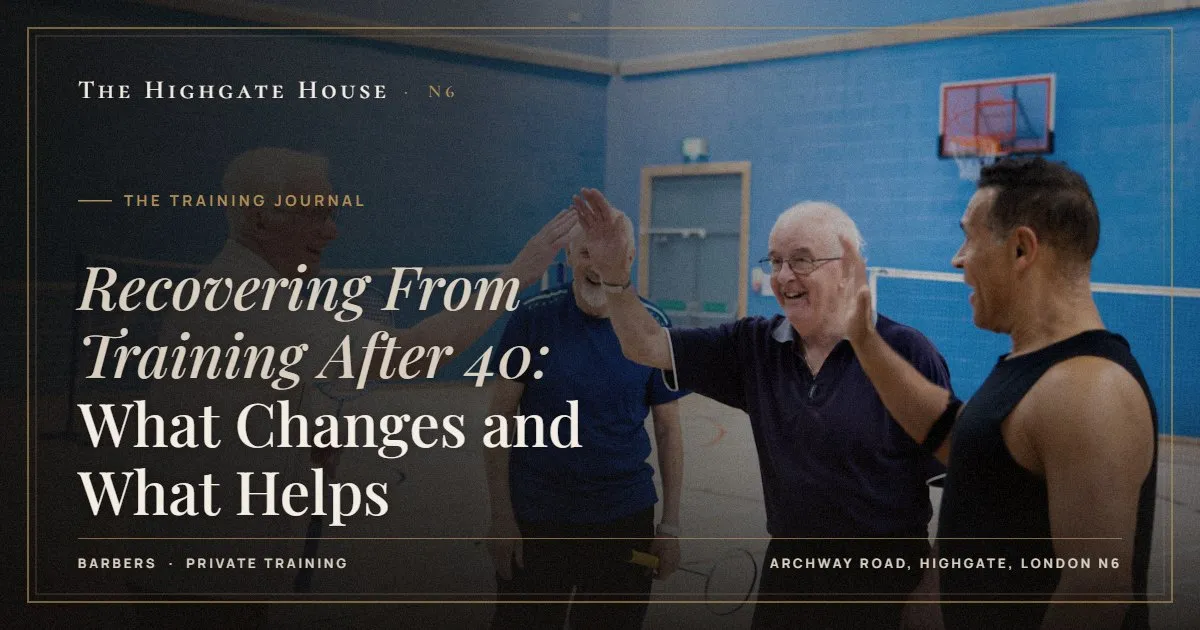
Recovering From Training After 40: What Changes and What Helps
Recovery after 40 often does feel slower, but the reasons are usually more practical than biological. Age plays a part: muscle mass tends to decline gradually if it is not trained, sleep often becomes lighter, and old injuries add up. Yet most people over 40 also carry heavier workloads, worse sleep, more stress and less daily movement than they did at 25, and those factors affect recovery at least as much as the birthday. The good news is that nearly all of them can be managed. Spacing hard sessions sensibly, warming up properly, sleeping better, eating enough protein and adjusting volume rather than intensity lets most people keep making progress well into their fifties and beyond.
I work mostly with professionals over 30, and the pattern is consistent: people who adapt their training structure recover fine. People who try to train like their younger selves, on less sleep, get stuck.
What actually changes
Muscle and connective tissue
Without regular strength training, adults gradually lose muscle as they age. Tendons and joints can also feel stiffer and take a little longer to settle after unfamiliar or high-impact work. That is a reason to train, not to stop: strength training is one of the most effective ways to slow the decline. Our post on muscle loss with age covers the bigger picture.
Sleep
Sleep tends to become lighter and more broken through middle age, and it is when most recovery happens. A busy job, children, late screens and evening drinks make it worse. If you change only one thing, improve your sleep.
Life load
Your body does not separate gym stress from work stress. A hard week at work with poor sleep reduces how much training you can recover from. This is the factor people over 40 most often underestimate.
Signs you are not recovering well
- Weights that felt manageable last week feel heavy for several sessions in a row.
- Soreness that lingers for more than three or four days after normal sessions.
- Joints that ache at rest, not only during training.
- Waking unrefreshed, irritability, low motivation to train.
- Getting minor colds or niggles more often than usual.
One bad session is noise. Several of these together for a week or two is a signal to pull back. Persistent pain, chest discomfort, unusual breathlessness or dizziness are reasons to stop and see your GP, not to push through.
How to structure your training week
For most people over 40, two or three strength sessions a week, with at least a day between hard sessions for the same muscles, works well. A simple pattern:
| Day | Session |
|---|---|
| Monday | Full-body strength (squat or leg press pattern, push, pull) |
| Tuesday | Walk 30 to 45 minutes |
| Wednesday | Easy cardio or mobility |
| Thursday | Full-body strength (hinge pattern, different push and pull) |
| Friday | Walk |
| Weekend | One active outing, one genuine rest day |
This fits the NHS physical activity guidelines for strength and aerobic activity and leaves enough space to recover. If you are curious how long individual muscles need between sessions, see how long muscles take to recover.
Adjustments that make the biggest difference
1. Reduce volume before you reduce intensity
Older lifters often respond well to fewer hard sets, done well, rather than lots of moderate ones. Keep some heavy, challenging work, but trim the number of sets if you are struggling to recover. Leaving a rep or two in reserve on most sets helps too.
2. Warm up for longer
Five minutes on the air bike, then a few lighter sets of your first exercise, builds up to working weight. It feels slow and saves a lot of tweaks.
3. Plan lighter weeks
Every four to eight weeks, or around a busy work period, cut volume by roughly a third to half for a week. Strength usually returns or improves afterwards. Planning it in avoids being forced into it by an injury.
4. Be choosy about impact
Lots of jumping and sprinting can be hard on tendons if you are not used to it. Introduce it gradually, if at all, and use lower-impact conditioning, such as the air bike, for most of your cardio.
5. Eat enough protein and enough overall
Muscle repair needs protein, and appetite and habits often mean older adults eat less of it than they think. Aim for a portion at each meal. Our guide to protein after 50 explains why needs shift. Being in a large calorie deficit also slows recovery; diet modestly.
6. Protect sleep like a training session
A consistent bedtime, a cool dark room, and caffeine finished by early afternoon help most people. If you train in the morning, the evening routine matters even more.
7. Keep moving on rest days
Complete rest after a hard session often leaves people stiffer, not fresher. A 30-minute walk, some easy cycling or ten minutes of mobility work increases blood flow and keeps joints moving without adding meaningful fatigue. The aim is to finish the day feeling better than you started it. If a rest-day activity leaves you tired the next morning, it was a training session, not recovery.
What does not make much difference
Expensive recovery gadgets, endless supplements and elaborate cool-downs get most of the attention and do the least. If sleep, food, training structure and daily walking are in place, these are optional extras. If they are not, no gadget will compensate.
Tracking whether it is working
Write down your main lifts and how they felt. Every couple of months, an InBody scan in the studio shows whether you are holding or building muscle while losing fat. Steady strength and stable or rising muscle mass mean your recovery is fine, whatever your soreness says. In private 1-1 training in Highgate, we adjust the plan session by session based on that record and how you arrive on the day.
Questions we get asked
Do I need more rest days after 40?
Not necessarily more, but better placed ones. Separate hard sessions and keep easy movement on the days between.
Is it too late to start lifting at 45 or 55?
No. Adults of all ages respond to strength training. Start conservatively, and check with your GP first if you have a heart condition, high blood pressure, joint problems or have been inactive for a long time.
Should I stretch more?
Regular mobility work helps many people feel better, but it is not a substitute for sleep and sensible programming.
Where can I see training prices?
They are on the personal training page, and the Highgate House homepage has more about the studio.
Book with The Highgate House
Ready to start training properly? Email us at [email protected] with the service and the day that suits you, and we will come back to you with times.
Visit The Highgate House · Private personal training
The Highgate House, Archway Road, Highgate, London N6.
