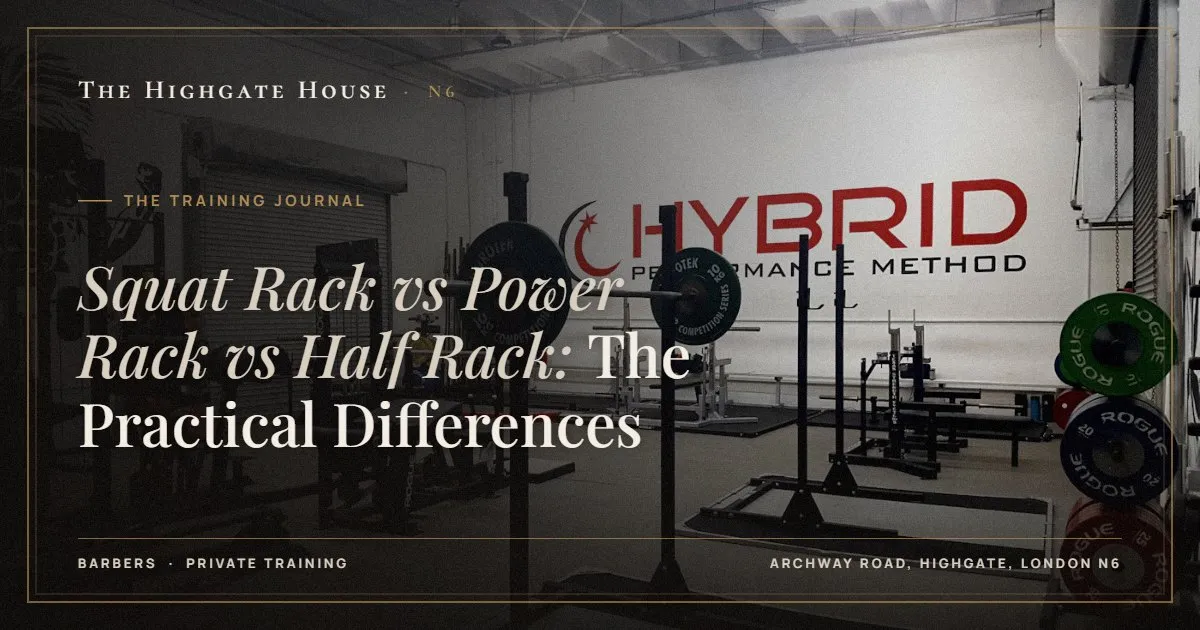
Squat Rack vs Power Rack vs Half Rack: The Practical Differences
A power rack is a full cage with four upright posts: you lift inside it, with adjustable safety bars on both sides that catch the bar if you fail. A half rack has two posts at the front, with spotter arms or safeties that stick out towards you, and you lift in front of it rather than inside it. A squat rack, in the strict sense, is a pair of upright stands with hooks to hold the bar, often with no proper safeties at all. If you train alone and heavy, a power rack is the safest choice. A half rack is a good compromise when space or ceiling height is tight. Basic squat stands suit lighter training or lifting with a spotter. Whatever you use, the safeties set at the right height matter more than the frame.
The words get used loosely. Plenty of gyms call any of these “the squat rack”, and retailers mix the terms too. Here is what actually separates them.
The three designs, explained
Squat stands
Two separate or joined upright posts, each with a hook (J-hook) to hold the bar. Many have short spotter arms; some have none. They take up very little space and are often the cheapest option. Independent stands can wobble or move if the bar is racked roughly, and without long safeties there is nothing to catch a missed rep.
Half rack
Two uprights joined at the base by a frame, often with rear posts and a pull-up bar overhead. You stand in front of it, and long spotter arms extend forward so the bar can drop onto them. It is more stable than stands and gives proper safety for most lifts, with a smaller footprint than a full cage. Because the bar is outside the frame, you need room in front.
Power rack (power cage)
Four uprights connected into a box. You walk the bar out inside the cage, and pins or straps run front to back at the height you choose. If you fail a squat or bench press, you lower the bar onto them and step or roll out. It is the most secure option for solo heavy training, and the frame is the most stable. It takes more floor space and needs ceiling height.
Side by side
| Feature | Squat stands | Half rack | Power rack |
|---|---|---|---|
| Safety when training alone | Low unless long safeties fitted | Good | Best |
| Stability | Lowest | Good | Highest |
| Floor space | Smallest | Medium, plus room in front | Largest footprint |
| Ceiling height needed | Low | Medium to high | High |
| Pull-ups | Rarely | Usually | Usually |
| Attachments | Few | Some | Most |
Safety: the part that matters
Every rack is only as safe as how you set it up. The common rules apply whichever design you use:
- Set the hooks at the right height. For squats, roughly mid-chest, so you unrack with a small dip of the knees rather than going up on your toes. Our guide to using a squat rack safely covers setup in detail.
- Set the safeties just below the bottom of your rep. For a squat, a few centimetres below the bar at full depth. Too high and you hit them every rep; too low and they are useless.
- Test with an empty bar. Squat to depth and check the bar clears the safeties. Then do a deliberate fail onto them, so you know what to do when it matters.
- For the bench press, set safeties just below chest height with your back arched in your usual position. Bench alone without safeties is one of the riskier things people do in gyms.
- Use collars. Plates sliding off one end of a bar can tip it.
The UK’s Chief Medical Officers recommend strength training on at least two days a week, as set out in the physical activity guidelines. The rack is the tool that makes barbell strength work safe enough to do regularly, especially if you train alone.
Buying one for home
Setting up a home gym in a London flat usually comes down to space, ceiling height and floor. Before buying, check:
- Ceiling height against the rack’s height, plus room for pull-ups and overhead pressing. Many period conversions and basements are tighter than you think.
- Floor load and surface. You need thick rubber matting, and in an upstairs flat, a sensible conversation about floor strength and the neighbours.
- Footprint. Measure for the bar, which is about 2.2 metres long for a standard Olympic bar, plus room to load plates at each end.
- Hole spacing. Closer spacing on the uprights lets you set hooks and safeties more precisely.
- Safety type. Pins, spotter arms or straps. Straps are quieter and kinder to the bar; pins and arms are simpler.
- Whether it bolts down. Some racks need bolting or weighting for stability.
Our guide to setting up a home gym in a small flat covers the rest of the kit.
Mistakes I see with racks
- No safeties set, because it is “only a warm-up”. Sets get heavier and the habit never forms.
- Hooks too high. Going up on toes to unrack a heavy bar is a common way to lose balance.
- Walking out too far from a half rack or stands. Two or three short steps back is enough.
- Using the rack for curls in a busy gym. That one is about manners rather than safety.
- Assuming any rack makes heavy solo benching safe. Only if the safeties are set correctly.
What we use in the studio
Our private studio on Archway Road has a squat rack with a barbell and plates, alongside dumbbells, a cable station, lat pulldown and seated row. In a 1-1 session, setup is part of the coaching: hook height, safety height, how to bail safely, and how to unrack and walk out without wasting energy. If you are new to barbell lifting, or want to train heavy with someone checking every rep, see how personal training in Highgate works. Prices are on the personal training page.
If you have a back, shoulder or knee problem, a heart condition, are pregnant or are returning after a long break, check with your GP first before starting heavy barbell training.
Questions we get asked
Is a half rack safe enough to train alone?
Yes, if it has long spotter arms set at the correct height. A full power rack is still the most secure option for very heavy work.
Can I bench press in a squat rack?
You can if the safeties are set just below chest height. Benching heavy alone with no safeties is not wise.
Is a power rack the same as a power cage?
Yes. The terms are interchangeable.
What does a Smith machine have to do with it?
A Smith machine fixes the bar on rails. It is a different tool, with a fixed path rather than free movement, and not a substitute for a rack for most lifters.
Book with The Highgate House
Ready to start training properly? Email us at [email protected] with the service and the day that suits you, and we will come back to you with times.
Visit The Highgate House · Private personal training
The Highgate House, Archway Road, Highgate, London N6.
