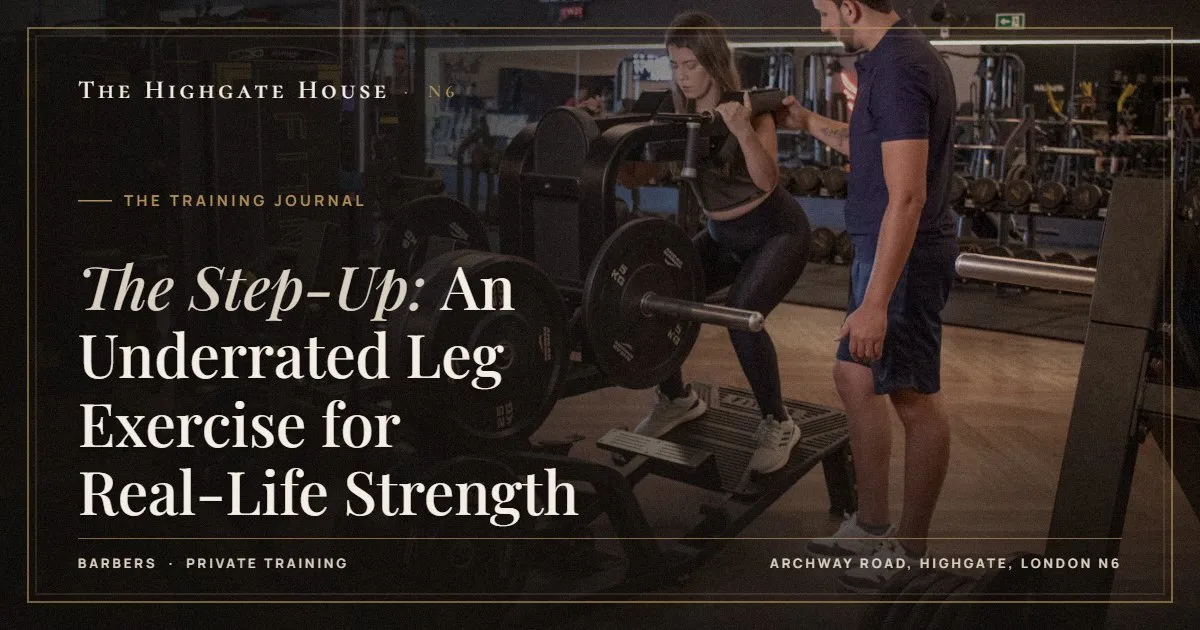
The Step-Up: An Underrated Leg Exercise for Real-Life Strength
A good step-up is one leg doing all the work. Put your whole foot on a box roughly knee height or a little lower, lean your chest slightly forward, and stand up by driving through that foot without pushing off the floor with the back leg. Then lower yourself down slowly on the same leg. Done this way, the step-up trains the quads and glutes hard, exposes left-right differences, and carries over directly to stairs, hills and getting up from the floor. Done badly, with a big bounce off the trailing foot, it is mostly a calf exercise for the wrong leg.
Why it is underrated
The step-up looks too simple to be taken seriously. It has no barbell, no impressive numbers, and it appears in fitness classes as a cardio move. That reputation hides how useful it is.
- It is genuinely single-legged. Unlike a split squat, the back leg does not help much if you do it properly. Weaknesses on one side have nowhere to hide.
- It is easy on the back. Load is usually held in the hands, so the spine is not compressed as in a back squat.
- It is easy to learn. Most people can do a reasonable step-up in their first session, which makes it a sensible choice for beginners and for people returning after time off.
- It matches real life. Climbing stairs, or the long pull up Archway Road towards Highgate, is a series of step-ups. Training the movement makes the daily version feel easier.
The catch is that it is slow to do (one leg at a time) and you cannot load it as heavily as a squat. It works best as a second or third exercise, not the main lift of the day.
How to do it, step by step
- Set the box. Start with a height where your thigh is roughly parallel to the floor or slightly below when your foot is on top. For most people that is a little below knee height.
- Place the whole foot. The entire sole should be on the box, not just the toes. Heel included.
- Lean in. Bring your chest slightly forward so your weight sits over the front foot. Staying bolt upright makes it much harder to stand without pushing off the back leg.
- Drive up. Push through the middle and heel of the front foot. Think of the back leg as a passenger: toes may stay in contact for balance, but they should not spring.
- Stand fully. Finish tall at the top, hip fully straight. The trailing foot can tap the box or hang beside it.
- Lower slowly. Take two to three seconds to come down on the same working leg. This lowering phase is half the value of the exercise.
- Complete all reps on one side, then switch. Start with your weaker leg and match the reps on the stronger one.
Box height changes the exercise
A lower box (mid-shin) is more about the quads and is kinder to stiff hips and knees. A higher box (above knee) asks more of the glutes and hip flexibility, but it also makes cheating with the back leg much more tempting. Higher is not automatically better. If you need to lurch or twist to get up, the box is too high.
Common faults and fixes
| Fault | What it looks like | Fix |
|---|---|---|
| Back-leg push-off | A bounce from the floor before you rise | Lift the back toes so only the heel touches, or lower the box |
| Knee caving in | Front knee drifts towards the other leg as you rise | Lighten the load; keep the knee over the middle toes |
| Dropping down | Falling off the box on the way back | Count three seconds on the way down |
| Toes only on box | Heel hanging off the edge | Move the whole foot onto the box |
| Hip hiking | The pelvis tilts or twists to get up | Lower the box; add a slight forward lean |
A progression that works
- Bodyweight, low box. 2 sets of 10 per leg with a slow lowering phase.
- Bodyweight, knee-height box. Same reps, no push-off.
- Dumbbells at your sides. The most stable way to add load. Build up to 3 sets of 8 to 10.
- Single dumbbell held on the opposite side. Holding a weight in the hand opposite the working leg adds a balance and hip-control challenge.
- Front-loaded. One dumbbell held at the chest makes you work harder to stay upright.
- Tempo and pauses. A two-second pause at the top and a four-second lowering makes a modest weight feel very heavy.
Progress one variable at a time: reps first, then load, then height. If your knees are the concern, the lowering phase and a lower box are the most valuable parts.
Where it fits in a programme
For most people, two to three sets of eight to ten per leg, once or twice a week, after a main lift such as a squat or deadlift. It pairs well with an upper body pull, so one muscle group rests while the other works. Runners can use it as a primary strength exercise, and for older adults it is one of the most practical exercises available. Our guide to split squats vs lunges compares the other single-leg options if you want to choose between them, and walking lunges covers a more athletic, travelling version.
The UK Chief Medical Officers recommend muscle-strengthening activity on at least two days a week, and the NHS activity guidelines for adults set out the guidance in plain terms. A step-up is one of the simplest ways to cover the legs.
Coaching it in the studio
We use step-ups often in private sessions because they tell us so much in a few reps: which knee drifts, which hip tires first, whether one ankle is stiffer. In our basement studio we can set box height precisely and add load with the dumbbell rack, and because you are the only person training there, a slow, careful set of eight is not interrupted by someone waiting for the box. If that sounds useful, see how our personal trainer in Highgate structures a first session, or read about our approach to 1-1 coaching for busy adults.
Check with your GP first if you have a recent knee or hip injury, a joint replacement, balance problems, or a heart condition, and use a rail or wall for support when starting out.
Questions we get asked
What height should my step be?
Start where your thigh is about parallel to the floor with the foot on the box, usually a little below knee height. Go lower if you cannot rise without pushing off the back leg.
Are step-ups bad for the knees?
For most people they are one of the kinder leg exercises, especially from a lower box with a slow descent. Sharp pain is a reason to stop and get it checked.
Should I alternate legs?
Doing all the reps on one leg first keeps the effort concentrated and makes the comparison between sides clearer. Alternating is fine for conditioning.
Are step-ups as good as squats?
Different, not worse. Squats allow heavier loads. Step-ups train each leg alone and are easier on the back. Most programmes benefit from both.
Book with The Highgate House
Ready to start training properly? Email us at [email protected] with the service and the day that suits you, and we will come back to you with times.
Visit The Highgate House · Private personal training
The Highgate House, Archway Road, Highgate, London N6.
