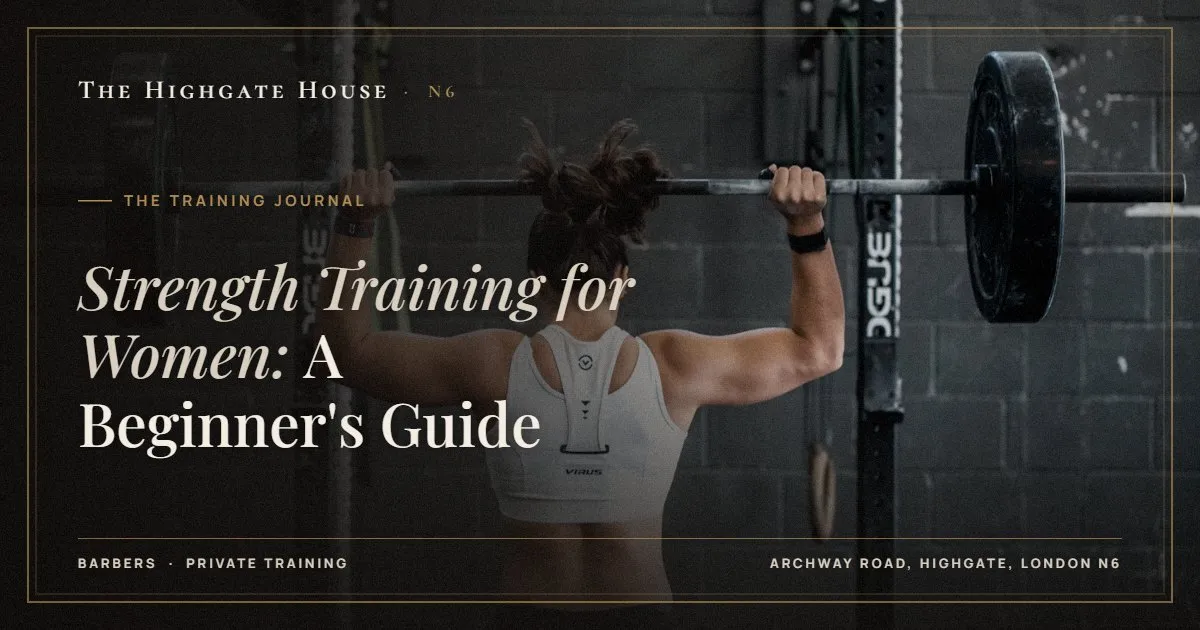
Strength Training for Women: A Beginner's Guide
If you are a woman new to strength training, start with two full-body sessions a week, built around six basic movements: a squat, a hinge, a push, a pull, a single-leg exercise and a loaded carry. Use weights that leave you with two or three reps in hand at the end of each set, and add a little load or a rep or two every week or so. That is genuinely most of it. The physiology of getting stronger is the same for women as for men; what differs is usually the starting point, the advice you have been given, and the confidence to pick up something heavier than a pink dumbbell. This guide covers the practical detail.
Why bother: what the guidance says
The UK Chief Medical Officers recommend that adults do activities that build strength on at least two days a week, alongside 150 minutes of moderate activity. The NHS summary of those guidelines is worth reading in full. Far fewer adults meet the strength part than the aerobic part, and women are less likely to meet it than men.
The reasons to close that gap are practical rather than cosmetic: stronger muscles make everyday life easier, help maintain bone health over time, and make it far easier to stay active into later life. Our separate post on strength training and bone health goes into what the guidance says there.
The worry that lifting will make you bulky has its own post, will lifting weights make women bulky, so I will only say this here: building noticeable muscle takes years of deliberate effort and eating for it. It does not happen by accident in a beginner programme.
The six movements to learn first
Forget lists of 40 exercises. Almost every useful programme is built from a handful of patterns. Learn one version of each and you can train for years.
| Pattern | Beginner version | What to focus on |
|---|---|---|
| Squat | Goblet squat to a box | Knees track over toes, chest stays tall |
| Hinge | Dumbbell Romanian deadlift | Hips go back, back stays long, weights close to legs |
| Push | Incline push-up or dumbbell bench press | Shoulder blades set, elbows at about 45 degrees |
| Pull | Lat pulldown or seated cable row | Lead with the elbows, no swinging |
| Single leg | Split squat or step-up | Balance first, then load |
| Carry | Farmer’s walk with dumbbells | Stand tall, walk slowly, grip hard |
Most women I coach are relatively strong in the lower body from day one and find pressing and pulling harder at first. That is normal and changes quickly. The pull-up is a fine long-term goal, but the pulldown and row build the strength for it.
A simple two-day plan for the first eight weeks
Two sessions, at least a day apart. Each takes 45 to 60 minutes including a short warm-up.
Session A
- Goblet squat: 3 sets of 8 to 10
- Dumbbell bench press or incline push-up: 3 sets of 8 to 10
- Seated cable row: 3 sets of 10 to 12
- Step-up: 2 sets of 8 each leg
- Farmer’s walk: 3 lengths of about 20 metres
Session B
- Dumbbell Romanian deadlift: 3 sets of 8 to 10
- Lat pulldown: 3 sets of 10 to 12
- Split squat: 2 sets of 8 each leg
- Half-kneeling one-arm dumbbell press: 2 sets of 8 each side
- Glute bridge or hip thrust: 2 sets of 12
Rest about 90 seconds between sets of the bigger lifts, less on the smaller ones. If you can manage a third day, repeat Session A. Our beginner gym workout plan lays out how to stretch this into a full eight-week block with three days.
How to pick a starting weight
This is where most beginners go wrong, and usually by going too light rather than too heavy. A useful method:
- Do a warm-up set with something clearly easy.
- Pick a weight you think you could lift 12 times. Do 10 reps.
- If the last rep was quick and comfortable, go heavier next set. If your form changed on the last two reps, go lighter.
- The right weight leaves you with two or three good reps in reserve. The final reps should feel slow but clean.
Write every weight down. You will not remember next week, and the notebook is how you know whether you are progressing.
What the first twelve weeks actually feel like
Weeks 1 to 3. Clumsy, then less clumsy. Strength rises quickly, mostly because your nervous system is learning the movements. Some muscle soreness a day or two after the first sessions is normal and settles within a couple of weeks.
Weeks 4 to 8. The weights you started with feel light. This is the stretch where adding load each week is easiest. Many people notice they carry shopping, children or suitcases with less effort.
Weeks 9 to 12. Progress slows a little. You may need to move from adding weight every session to adding a rep or two first. This is the point where sticking with a plan matters more than finding a new one.
Scales are a poor guide over this period, because water and food weight move up and down. Strength numbers, how clothes fit, and occasional body composition measurements tell you more.
Things that are specific to women, and things that are not
Exercise selection, sets, reps and progression are the same principles for anyone. A few things are worth considering:
- Your cycle. Some women notice energy and strength vary across the month; many notice nothing. There is no need to plan around it unless you find it affects you, in which case lighter sessions on harder days are perfectly sensible.
- Pregnancy and after birth. Strength training can continue in pregnancy for many women, but the rules change, and returning after birth needs a gradual approach. Speak to your midwife or GP first.
- Pelvic floor. If you leak when lifting, coughing or jumping, it is common but not something to ignore; a women’s health physiotherapist is the right person to see, and training can usually be adapted around it.
- Perimenopause and beyond. Strength work becomes more valuable, not less. We cover that in strength training through perimenopause.
If you have a heart condition, a joint injury, are pregnant, or are returning after a long break, check with your GP first before starting a programme.
Why a private room helps at the start
Plenty of women tell me the hardest part was never the training. It was walking into the free weights area of a busy gym, feeling watched, and retreating to the cross-trainer. A private 1-1 studio in Highgate takes that out of the equation: during your session the room is booked to you alone, with a squat rack, dumbbells, a cable station and a pulldown, and nobody waiting for the bench. The first few sessions are about learning those six patterns well enough to train confidently anywhere.
Questions we get asked
How often should a beginner woman lift weights?
Two full-body sessions a week is enough to make steady progress and meets the UK strength guidance. Three is better if you can recover from it, but two you actually do beats four you skip.
Should I do cardio or weights first?
If strength is the priority, lift first while you are fresh. A short, easy warm-up on a bike beforehand is fine.
Do I need machines or free weights?
Both have a place. Machines like the pulldown and cable row are easy to learn; dumbbells and the barbell teach balance and coordination. A mix works well.
How do I know I am progressing?
Your training log. If the weights or reps are creeping up every week or two, you are progressing. If you would like that tracked for you, our personal training includes it.
Book with The Highgate House
Ready to start training properly? Email us at [email protected] with the service and the day that suits you, and we will come back to you with times.
Visit The Highgate House · Private personal training
The Highgate House, Archway Road, Highgate, London N6.
