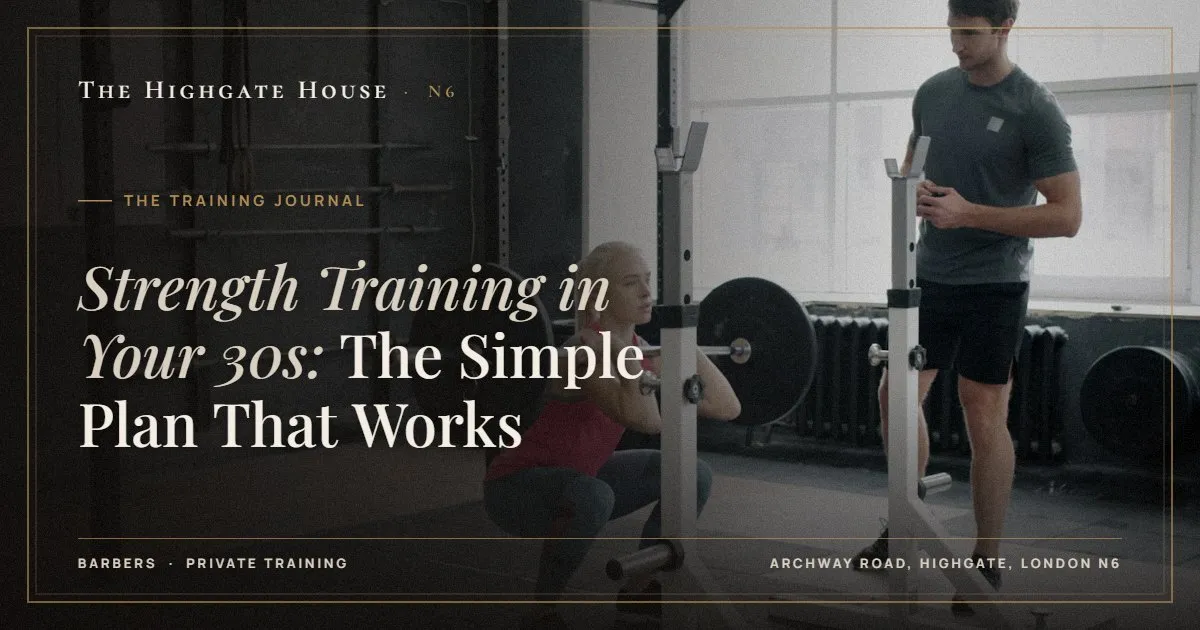
Strength Training in Your 30s: The Simple Plan That Works
The plan that works for most people in their 30s is two full-body strength sessions a week, built on six basic movements, with the weights going up slowly and a written record of every session. Your body has not suddenly changed at 30. Your life has: longer hours, more travel, children, less sleep. A good plan for this decade is less about clever programming and more about something you can repeat for years when the week goes wrong. Below is that plan, how to progress it, and the mistakes I see most often in clients in their 30s.
What actually changes in your 30s
People often arrive at the studio convinced their metabolism has collapsed. In most cases what has collapsed is the amount they move. University sport has gone, the commute is a seat on the Northern line, and the desk has taken over. Muscle and strength respond to training at 35 much as they did at 25, provided you give them a reason to.
Three things do genuinely shift, and the plan should respect them:
- Time is the scarce resource. A programme that needs five sessions a week will be abandoned by March.
- Recovery is more fragile, mostly because sleep and stress are worse, not because of age itself. A heavy work week can flatten a session.
- Old injuries start to talk. The ankle from five-a-side or the shoulder from rowing at university will shape exercise choices.
The UK Chief Medical Officers recommend muscle-strengthening activity on at least two days a week, alongside 150 minutes of moderate activity. The NHS summary of the guidelines is a good one-page read. Two strength sessions is not a compromise. It is the recommendation.
The six movements to build around
Nearly every useful strength exercise is a version of one of these. Cover all six twice a week and you have trained everything that matters.
| Movement | Main option | Easier or joint-friendly option |
|---|---|---|
| Squat | Barbell back squat | Goblet squat with a dumbbell |
| Hinge | Romanian deadlift | Dumbbell Romanian deadlift |
| Push | Bench press or dumbbell press | Push-ups, hands raised |
| Pull | Lat pulldown or seated cable row | Single-arm dumbbell row |
| Single leg | Split squat | Step-up to a low box |
| Carry | Farmer’s walk | Suitcase carry, one hand |
If you are new to the hinge, start with the dumbbell version and read our guide to Romanian deadlift form before loading a bar.
The plan: two sessions a week
Each session takes about 50 to 60 minutes including a short warm-up. Leave at least one day between them, for example Monday and Thursday.
Session A
- Barbell back squat: 3 sets of 5 to 8
- Dumbbell bench press: 3 sets of 8 to 10
- Seated cable row: 3 sets of 10 to 12
- Split squat: 2 sets of 8 each leg
- Farmer’s walk: 3 walks of about 30 metres
Session B
- Romanian deadlift: 3 sets of 6 to 8
- Lat pulldown: 3 sets of 8 to 12
- Standing overhead dumbbell press: 3 sets of 8 to 10
- Step-up: 2 sets of 8 each leg
- Pallof press or dead bug: 2 sets
Finish either session with five to eight minutes on the air bike if you have time. It is optional. The lifts come first.
How to progress without getting hurt
Use a rep range, not a fixed number. When you can do every set at the top of the range with good form and one or two reps left in the tank, add the smallest load available next session and drop back to the bottom of the range. That is the whole system. Our piece on progressive overload goes into more detail.
Some rules of thumb I give clients in their 30s:
- Stop sets with a rep or two in reserve. Grinding to failure every set costs recovery you do not have spare in a busy week.
- Write it down. Weight, sets, reps, and one line on how it felt. Without a log you will repeat the same weights for a year.
- Expect progress to slow. Beginners can add load almost weekly for a couple of months. After that, adding a rep is progress.
- Take an easier week every six to eight weeks, or whenever life forces one on you. Do the same exercises with less weight.
If you have had a long break from exercise, an injury, a heart condition, or are pregnant, check with your GP first before starting a programme like this.
The mistakes that stall people in this decade
Training like you are 22 for three weeks
Five sessions, a new programme, a punishing diet. It feels productive and it lasts until the first work trip. Two sessions you actually do beat five you plan.
Treating cardio as the main event
Running and cycling are excellent for your heart and lungs. They do not replace lifting for muscle and strength. If you only have two slots, make them strength sessions and walk or cycle on other days.
Changing the programme every fortnight
Novelty feels like progress. It rarely is. Keep the same main lifts for at least eight to twelve weeks so you can see whether they are moving.
Ignoring sleep and food
Enough protein spread through the day and reasonable sleep do more for recovery than any supplement. If you are routinely sleeping six hours, expect sessions to suffer, and plan lighter weeks around the worst of it.
When coaching helps
You can run this plan alone in any decent gym. Where a coach earns their fee is in the first few months, when technique on the squat and hinge is being set, and later, when progress stalls and you need someone to see what has changed. In our private Highgate studio the room is booked to you alone for the hour, and we track body composition on an InBody scanner so you can see muscle gained, not just weight lost.
Questions we get asked
Is two sessions a week really enough in your 30s?
For building strength and some muscle, yes, if the sessions cover the whole body and the weights progress. Three sessions can help later, but two you never miss is the better starting point.
Should I lift heavy or light?
Mostly moderate: weights you can lift for about 5 to 12 reps with good form and a rep or two to spare. Very light weights work too if you take sets close to effort, but they take longer.
How soon will I notice a difference?
Most people feel stronger and move better within a few weeks, largely because their technique and coordination improve. Visible change takes longer, usually a few months of consistent training and sensible eating.
Can I do this at home?
With adjustable dumbbells, most of it. You lose the barbell and cable options, but goblet squats, dumbbell Romanian deadlifts, presses and rows cover the six movements well.
If you would like this plan set up properly for your body and diary, see how 1-1 training with Artem works, or start at The Highgate House homepage.
Book with The Highgate House
Ready to start training properly? Email us at [email protected] with the service and the day that suits you, and we will come back to you with times.
Visit The Highgate House · Private personal training
The Highgate House, Archway Road, Highgate, London N6.
