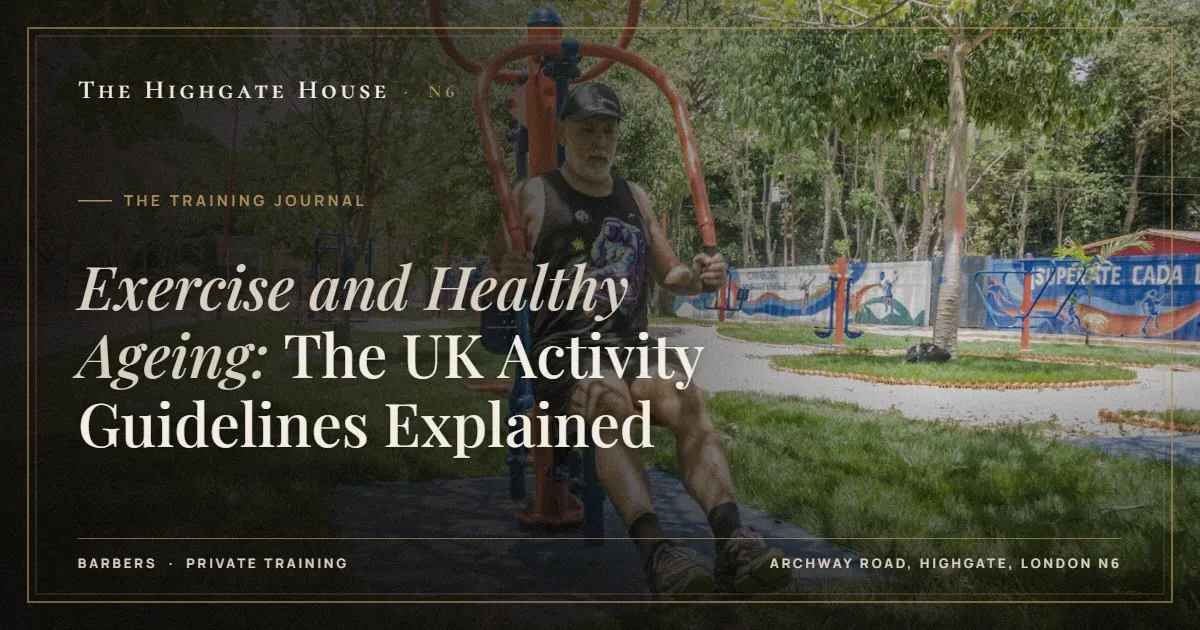
Exercise and Healthy Ageing: The UK Activity Guidelines Explained
The UK Chief Medical Officers’ guidelines ask adults to do at least 150 minutes of moderate activity a week, or 75 minutes of vigorous activity, or a mix of the two. On top of that, they ask for muscle-strengthening activity on at least two days a week and for long periods of sitting to be broken up. Older adults get the same targets plus one addition: activities that improve balance and flexibility, also on two days a week. That is the whole of it. The more useful questions are what actually counts, which part people tend to skip, and how to fit it into a real week. This post answers those.
Where the guidelines come from
The current version was published in 2019 by the four UK Chief Medical Officers, replacing guidance from 2011. It covers everyone from under-fives to older adults, and it was built from a review of the research on activity and health rather than from any single study. The adult section applies from age 19. You can read the plain-English summary on gov.uk, which is short and worth two minutes of your time.
Two principles sit underneath the numbers, and they matter more than the numbers themselves. First, some activity is better than none, and more is better still. Second, there is no minimum length for a bout to count. The older guidance talked about ten-minute blocks. That has gone. A brisk eight-minute walk to Highgate station counts.
The four parts, in plain terms
| Part | Target | How to tell you are doing it |
|---|---|---|
| Moderate activity | At least 150 minutes a week | Breathing faster, can still talk, could not comfortably sing |
| Vigorous activity (alternative) | At least 75 minutes a week | Breathing hard, can only say a few words |
| Muscle strengthening | At least 2 days a week | Muscles worked hard enough that the last few reps are challenging |
| Less sitting | Break up long periods of inactivity | You stand up and move regularly through a desk day |
| Balance and flexibility (older adults) | At least 2 days a week | Activities that challenge standing steadiness and range of movement |
The “talk test” in the right-hand column is the practical way to judge intensity without a heart rate monitor. One minute of vigorous activity is treated as roughly equal to two minutes of moderate, which is why the two targets differ by a factor of two.
The part most people skip: strength
Most adults who think of themselves as active are covering the cardio target through walking, cycling, running or sport. Far fewer are doing the strength part. National surveys have consistently found that muscle-strengthening is the least met element of the guidelines, and in my experience with clients over 30 it is the one most often missing from an otherwise busy week.
It matters more as you age. Muscle mass and strength decline gradually from middle age if nothing is done about it, and strength is what lets you carry a suitcase up the Tube stairs, get up from a low chair or catch yourself when you trip. We go into the mechanics in our piece on muscle loss with age. Strength work also loads bone, which is why the guidelines say it helps keep “muscles, bones and joints” strong.
What counts as muscle strengthening is broader than people assume. Lifting weights, resistance bands, bodyweight exercises such as squats and press-ups, heavy gardening and carrying heavy shopping all qualify, as long as the effort is genuinely demanding. The test is whether the muscles are close to tired by the end of a set. Ten easy squats while the kettle boils are a good habit, but they are not what the guideline means.
What changes after 65
The targets for older adults are the same as for younger adults, with balance and flexibility added. The guidelines also stress that older adults who are currently inactive should start small and build up, and that even light activity brings benefits compared with sitting.
Balance is the addition people underestimate. Falls are a major cause of injury in later life, and balance is a trainable quality, like strength. Useful options include standing on one leg while brushing your teeth, tai chi, dance, bowls, or structured single-leg work in the gym. Our post on balance training for over-60s sets out a short routine.
I would add one practical point. There is no reason to wait until 65 to start the balance work. Many of the people I coach in their forties and fifties have one side noticeably steadier than the other, usually from an old ankle or knee injury. Fixing that early is easy.
A week that meets the guidelines
Here is an example for a desk-based professional with a commute, written as numbered days so you can see how little reorganisation it takes.
- Monday: 45 minutes of strength training covering legs, a push, a pull and a carry. Walk to and from the station briskly (around 20 minutes moderate).
- Tuesday: Brisk 30-minute walk at lunch or a cycle commute.
- Wednesday: Brisk walking on the commute again. Stand for calls, and get up once every 30 to 45 minutes.
- Thursday: Second strength session, 45 minutes, including a single-leg exercise for balance.
- Friday: Rest day apart from normal walking.
- Saturday: 40 to 60 minutes of moderate activity: a walk over Hampstead Heath, a game of padel, a family bike ride.
- Sunday: 20 minutes of easy mobility or yoga.
That comfortably passes 150 moderate minutes and gives two strength days. None of it is extreme. The two strength sessions are the only part that needs a diary entry; the rest attaches to things you already do.
Common misreadings
- “150 minutes is the goal.” It is the minimum the evidence supports for meaningful benefit. More activity brings further benefit, up to a point.
- “Steps cover everything.” A high step count can cover the moderate activity target if much of it is brisk, but it does not cover strength. See our view on how many steps a day are useful.
- “Exercise cancels out sitting.” The guidelines treat sitting time as a separate issue. Someone who trains hard for an hour and then sits for ten is still advised to break that up.
- “Vigorous means punishing.” It means breathing hard enough that conversation is difficult. A hilly run, a fast cycle or air bike intervals all qualify.
- “It is too late to start.” The guidelines say explicitly that it is never too late, and the biggest relative gains come from moving from doing nothing to doing something.
If you have a heart condition, are pregnant, have been inactive for a long time, or have a health problem you are unsure about, check with your GP first before raising your activity sharply. The NHS also publishes the same guidance with practical examples on its exercise pages.
Where personal training fits
Most people can meet the cardio part on their own. The strength part is where coaching tends to pay for itself, because two sessions a week only help if they are progressive, safe and done consistently for years. In our Highgate personal training studio, a typical client trains with me once or twice a week to cover the strength target properly, then fills the rest of the guidelines with walking, cycling or sport. If you would like help building the strength days into a busy week, private 1-1 sessions are the most direct route.
Questions we get asked
Does housework count towards the 150 minutes?
If it raises your breathing to a moderate level, yes. Vigorous vacuuming or carrying laundry up stairs can count. Gentle tidying probably does not.
Can I do all 150 minutes at the weekend?
The guidelines suggest spreading activity across the week, ideally some every day, but meeting the total in fewer, longer sessions still brings benefit.
Is yoga muscle strengthening?
Some forms are demanding enough to count, particularly holds and flows that tire the muscles. Gentle, stretch-based classes count better towards flexibility.
Do the guidelines differ for women?
No. The adult targets are the same for men and women. There is separate guidance for pregnancy and after childbirth.
Book with The Highgate House
Ready to start training properly? Email us at [email protected] with the service and the day that suits you, and we will come back to you with times.
Visit The Highgate House · Private personal training
The Highgate House, Archway Road, Highgate, London N6.
