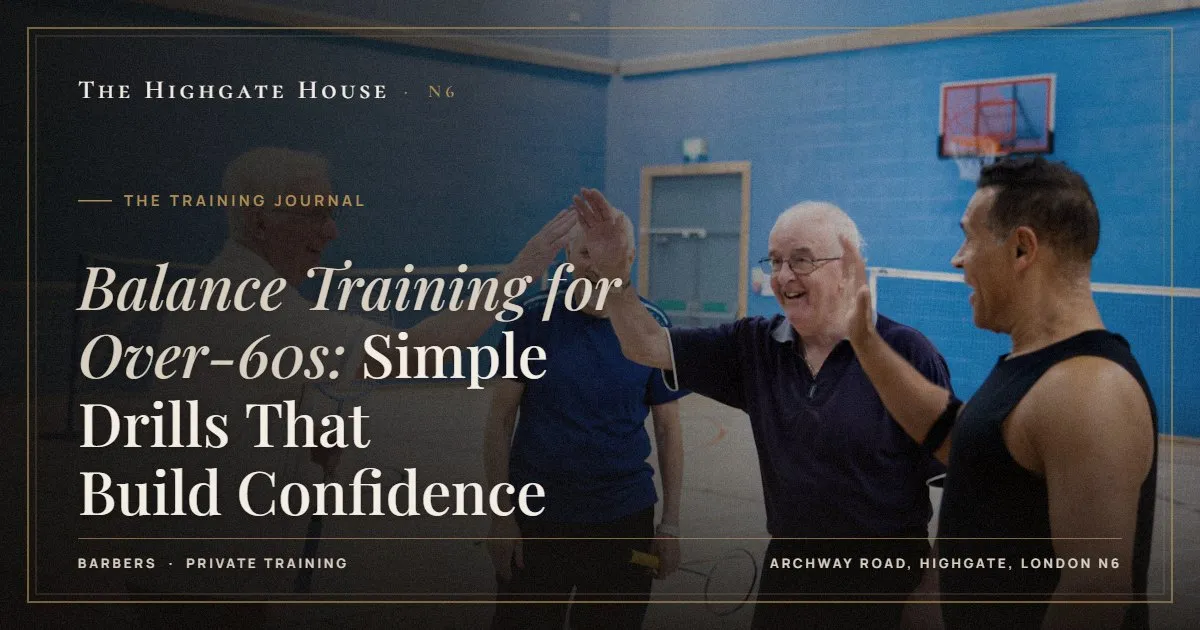
Balance Training for Over-60s: Simple Drills That Build Confidence
The best balance exercises for over-60s are simple, progressive and practised often: standing with your feet closer together, then heel-to-toe, then on one leg, then stepping, turning and carrying, always with a sturdy surface within reach. A few minutes a day works better than one long session a week. NHS guidance for older adults recommends activities that improve strength, balance and flexibility on at least two days a week, and balance improves fastest when it is paired with leg strength. Below is a clear sequence of drills you can start at home, plus how to know when to move on.
Why balance changes, and why it can be trained
Balance is not one thing. It depends on your eyes, the balance organs in your inner ear, the sensors in your feet and ankles that tell you where you are, and the leg and hip strength that lets you correct a wobble quickly. With age, several of these tend to decline together, and many people also simply stop doing the things that challenge balance: stepping over obstacles, standing on one leg to put on a sock, walking on uneven ground.
The encouraging part is that balance responds to practice at any age. The body adapts to the demands placed on it. Practise standing on one leg and you get better at standing on one leg. Practise stepping quickly and your recovery step gets quicker. The NHS guidelines for older adults make the point directly: if you have fallen or are worried about falling, exercises for strength, balance and flexibility help make you stronger and more confident on your feet.
Before you start: safety set-up
- Stand next to a kitchen worktop, a heavy chair against a wall, or in a corner, so support is always within arm’s reach.
- Wear flat, supportive shoes to begin with. Barefoot work comes later, on a non-slip floor.
- Clear the floor of rugs, cables and pets.
- Practise when you are alert, not straight after getting up at night or after a large meal.
- Stop if you feel dizzy or light-headed, and sit down.
Check with your GP before starting if you have had a fall recently, experience dizziness or vertigo, have a heart condition, are recovering from a joint replacement, or have not exercised for a long time. If you have had falls, ask about a referral to a falls prevention or strength and balance service as well.
The drills, in order
Work through these in sequence. Each one has a target. When you can meet it comfortably, without grabbing for support, move to the next. Most people spend one to three weeks on each stage.
Stage 1: Narrowing the base
- Feet together. Stand with feet touching, hands hovering over the support. Target: 30 seconds, three times.
- Semi-tandem. The heel of one foot beside the big toe of the other. Target: 30 seconds each way.
- Tandem stance. Heel directly in front of toe, as if on a tightrope. Target: 30 seconds each way.
Stage 2: Standing on one leg
- Single-leg stand with fingertip support. Lift one foot a few centimetres. Target: 30 seconds each leg.
- Single-leg stand, hands off. Hover the hand over the support rather than holding it. Target: 20-30 seconds each leg.
- Single-leg stand with a head turn. Slowly look left and right while balancing. This challenges the inner ear. Target: 5 turns each way, each leg.
Stage 3: Moving balance
- Heel-to-toe walk along the worktop, 10 steps forwards, then backwards with care.
- Sideways stepping with a pause on one leg between steps, 10 each way.
- Step-ups onto the bottom stair, holding the banister, 8-10 each leg. This builds the strength that balance relies on.
- Clock reach. Stand on one leg and tap the other foot lightly forwards, to the side and behind. 3 rounds each leg.
Stage 4: Real-life challenges
- Carry and turn. Walk holding a light shopping bag in one hand, turn around, walk back. This trains the trunk to stay upright under an uneven load.
- Sit to stand without hands, 8-10 slow reps from a firm chair.
- Single-leg stand with eyes closed, only with support right beside you, a few seconds at a time.
How often, and for how long
Little and often is the principle. Five to ten minutes a day is more effective than an hour once a week, and it is easy to attach to something you already do: balance on one leg while the kettle boils, or do your tandem stance while brushing your teeth, holding the basin.
On top of that, two sessions a week of proper strength work for the legs and hips make a real difference. Balance is partly a skill and partly a strength problem. If your hips and thighs cannot catch a stumble quickly, practising stillness only gets you so far. I go into the strength side in more detail in weight training for over-60s.
Mistakes I see most often
- Holding on too tightly. A white-knuckle grip means the arms are doing the balancing. Use fingertips, then hover.
- Staring at the feet. Look ahead at a fixed point at eye level. Looking down makes balance harder, not easier.
- Locking the knee. Keep a soft bend in the standing leg.
- Progressing too quickly. Doing a drill once does not mean you own it. Meet the target on several days before moving on.
- Only doing the easy ones. Balance training should feel slightly uncertain. If it is effortless, it is no longer training.
What it looks like with a trainer
Working 1-1 lets us go further, safely. In the studio at The Highgate House I can stand within arm’s reach while you try harder variations, use the squat rack as a support frame, and load the legs properly with dumbbells and the cable station. We can also test progress in a consistent way, so you can see that your single-leg stand or sit-to-stand has genuinely improved rather than guessing. The studio is booked to you alone during your session, which many older clients prefer to a busy gym floor. The personal training page has more on how sessions run.
If you are in your fifties and want to build the foundations earlier, the workout plan for over-50s covers strength, balance and fitness together.
Questions we get asked
How long should I be able to stand on one leg?
There is no single number that applies to everyone. A practical aim is to work up to around 30 seconds on each leg with your hands hovering over a support, then make it harder from there.
Is tai chi good for balance?
Yes. It involves slow weight shifting, stepping and turning, which are exactly the skills balance depends on, and many people enjoy it. It works well alongside leg strength training.
I have had a fall. Should I wait before starting?
Speak to your GP first. They can check for causes such as medication or blood pressure and may refer you to a specialist falls service. Once you are cleared, supported balance work is usually encouraged.
Can my partner and I train together?
Ask us. Sessions are planned around the individual, so the right set-up depends on both your needs.
If you would rather start with someone beside you, book an initial session of private personal training in Highgate.
Book with The Highgate House
Ready to start training properly? Email us at [email protected] with the service and the day that suits you, and we will come back to you with times.
Visit The Highgate House · Private personal training
The Highgate House, Archway Road, Highgate, London N6.
