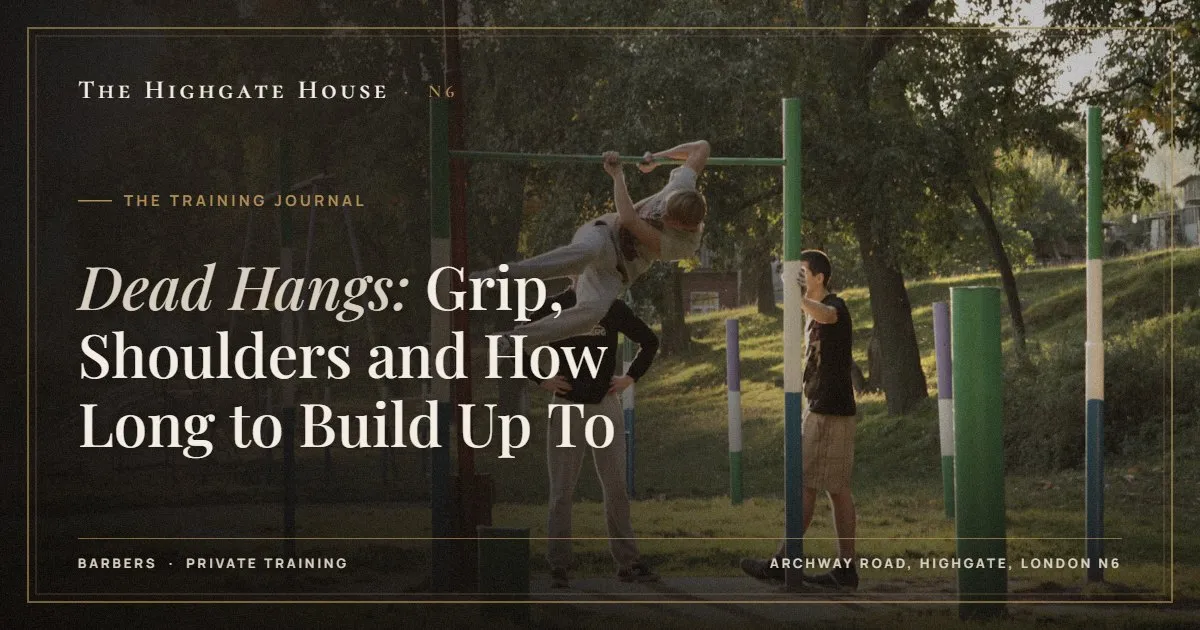
Dead Hangs: Grip, Shoulders and How Long to Build Up To
A dead hang is simply hanging from an overhead bar with straight arms and your feet off the floor. It trains grip endurance, gets the shoulders used to working overhead and is the starting position of every pull-up. For most adults, a sensible first goal is a relaxed 20 to 30 seconds. A solid one-minute hang is a good longer-term target, and anything past that is more of a grip specialism than a health marker. Build up gradually, a few seconds at a time, and stop any set the moment your shoulders feel pinchy rather than simply stretched.
What a dead hang actually trains
It looks passive, but quite a lot is going on.
- Grip endurance. The forearm flexors are holding your whole bodyweight for the duration. This is the main limiter for most people, and the reason hangs carry over so well to deadlifts, rows and carrying shopping up Highgate Hill.
- Overhead shoulder position. Hanging puts the arms fully overhead under gentle traction. For desk workers whose shoulders rarely go above eye level, that range can feel unfamiliar at first.
- Pull-up readiness. Every pull-up starts from a hang. If you cannot hold the bottom position comfortably for 20 seconds, the first rep will be hard for reasons that have nothing to do with your back.
What it does not do is decompress your spine in any lasting, measurable way, despite what you may read. It can feel pleasant on a stiff back, and that is a perfectly good reason to do it, but it is not a treatment.
Passive hang vs active hang
These are two different exercises sharing a bar, and it is worth knowing which one you are doing.
| Passive (dead) hang | Active (scapular) hang | |
|---|---|---|
| Shoulders | Relaxed, rising towards the ears | Pulled slightly down and back, neck long |
| Main purpose | Grip, overhead range, gentle stretch | Shoulder control, pull-up preparation |
| Typical duration | 20 to 60 seconds | 10 to 30 seconds, or as reps |
| Who should be cautious | Anyone with unstable or recently injured shoulders | Few restrictions; a good starting point |
A useful drill combines them: hang passively, then without bending your elbows, draw your shoulder blades down so your body rises an inch or two, pause, and lower again. These scapular pulls are one of the best ways to teach the first part of a pull-up.
How to do a dead hang properly
- Set the bar height. Ideally you can reach it from standing on tiptoe or a low, stable box. Jumping up to a bar and dropping into the hang jolts the shoulders, which is the opposite of what you want.
- Grip. Overhand, hands about shoulder-width or a touch wider, thumbs wrapped around the bar. A thumbless grip feels easier on the wrists but gives you less security.
- Lower in. Take your weight gradually by bending your knees or stepping off the box, rather than letting yourself drop.
- Find your position. Arms straight, ribs down rather than flared, legs together and slightly in front of you so you are not swinging. Breathe slowly.
- Get off before your grip fails. End the set while you still have a second or two in hand, stepping back down onto the box. Grip failure at the top of a tall bar is how people land badly.
How long to build up to
There is no official standard for hang time, so treat the following as practical coaching benchmarks rather than norms.
- Starting out: 3 to 5 sets of 10 to 15 seconds, with feet able to take some weight if needed.
- Comfortable: 3 sets of 30 seconds without shaking or shoulder discomfort.
- Strong: a single relaxed hang of 60 seconds.
- Beyond: 90 seconds and up is real grip endurance. Useful for climbers and some sports; not necessary for general health.
Progress by adding two to five seconds per set each week, or one set at a time. Grip tissues adapt more slowly than you might like, and forearms that are sore for days afterwards are a sign you added too much too fast. Two or three hanging sessions a week is plenty.
If you want hangs to support a broader grip goal, our piece on grip strength exercises covers carries, holds and how to combine them without overcooking your forearms.
Common mistakes
Hanging to the point of failure every time
Grinding until your hands open teaches nothing extra and leaves your forearms tired for the next session’s pulling work. Finish with a little in reserve.
Swinging or kipping
Momentum shortens the time your grip is genuinely working and loads the shoulders unpredictably. Keep the legs still and slightly forward.
Ignoring a pinch in the front of the shoulder
A stretch across the lats and armpits is normal. A sharp or pinching feeling at the front or top of the shoulder is not. Shorten the hang, switch to an active hang, or take some weight through your feet.
Treating it as a warm-up for everything
A short hang before pulling work is reasonable. Long hangs before heavy deadlifts will tire your grip before the main event.
Who should take more care
Hanging is low-impact, but it does put the shoulder in its most open position under load. If you have a history of shoulder dislocation, a current rotator cuff problem, recent shoulder surgery or elbow tendon pain, start with feet-supported hangs or skip them until you have had advice. Check with your GP first if you have a heart condition, high blood pressure that is not well controlled, are pregnant, or are coming back after a long break. The NHS guidance on strength exercises is a sensible plain-English reference for building up gradually.
Where hangs fit in a programme
Hangs work best as a short finisher on upper-body or pulling days, or as a standalone grip block done two or three times a week. A simple arrangement looks like this:
- Pulling day: rows and pulldowns as your main work, then 3 hangs of 20 to 40 seconds at the end.
- Pull-up practice: scapular pulls and active hangs first, then assisted or negative pull-ups. Our guide to getting your first pull-up sets out the full progression.
- Core link: once the hang is steady, hanging knee raises use the same position to train the trunk.
In the studio there is no need to hang from a bar to build the qualities a hang develops. Heavy holds on the cable station, rows and lat pulldowns all train grip and overhead pulling in a controlled way, and they let me load each person precisely. If shoulder position is the issue, we usually spend the first part of a private training session on getting the arms comfortably overhead before adding any load.
Questions we get asked
Do dead hangs really help with posture?
They help with the overhead range of the shoulders, which often gets stiff in desk workers. Posture as a whole depends far more on how strong and varied your movement is across the week than on any single drill.
Should I use chalk or gloves?
Chalk is fine and makes a slippery bar much easier. Gloves add thickness and tend to reduce grip security, so most coaches avoid them for hanging.
My hands hurt more than my forearms. Is that normal?
Early on, the skin of the palms often gives up first. It toughens within a few weeks. Holding the bar in the base of the fingers rather than deep in the palm reduces skin pinching.
Can I do dead hangs every day?
Short, easy hangs most days are fine for many people. If you are building longer hang times, three days a week with rest in between works better. Our personal training page explains how we plan grip and pulling work around a full programme.
Book with The Highgate House
Ready to start training properly? Email us at [email protected] with the service and the day that suits you, and we will come back to you with times.
Visit The Highgate House · Private personal training
The Highgate House, Archway Road, Highgate, London N6.
