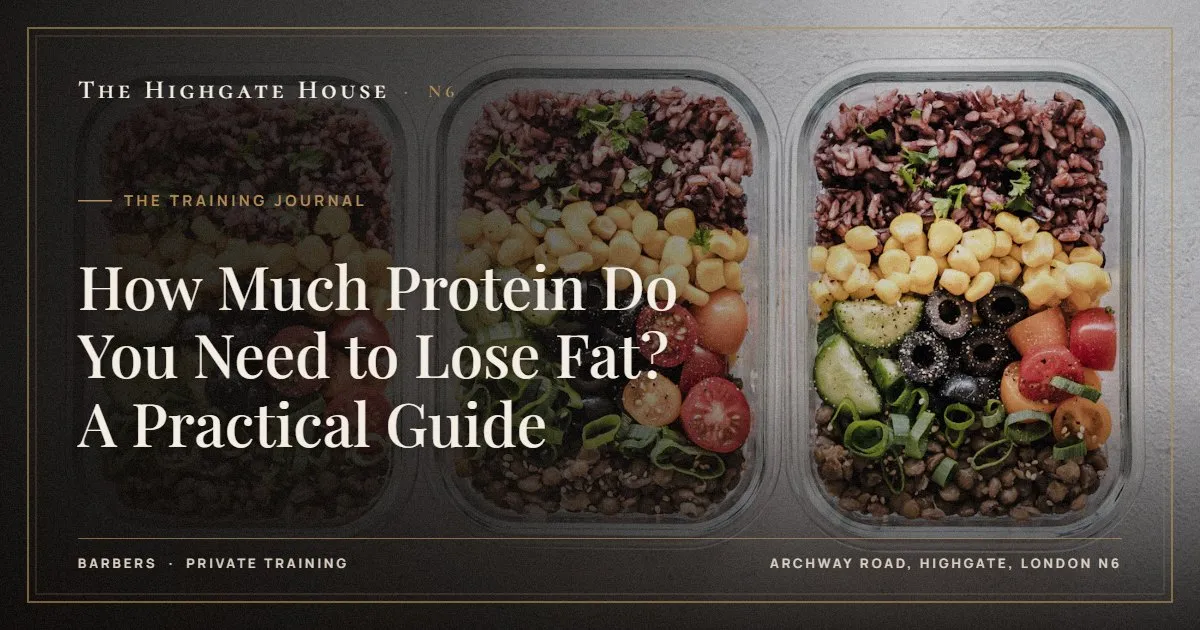
How Much Protein Do You Need to Lose Fat? A Practical Guide
If you are trying to lose fat while strength training, a practical target for most healthy adults is roughly 1.6 to 2.2 grams of protein per kilogram of body weight per day, spread over three or four meals. For someone weighing 80kg, that is about 130 to 175g a day. If you carry a lot of excess weight, base the sum on your goal weight rather than your current one. That is well above the UK reference intake, which is set to prevent deficiency in the general population, not to protect muscle while you eat less. Protein does not burn fat by itself. Its job during a diet is to help you keep muscle and stay full.
Why protein matters more when you are eating less
Fat loss requires a calorie deficit: eating less energy than you use. The trouble is that a deficit does not only take fat. Without a reason to keep muscle, the body will give some of it up too. Two things send that reason: lifting weights and eating enough protein. Together they tilt the loss towards fat.
Protein also helps in two practical ways:
- Fullness. Protein-rich meals tend to keep people satisfied for longer than meals of the same calories built mainly from refined carbohydrate or fat. In a deficit, hunger is the reason most diets end.
- Digestion cost. The body uses more energy digesting protein than it does carbohydrate or fat. The effect is modest, but it nudges in the right direction.
If you want the bigger picture on the deficit itself, see calorie deficit explained.
Where the numbers come from
The UK Reference Nutrient Intake for adults is 0.75g of protein per kilogram of body weight per day, which works out at about 56g for a typical man and 45g for a typical woman according to the British Nutrition Foundation. That figure is about avoiding deficiency in people who are not trying to change their body.
For people who train with weights, sports nutrition bodies such as the International Society of Sports Nutrition suggest 1.4 to 2.0g per kilogram, and research on dieting lifters tends to support the upper end when the deficit is larger or the person is already lean. That is why I use 1.6 to 2.2g/kg as a working range. Beyond that, there is little evidence of extra benefit for most people, and the extra calories are better spent elsewhere.
Working out your own target
- Pick your reference weight. If you are within a few kilos of a healthy weight, use your current weight. If you are carrying significantly more, use your goal weight, or roughly what you would weigh at a healthy level.
- Choose a point in the range. Start at about 1.6g/kg if your deficit is gentle. Move towards 2.0 to 2.2g/kg if you are dieting harder, are already fairly lean, or are over 50 and want to protect muscle.
- Multiply. 70kg × 1.8 = 126g a day.
- Divide by meals. Over three meals and a snack, that is roughly 30 to 40g per meal and a smaller amount at the snack.
Precision matters less than consistency. Hitting 120g most days is far more useful than hitting 160g twice a week.
What 30 to 40 grams looks like on a plate
Approximate protein in common foods (values vary by brand and cooking):
| Food | Portion | Protein, approx. |
|---|---|---|
| Chicken breast, cooked | 150g | 45g |
| Salmon fillet, cooked | 130g | 30g |
| Tinned tuna, drained | 1 small tin (about 110g) | 25g |
| Greek-style yoghurt, 0% fat | 200g | 20g |
| Eggs | 3 large | 18g |
| Cottage cheese | 200g | 20g |
| Firm tofu | 150g | 18 to 22g |
| Lentils, cooked | 200g | 18g |
A simple rule: build each meal around a protein source roughly the size and thickness of your palm, or two palms for larger appetites, then add vegetables and some carbohydrate. If you eat mainly plants, combining sources across the day (beans, lentils, tofu, dairy or soya alternatives, grains) covers it, though it takes a little more volume. There is more on that in vegetarian protein sources.
A realistic day at around 140 grams
- Breakfast: 200g Greek yoghurt with berries, plus two eggs on toast. Around 35g.
- Lunch: a large salad or grain bowl with 150g chicken or a tin of tuna and some beans. Around 40 to 45g.
- Afternoon: cottage cheese with crackers, or a glass of milk and a handful of nuts. Around 15 to 20g.
- Dinner: a salmon fillet or lean steak with vegetables and potatoes or rice. Around 35 to 40g.
None of that needs supplements. Protein powder is a convenience, useful when a meal would otherwise be low in protein, not a requirement.
Mistakes that undermine the effort
- Back-loading the day. Very little protein until a large dinner. Spreading it out tends to help both muscle and appetite.
- Counting “protein” snacks as meals. Many bars are mostly sugar with protein added. Check the label.
- Forgetting the calories. High-protein foods still have energy. Fatty cuts, cheese and nuts add up quickly.
- Eating the protein but skipping the weights. Protein without a training stimulus does far less to protect muscle.
Who should be careful
If you have kidney disease, reduced kidney function, or another medical condition where protein intake is managed, do not raise your intake without speaking to your GP or a registered dietitian. The same applies if you are pregnant, have diabetes managed with medication, or have a history of disordered eating. For healthy adults, intakes in the range above are widely used and considered safe.
How this fits with training
In our studio, protein comes up in the first conversation and at every review, because it is one of the few nutrition habits that reliably makes training work better. We do not hand out meal plans. We agree a target, a couple of meals you can repeat, and check how it is going alongside the InBody scan, which estimates whether you are keeping muscle as weight comes off. If you want to know what that involves, see 1-1 personal training in Highgate.
Questions we get asked
Does eating more protein make you lose fat faster?
Not directly. The deficit drives fat loss. Protein helps you keep muscle and manage hunger while you are in it.
Is it a problem to eat more than 40g in one meal?
No. Your body digests and uses it. Spreading intake is a sensible habit, not a strict rule.
Should I count grams forever?
Count for two or three weeks to calibrate, then switch to portions. Most people can estimate well after that.
Can I combine this with personal training?
Yes, and that is where it matters most. Read about our private personal training or visit The Highgate House.
Book with The Highgate House
Ready to start training properly? Email us at [email protected] with the service and the day that suits you, and we will come back to you with times.
Visit The Highgate House · Private personal training
The Highgate House, Archway Road, Highgate, London N6.
