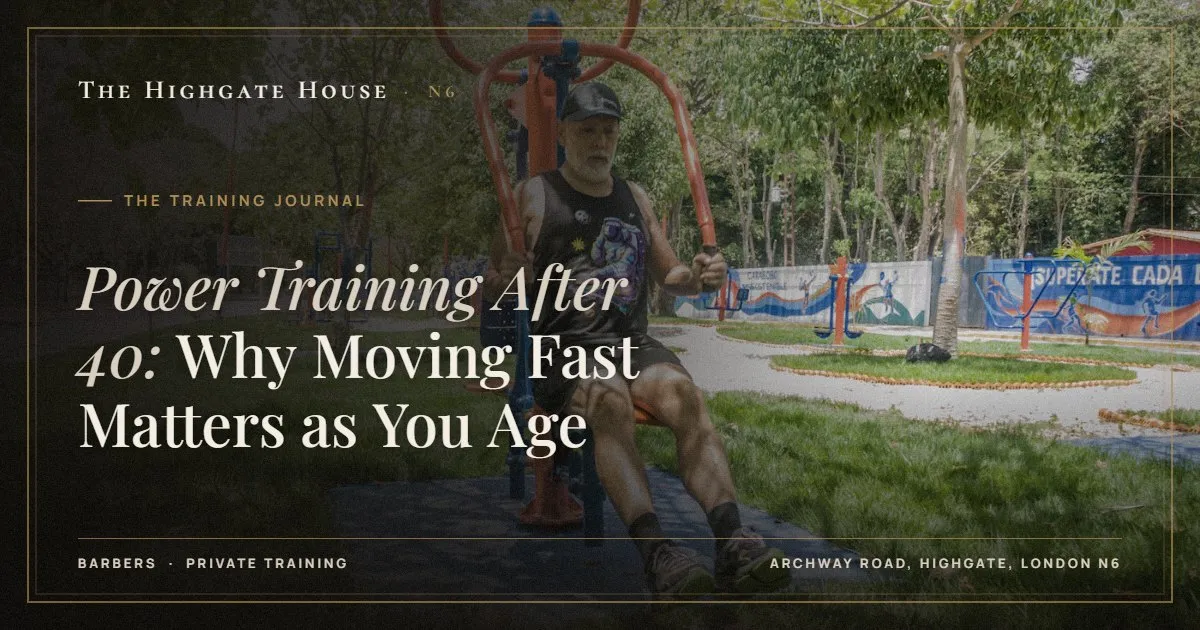
Power Training After 40: Why Moving Fast Matters as You Age
Power is strength applied quickly: how fast you can produce force, not just how much. After 40 it tends to decline sooner and faster than plain strength, and it is power, more than maximal strength, that lets you catch yourself on a wet kerb, climb stairs briskly or get up off the floor without thinking about it. The good news is that it responds to training at any age, and you do not need box jumps or Olympic lifts to train it. Lifting moderate weights with real intent on the way up, plus short, sharp efforts on a bike, covers most of what a busy adult needs.
Strength and power are not the same thing
Strength is the most force you can produce, regardless of time. A slow, grinding deadlift is a strength test. Power is force multiplied by speed. Standing up quickly from a low chair, stepping up onto a high kerb, or throwing a ball are power tasks.
Many people over 40 who already lift weights train strength well but power barely at all. Every rep is slow and controlled, which is good for learning technique and building muscle, but it does not ask the nervous system to fire quickly. Over years, the fastest-contracting muscle fibres get less use, and the ability to move sharply fades even while the numbers on the bar hold steady.
That matters for everyday life. A trip or slip is recovered in a fraction of a second. It is your speed of reaction and force, not how much you could squat slowly, that decides whether you stay upright. Our piece on muscle loss with age explains the broader picture.
What the official guidance says
The UK Chief Medical Officers’ guidance recommends that adults do activities that strengthen the major muscle groups on at least two days a week, and that older adults include activities that improve balance and coordination as well. It does not single out power training by name, but the NHS guidance for older adults stresses strength and balance work to reduce the risk of falls. Power training sits naturally inside that: it is strength work done with intent and speed.
Safe ways to train power without jumping
Jumping and throwing are classic power exercises, but they are not the only way in and not the best starting point for everyone. These options carry far less impact.
1. Lift with intent on the way up
Take a weight you could lift for 10 or 12 reps, and do 5 or 6. Lower it under control over two or three seconds, then drive it up as fast as you can while keeping perfect form. The bar may not actually move quickly; what matters is that you try to. This works for goblet squats, dumbbell presses, cable rows and lat pulldowns.
2. Sit-to-stand with speed
From a box or bench at knee height, stand up as quickly as possible, then sit back down slowly. Three sets of five. Hold dumbbells once bodyweight is easy. It is simple, it mirrors a real-life task, and it is a fair test of leg power.
3. Short sprints on a bike
An air bike or exercise bike lets you produce maximum effort with no impact. Six to eight seconds flat out, then a full minute or more of easy pedalling, repeated four to six times. These are power efforts, not conditioning, so the long rest matters. See our guide to air bike intervals for how this differs from a conditioning session.
4. Cable work with speed
Cable machines allow fast pulling and pressing with a smooth load. A fast cable row or a quick-tempo standing chest press trains the upper body to produce force quickly without a heavy barbell.
5. Low-level hops, later
Once knees, ankles and confidence are good, small hops on the spot or low step-ups done briskly can follow. Build up gradually and skip this entirely if your joints object.
A simple twice-weekly plan
Power work is best done early in a session, when you are fresh. A sample structure:
Order | Exercise | Sets x reps |
|---|---|---|
1 | Fast sit-to-stand | 3 x 5 |
2 | Dumbbell press, fast up, slow down | 3 x 5 |
3 | Main strength lift (squat or hinge) | 3 x 6 to 8 |
4 | Cable row | 3 x 8 to 10 |
5 | Air bike: 6 to 8 second sprints | 4 to 6 efforts, 60 to 90 seconds easy between |
Rest fully between power sets: a minute or two. If reps start slowing noticeably, stop the set. Tired, slow reps train endurance, not power.
Common mistakes
Turning it into cardio. Short rests and high reps feel productive but train something else. Keep efforts short and sharp.
Going too heavy. Power needs speed. Weights you can only grind up slowly are strength work.
Sacrificing control on the way down. Lowering slowly protects joints and keeps the rep honest.
Starting with jumps. If you have not jumped in years, tendons and joints need weeks of preparation first. See our guide to plyometrics for beginners before adding any.
How to tell if it is working
Progress in power is easier to feel than to measure at home. Useful signs: fast sit-to-stands feel snappier and you can add load without slowing down; the bike sprints reach a higher peak output on the monitor; stairs and hills feel less of an effort; and getting up from the floor becomes a single fluid movement. Retest a simple measure every six to eight weeks, such as how many fast sit-to-stands you can complete in 30 seconds with good form.
Who should take extra care
Check with your GP first if you have a heart condition, high blood pressure that is not well controlled, osteoporosis, recent joint surgery or injury, are pregnant, or are coming back after a long break. Fast efforts raise heart rate and blood pressure quickly, so it makes sense to have the all-clear.
How I coach it in the studio
In our private Highgate studio, power work is usually a short block at the start of a session. I watch bar speed and form, and stop sets the moment reps slow down. With clients over 40, the aim is not athletic performance for its own sake. It is keeping the ability to move quickly and confidently in daily life. If you want this built into a programme that also respects old injuries, that is exactly what private personal training is for.
Questions we get asked
Is power training safe after 50?
Yes, for most people, when it starts with low-impact options like fast sit-to-stands and bike sprints, and progresses gradually.
How often should I train power?
Twice a week is plenty for most adults, as a short block within a normal strength session.
Will it help me build muscle?
It complements muscle-building work rather than replacing it. Keep your normal strength training too.
Do I need special equipment?
No. Dumbbells, a cable station and a bike cover it. Our personal training page shows what the studio has.
Book with The Highgate House
Ready to start training properly? Email us at [email protected] with the service and the day that suits you, and we will come back to you with times.
Visit The Highgate House · Private personal training
The Highgate House, Archway Road, Highgate, London N6.
