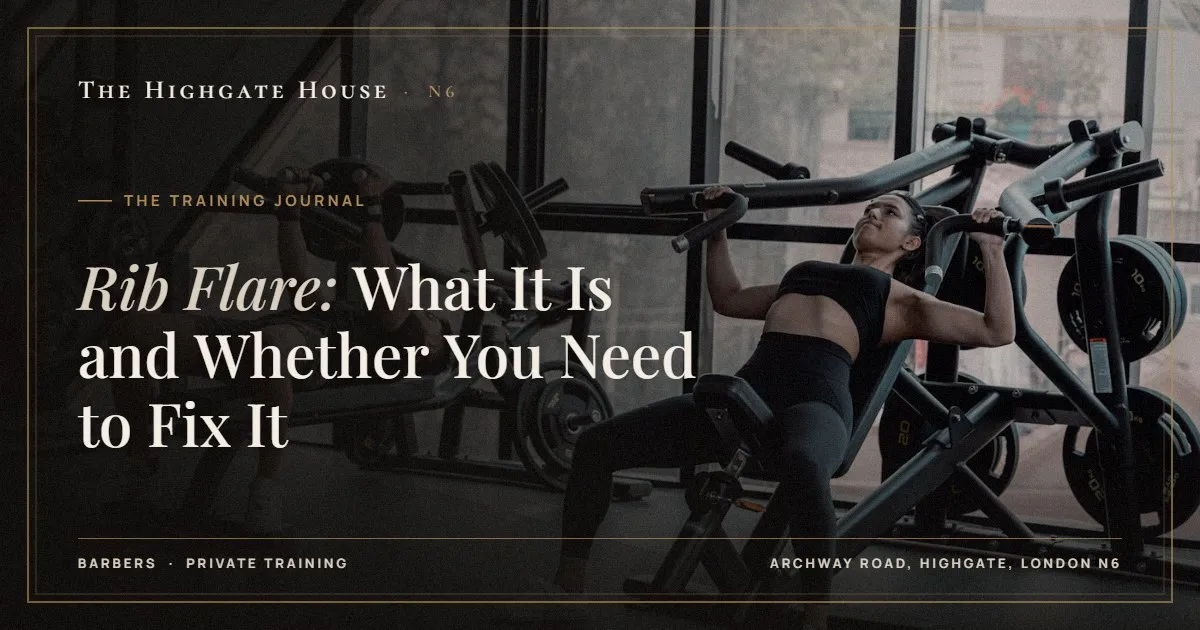
Rib Flare: What It Is and Whether You Need to Fix It
Rib flare is when the bottom of your ribcage lifts and pokes forward, so the lower ribs stand proud of your stomach instead of sitting flat over it. In most adults it is not a structural problem but a position: you arch your lower back and lift the chest, usually to compensate for stiff shoulders or a weak hold on your trunk. It matters most when you lift weights overhead or squat, because a flared ribcage means your spine is taking the load in an arched position. You rarely need to “fix” it in everyday life. You do need to control it under a bar.
What rib flare actually is
Your ribcage is attached to your thoracic spine at the back and, through cartilage, to your breastbone at the front. It moves every time you breathe: up and out on the inhale, down and in on the exhale. A flare is what you see when the ribcage stays in its “inhaled” position, tilted up at the front, even when you are breathing out or standing still.
There are two quite different versions, and they need telling apart.
- Positional flare. The ribs flare when you raise your arms, stand tall, or lie on your back, and they settle when you exhale fully and gently draw your lower ribs down. This is by far the most common and is a habit of movement, not a shape.
- Structural flare. One or both sides of the lower ribcage stick out regardless of position or breathing. This can be how your skeleton developed, sometimes alongside a chest wall difference such as pectus excavatum, or a curve in the spine. Training will not reshape bone.
If one side sticks out noticeably more than the other at rest, or the shape has changed recently, or there is pain, see your GP before you start trying to train it away.
Why it shows up when you lift
The simplest test is to lie on your back, knees bent, and raise both arms over your head towards the floor behind you. If your lower ribs pop up and your lower back lifts off the mat before your arms get there, you have found it. Your shoulders ran out of range, so your spine arched to finish the movement for them.
The same thing happens in the gym:
- Overhead pressing. If the shoulders cannot get the arms fully overhead, people lean back and flare the ribs to get the bar into place.
- Squats. Big breath in, chest up, and the ribcage tilts so far that the lower back arches. Many people were taught “chest up” and overdid it.
- Lat pulldowns and pull-ups. Arching back to bring the bar down turns a back exercise into a partial spinal extension exercise.
None of this is dangerous in isolation. The issue is that repeated loading in an arched position puts more of the work on the joints of the lower back and less on the muscles you meant to train.
Do you need to fix it?
Honest answer: it depends what you want to do. Here is how I think about it with clients.
| Situation | Worth working on? |
|---|---|
| Ribs flare a little when you stand relaxed, no pain, no lifting goals | Not really. Bodies vary and posture is not a fixed score. |
| Ribs flare when you press overhead or squat heavy | Yes. Learn to stack ribs over pelvis before adding load. |
| Lower back aches after overhead work | Yes, and look at shoulder range as well as the ribcage. |
| Flare on one side only, present at rest, not changed by breathing | Check with your GP first. This may be structural. |
| You want a flatter-looking stomach | Limited. It can help how you carry yourself, but it is not a fat-loss method. |
The goal is not a ribcage locked down all day. It is being able to choose the position when it matters. Posture is not a fixed score, and the same logic applies here.
How to bring the ribs down: the drills that work
The fix sits in three places: breathing, trunk control, and shoulder range. You need all three, because if the shoulders cannot get overhead, your spine will keep cheating no matter how strong your core is.
1. Learn the full exhale
Lie on your back, feet flat, knees bent, hands on your lower ribs. Breathe in through the nose for about four seconds and feel the ribs widen sideways into your hands, not just lift up. Breathe out slowly through pursed lips for six to eight seconds, as if blowing through a straw, and let the ribs sink down and in. At the end, pause for two seconds before the next breath. Five breaths is a set. This teaches you what “ribs down” feels like, which most people have genuinely never noticed.
2. Dead bug with a full exhale
Same position, arms reaching to the ceiling, knees lifted to 90 degrees. Exhale fully so your lower back settles towards the mat, then slowly lower one arm and the opposite leg, only as far as you can go without the ribs lifting. Return and switch. This is the drill that transfers most directly to lifting. There is a full guide to the dead bug exercise if you want the progressions.
3. Wall slide with ribs down
Stand with your back to a wall, feet a little forward, and exhale until your lower ribs sit closer to the wall. Slide your forearms up the wall only as far as you can without the ribs leaving it. Most people find their honest overhead range is shorter than they thought. That is useful information, not a failure.
4. Half-kneeling press with a light dumbbell
Kneeling on one knee locks the pelvis in place, which makes it hard to arch to cheat a press. Squeeze the glute of the down leg, exhale, and press a light dumbbell overhead. If the ribs flare, the weight is too heavy or the range too long.
5. Open up the upper back and shoulders
If your thoracic spine is stiff, the lower back does the extending instead. Foam roller extensions and open-book rotations for a few minutes before pressing make a visible difference within a week or two.
How it changes the way you lift
Once you can find the position on the floor, take it into your big lifts:
- Squat. Take your breath into the belly and sides, not just the chest. Think “ribs over hips” rather than “chest up”. Your torso can still lean forward; the point is the ribcage and pelvis staying stacked. Our guide to bracing your core under load covers the breath in detail.
- Overhead press. Squeeze glutes, exhale slightly before you press, and finish with your head through the arms, not your ribs out in front of the bar.
- Pulldowns. Lean back only a little, keep the ribs quiet, and pull the elbows down to your sides. If you have to arch to finish, the weight is too heavy.
How long it takes
The awareness comes quickly. Most people can find a neutral ribcage on the floor in the first session. Holding it under load takes longer: a few weeks of practising it in warm-ups, then keeping the weights moderate while it becomes automatic. Shoulder range improves more slowly if you have spent years at a desk, typically over a couple of months of regular work. The mistake is to see it as a corrective project you finish before “real” training. It works best built into the warm-up and the lifts themselves, which is how I approach it in a private 1-1 session.
Common mistakes
- Crunching to pull the ribs down. Rounding forward is not the answer. You want ribs stacked over the pelvis, not collapsed onto it.
- Holding the position by holding your breath. If you can only keep the ribs down while not breathing, you have not learned it yet.
- Ignoring the shoulders. Core drills alone rarely solve flare during overhead work if the range is missing.
Check with your GP first if you have back pain that spreads into the legs, a recent rib or chest injury, are pregnant or recently postnatal, or notice the shape of your ribcage changing. The NHS has sensible guidance on back pain if that is part of the picture.
Questions we get asked
Can rib flare be fixed permanently?
Positional flare can become a habit you rarely slip into, especially under load. Structural flare is part of your skeleton and will not change with exercise, though stronger trunk muscles can make it less noticeable.
Does rib flare cause back pain?
Not on its own, and plenty of people with flared ribs have no pain. Lifting heavy in an arched position repeatedly can contribute to an irritable lower back, which is why it is worth controlling in the gym.
Is rib flare linked to anterior pelvic tilt?
They often appear together because both come from the same arched pattern, but they are not the same thing. See anterior pelvic tilt for that side of the picture.
Will a coach notice it?
A good one will spot it in the first few reps of an overhead press. Visit The Highgate House, or read more about personal training with Artem in Highgate.
Book with The Highgate House
Ready to start training properly? Email us at [email protected] with the service and the day that suits you, and we will come back to you with times.
Visit The Highgate House · Private personal training
The Highgate House, Archway Road, Highgate, London N6.
