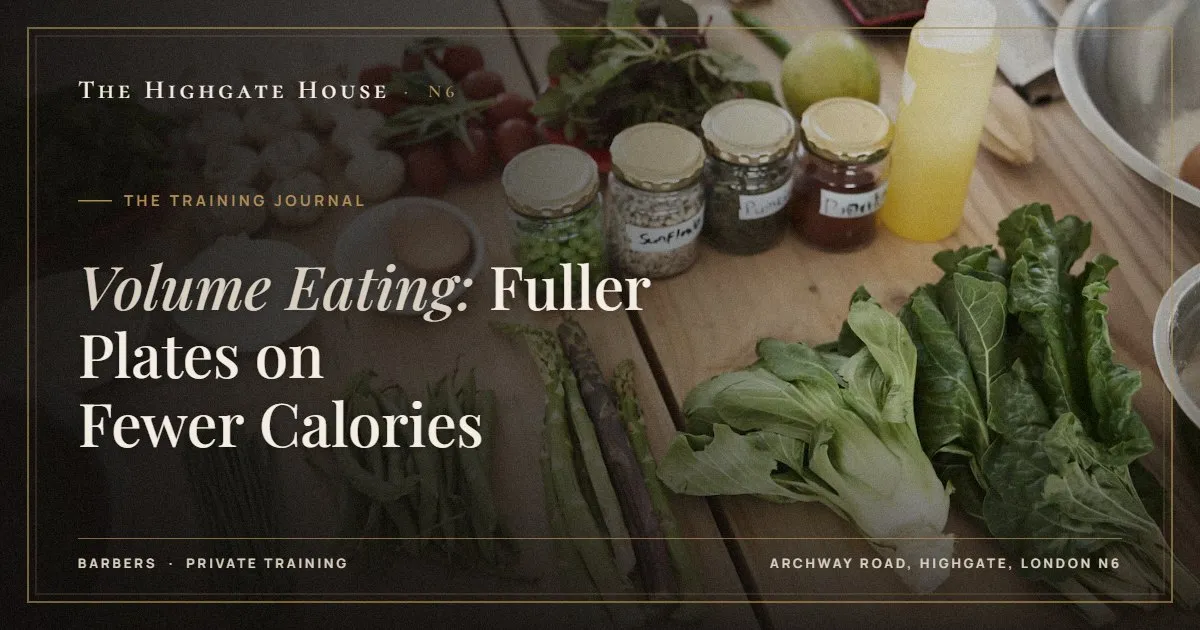
Volume Eating: Fuller Plates on Fewer Calories
Volume eating means building your meals around foods that take up a lot of space for relatively few calories, mostly vegetables, fruit, salad, soups, lean protein and whole grains. Because fullness is driven partly by how much food is in your stomach, a larger plate of lower-calorie food can leave you as satisfied as a smaller plate of richer food. That makes a calorie deficit easier to sustain if you are trying to lose fat. It is not a diet with rules; it is a way of arranging food so that eating less does not feel like eating less. It works best combined with enough protein and a little healthy fat, not as a plate of lettuce.
The idea behind it: energy density
Energy density is the number of calories in a given weight of food. Foods high in water and fibre, such as vegetables, fruit, broth-based soups and potatoes, have a low energy density. Foods high in fat and low in water, such as oils, butter, cheese, nuts, pastries and crisps, have a high energy density.
The practical point: you can eat a large bowl of strawberries for about the same calories as a small handful of nuts. Both are good food. Only one of them fills a bowl.
Fullness is not only about volume. Protein, fibre, how slowly you eat and how much you chew all play a part. But volume is one of the easiest levers to pull, and it is the one most people under-use when they try to lose weight.
How to build a volume plate
A simple structure that works for most main meals:
- Half the plate: vegetables or salad. Cooked or raw, ideally two or three types. Roasted with a light spray of oil, steamed, stir-fried, or as a big salad.
- A quarter: lean protein. Chicken, fish, eggs, lean mince, tofu, Greek yoghurt, beans or lentils. Protein keeps you full and supports muscle while dieting. Our guide to how much protein to eat when losing fat covers amounts.
- A quarter: starchy carbohydrate. Potatoes, rice, pasta, bread or grains. Potatoes and whole grains are particularly filling for their calories.
- A small amount of fat for flavour. A drizzle of olive oil, a little cheese, a few nuts. Enough to make it taste good, measured rather than poured.
This is close to what the NHS Eatwell Guide recommends for a balanced diet anyway, which is a good sign that volume eating is not a gimmick.
Easy swaps that add volume
| Instead of | Try | Why it helps |
|---|---|---|
| A full plate of pasta | Half pasta, half roasted vegetables | Same size plate, noticeably fewer calories |
| Granola with milk | Greek yoghurt, berries and a small sprinkle of granola | More protein, more volume, granola as a topping |
| Crisps as a snack | Air-popped popcorn or crunchy vegetables with houmous | More to eat for the calories |
| A creamy soup | A broth-based vegetable soup with beans or chicken | Very filling, low energy density |
| Two slices of toast with butter | One slice with eggs, tomatoes and mushrooms | More food, more protein |
| A large rice portion in a curry | Smaller rice, more vegetables in the curry | Keeps the meal generous |
Where volume eating goes wrong
Too little protein
A big salad with no protein fills you briefly and leaves you hungry an hour later. Build every meal around a protein source.
Too little fat
Cutting all fat makes food dull and can make it harder to stick to. A small, measured amount keeps meals enjoyable.
A sudden jump in fibre
Doubling your vegetable and bean intake overnight can cause bloating and discomfort. Increase gradually over a couple of weeks and drink enough water.
Treating it as eating unlimited “free” food
Low-calorie foods still have calories. Large portions of fruit, for example, add up. Volume eating makes a deficit easier; it does not remove the need for one.
Hidden calories on top
Dressings, sauces and cooking oils can quietly double the calories of a large salad or tray of roasted vegetables. Measure oil with a spoon rather than pouring.
Ignoring hunger altogether
If you are using volume to suppress real hunger on very low intake, the deficit is probably too large. A moderate deficit with plenty of food is more sustainable.
Who it suits
- People who feel hungry on a diet and struggle with small portions.
- People who eat out or with family and want a simple rule rather than tracking every gram.
- Anyone trying to eat more vegetables and fibre generally.
It suits less well people who struggle to eat enough, such as those trying to gain weight or muscle, older adults with small appetites, or very active people with high energy needs. For them, more energy-dense food is often helpful.
Check with your GP first if you have a digestive condition such as IBS or inflammatory bowel disease, kidney disease, diabetes, or a history of disordered eating. A dietitian can tailor advice where needed.
A sample day
- Breakfast: Greek yoghurt with berries and a sprinkle of oats or granola.
- Lunch: A large salad or vegetable soup with chicken, eggs or beans, plus a slice of wholemeal bread.
- Snack: An apple and a small piece of cheese, or carrot sticks with houmous.
- Dinner: Salmon or lean mince with potatoes and a big portion of roasted or steamed vegetables.
For a practical way to size portions without weighing everything, see our hand method for portion control.
Training and food together
Volume eating makes the food side of fat loss easier. Strength training makes sure the weight you lose is mostly fat rather than muscle. In private 1-1 sessions at The Highgate House we pair a structured strength programme with simple, sustainable nutrition habits like these, and check progress with waist measurements and InBody scans. Our calorie deficit explainer sets out the basics, and the personal training page has details and prices.
Questions we get asked
Is volume eating good for weight loss?
It can be, because it helps you feel full while eating fewer calories. It still depends on an overall calorie deficit.
Do I need to count calories as well?
Not necessarily. Many people use volume eating instead of counting. If progress stalls, a couple of weeks of tracking helps find the gap.
Can I volume eat at restaurants?
Yes. Choose a protein main with vegetables or salad, ask for sauces on the side, and add a vegetable side.
Is fruit too high in sugar for volume eating?
Whole fruit is high in water and fibre and is generally a good volume food. Fruit juice is not; it loses the fibre and volume. If you want a plan that brings food and training together, see 1-1 personal training in Highgate or the homepage.
Book with The Highgate House
Ready to start training properly? Email us at [email protected] with the service and the day that suits you, and we will come back to you with times.
Visit The Highgate House · Private personal training
The Highgate House, Archway Road, Highgate, London N6.
