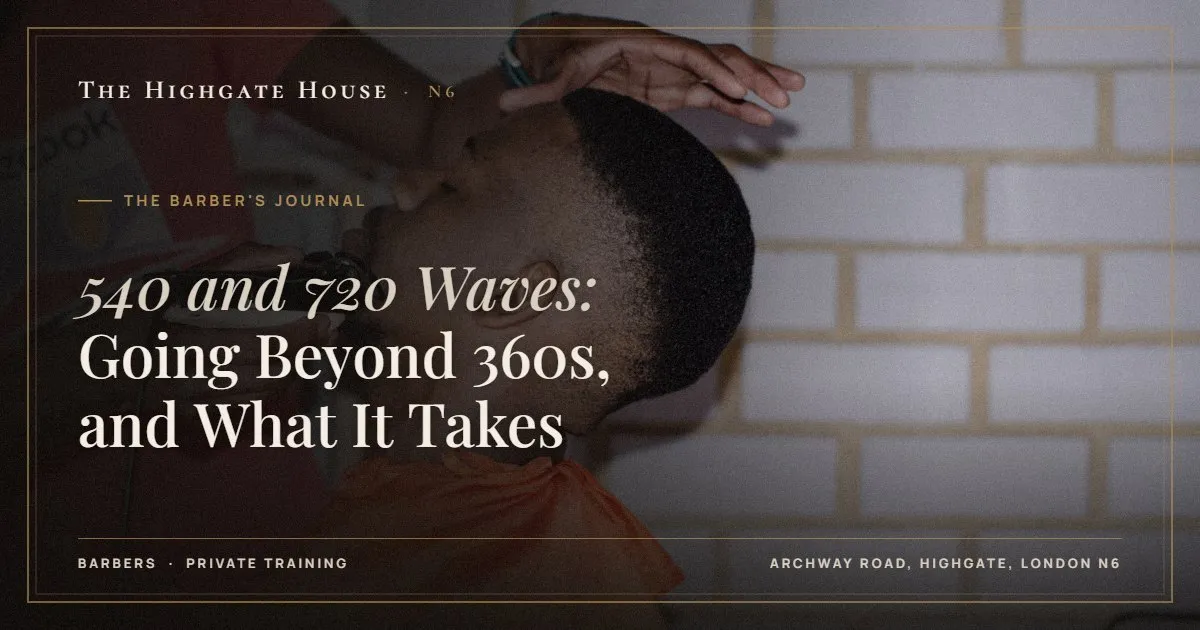
540 and 720 Waves: Going Beyond 360s, and What It Takes
540 and 720 waves are informal names for wave patterns that go further than a standard 360. A 360 is a full circle of waves spiralling out from the crown. A 540 usually means the pattern carries on past that circle into extra layers, typically down the back of the head towards the neck. A 720 generally means two full, connected rotations: so many tight, deep layers that the spiral seems to go round twice. There is no official definition, and people use the terms loosely. What they share is depth, consistency and connection, and that comes from months of disciplined brushing, the right cut and patience through a long grow-out, called wolfing. Hair texture matters too: not everyone’s hair will produce a true 720.
What separates a 360 from a 540 or 720
If you already have 360s, you know the basics: brush from the crown outward in the direction of the pattern, keep the hair moisturised, wear a durag to hold the pattern, and keep the cut short and even. The step up is about three things.
- More layers. Tighter, closer waves mean more ripples in the same space. More ripples make the spiral look as if it goes round further.
- Depth. The waves are more defined, with deeper troughs between crests, which takes longer hair and well-trained curl.
- Connection. The pattern flows cleanly across the whole head, especially the sides and the back, where 360s often break up.
If you are still getting a basic 360 to connect, focus there first. Our guide to 360 waves covers the foundation.
A realistic timeline
| Stage | What is happening | Rough duration |
|---|---|---|
| Connected 360s | Pattern visible all round after a fresh cut | Varies widely; often several months of daily brushing |
| First long wolf | Hair grown out without a cut, brushed daily to deepen | Often four to eight weeks at a time |
| Refining the layers | Repeated cut and wolf cycles; pattern tightens | Many months to a year or more |
| 540 or 720 territory | Deep, tight, connected layers across the whole head | Depends heavily on hair texture and consistency |
These are not promises. Hair with a tight, natural curl tends to wave more readily. Looser textures can still wave, but may not reach the same density of layers.
The brushing routine that gets you there
- Brush every day, in short sessions. Several short sessions spread through the day do more than one marathon. Always follow the pattern, starting at the crown.
- Use the right brush for the stage. Softer brushes for short hair and polishing; medium or hard when the hair is longer and you are training depth. The breakdown is in wave brush types.
- Brush when hair is damp. Many wavers brush after a wash or a light mist of water, then cover with a durag to set.
- Keep it moisturised. Dry hair breaks. Use a light moisturiser or pomade without heavy build-up.
- Wear a durag at night. It holds the pattern in place as you sleep. Tie it firmly but not tight enough to leave a line or cause discomfort. See how to wear a durag.
- Be consistent. Missing a few days during a wolf can set you back.
Wolfing for depth
Wolfing means letting the hair grow without a cut while you keep brushing. Longer hair lets the curl form deeper waves. When you cut it, the trained pattern stays and looks sharper.
- Plan your wolfs. Many wavers wolf for four to six weeks, then cut, then repeat.
- Do not cut too short after a wolf. Taking it all back to a very low grade wipes out much of the depth.
- Expect awkward stages. Around week three or four, hair can look untidy. Keep the neckline and edges tidy to stay presentable.
The cut
The barber’s job is the cut, not the waves. What matters for advanced waves is an even length on top, a cut that follows the direction of your pattern rather than fighting it, and a taper or fade at the sides and back that does not chop into the layers. Ask for the clipper to follow the grain and keep enough length to show depth.
At Highgate Cuts on Archway Road, every visit starts with an assessment: the barber looks at your hair, the pattern and what you want, then makes recommendations on length and how to finish the sides. Bring a recent photo of the waves at their best if you have one. Prices are not published yet: see the barber menu or email us.
Common mistakes
- Brushing against the pattern. It confuses the curl and breaks up layers.
- Over-brushing with a hard brush on short hair. It can irritate the scalp and damage edges.
- Tying the durag too tight. Heavy, constant tension on the hairline is something to avoid; the NHS lists hair being pulled by tight styles as one cause of hair loss.
- Chasing the label. A neat, connected 360 with good depth looks better than a patchy attempt at a 720.
- Too much product. Heavy greases build up, attract dust and can clog the scalp.
- Cutting right after a wolf with a very short guard. Agree length with the barber first.
Is it worth the effort?
For people who enjoy the discipline, yes. Waves reward consistency in a way few other styles do, and the progress is visible. But it is a commitment of months, not weeks, and your hair texture sets the ceiling. If you mainly want a sharp, low-maintenance short cut, a good 360 or a simple even crop with a clean taper will serve you well.
Questions we get asked
What is the difference between 540 and 720 waves?
Informally, a 540 carries the pattern past a full circle into extra layers, while a 720 has enough tight, deep layers to look like two full rotations. People use the terms loosely.
Can anyone get 720 waves?
Not everyone. Hair texture, curl tightness and density all play a part. Consistent brushing improves any wave pattern, but the ceiling varies.
How long should I wolf for?
Many people wolf for four to six weeks at a time. Longer wolfs can deepen waves but get harder to keep neat.
Does a fade help or hurt waves?
A low or mid taper can frame waves well. A high skin fade removes the hair on the sides where part of the pattern sits, so it shows fewer layers.
For a cut that respects your pattern, see the barber services in Highgate, or start at the homepage.
Book with The Highgate House
Ready for a proper cut? Email us at [email protected] with the service and the day that suits you, and we will come back to you with times.
Visit The Highgate House · The barbers
The Highgate House, Archway Road, Highgate, London N6.
