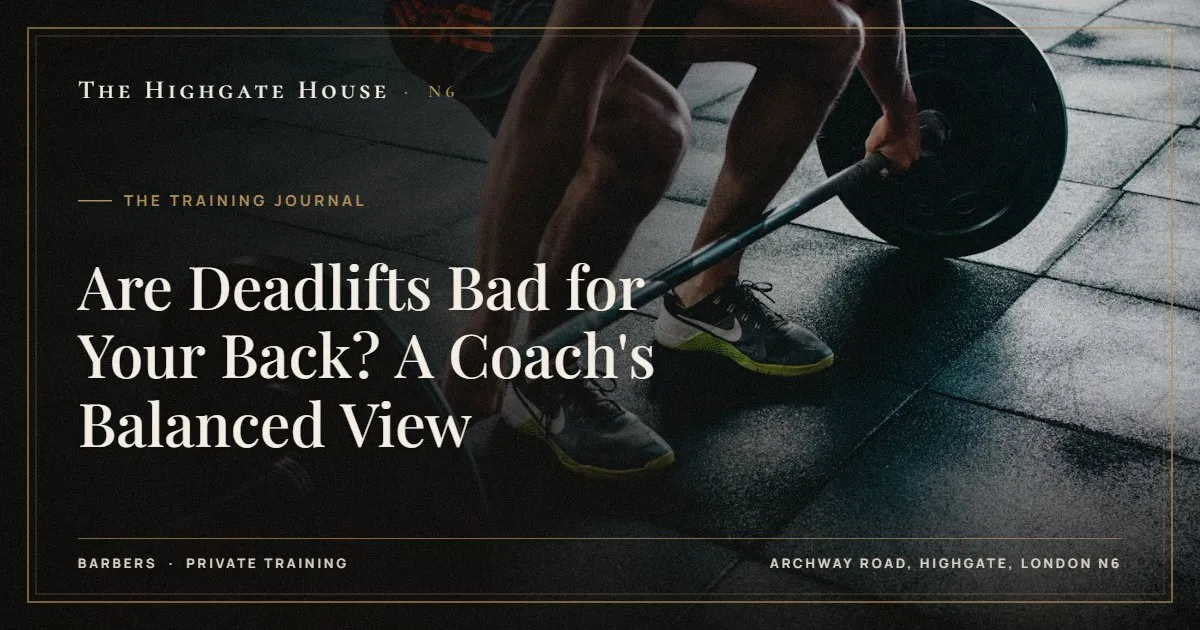
Are Deadlifts Bad for Your Back? A Coach's Balanced View
No, deadlifts are not bad for your back. Picking a weight up from the floor is something your back is built to do, and training it gradually tends to make the muscles of the hips, trunk and spine stronger and more tolerant of everyday load. What causes trouble is rarely the exercise itself. It is usually too much weight too soon, a setup that does not suit the person’s body, or doing heavy sets while tired and distracted. Handled sensibly, the deadlift is one of the more useful lifts a desk-bound adult can learn. Handled carelessly, any lift can hurt.
Below is how I think about the lift when someone tells me in their first session that they have “always been told deadlifts wreck your back”.
Where the reputation comes from
The deadlift looks risky because the load is in your hands and your spine sits between it and the floor. People also remember a friend who “did his back” at the gym, and the deadlift is an easy suspect. Two things get lost in that story.
First, backs get sore and stiff for lots of reasons, most of them unrelated to the gym. The NHS guidance on back pain notes that it is very common, usually improves within weeks, and that staying active is generally better than resting. A twinge that turns up after a deadlift session may have more to do with a long week of sitting, poor sleep and stress than the lift.
Second, the people who do get hurt deadlifting are often the ones who skipped the learning stage. They loaded the bar on day one, chased a number, or kept grinding reps after their form had clearly gone. That is a programming problem, not a deadlift problem.
What the lift actually asks of your back
In a well-performed deadlift the back’s main job is to hold position while the hips and legs do the moving. The muscles along the spine work hard to keep it steady, which is exactly why the lift builds a robust trunk. The work is mostly isometric: holding, not bending and straightening under load.
A small amount of rounding, particularly in the upper back, is normal and not dangerous in itself. What we try to avoid is the lower back rounding progressively as the bar leaves the floor, because that means the back is now moving under load rather than holding. Light weights forgive this. Heavy weights do not.
The real causes of deadlift back trouble
- Load that outruns skill. Most people can pull more than they can control well within a few weeks. Strength arrives faster than technique, so the bar gets heavy before the pattern is grooved.
- A poor start position. Bar too far from the shins, hips shooting up first, chest collapsing. The back ends up doing the lifting the legs should be doing.
- Losing tension before the pull. Yanking the bar off the floor instead of pulling the slack out first makes the spine absorb a jolt.
- Too many hard sets. Fatigue erodes form. A set of three heavy reps done well is better than a set of ten that falls apart after six.
- Ignoring warning signs. Sharp pain, pain that travels down the leg, or pain that gets worse rep by rep is a reason to stop, not push.
Who should hold off, or check with a GP first
Most healthy adults can learn a deadlift safely. Check with your GP or a physiotherapist before you start if you have had a recent back injury, pain that spreads into the leg or causes numbness or tingling, a diagnosed disc or spinal condition, a heart condition or uncontrolled high blood pressure, you are pregnant, or you are returning to training after a long break or surgery. None of these automatically rules the lift out. They just mean the plan should be agreed with someone who knows your history.
How a coach makes the deadlift safe
When I teach the lift in the studio, the barbell often does not come out in the first session at all. The order looks roughly like this:
- Teach the hinge. Push the hips back with a neutral spine and soft knees. Our guide to the hip hinge covers the drills I use, including a dowel along the back.
- Load the hinge lightly. A cable pull-through or a dumbbell Romanian deadlift lets you feel hamstrings and glutes working without a barbell on the floor.
- Raise the bar. Many people start pulling from blocks or plates so the bar sits higher. This shortens the range while you learn to keep tension.
- Pull from the floor, light. Only once the hinge is consistent. The first weeks are about identical reps, not heavier ones.
- Progress in small steps. Add weight only when the last rep looks like the first. If it does not, the weight stays where it is.
The step-by-step technique itself is in our guide to deadlifting properly. The point here is the order: pattern first, then load.
Choosing the right deadlift for your body
There is no single correct deadlift. Long legs and a short torso, tight hips, a history of back stiffness: all of these change which version suits you.
| Variation | Why it helps | Good for |
|---|---|---|
| Trap bar deadlift | Load sits beside you, torso more upright | Beginners, anyone wary of their lower back (if a trap bar is available) |
| Romanian deadlift | Starts from standing, no pull off the floor | Learning the hinge, hamstring strength |
| Block or rack pull | Shorter range, easier start position | Tight hips, longer limbs |
| Sumo deadlift | Wider stance, more upright back | Some builds, especially long torsos |
| Conventional deadlift | The classic pattern, most transferable | Once the hinge is solid |
The studio has a barbell, plates and a dumbbell rack, which covers the Romanian, conventional and raised-bar versions well. The cable station handles pull-throughs.
What a sensible deadlift week looks like
For a busy adult training two or three times a week, one hinge-focused session per week is usually plenty, with lighter hinge work elsewhere. Heavy deadlifts are demanding on recovery, so I rarely programme them hard more than once a week for clients over 30. Typical working sets are low in reps, in the three to six range, with one or two reps left in reserve. The heaviest set should never look like a struggle to survive.
Pairing the deadlift with trunk work helps. Dead bugs, side planks and Pallof presses build the control that keeps the spine steady under the bar. So does learning to brace properly before each rep.
Signs your deadlift needs fixing
- You feel it mostly in your lower back the next day, rather than hamstrings and glutes.
- Your hips rise before the bar moves.
- The bar drifts forward away from your legs.
- You hold your breath and go red but cannot say where the effort was.
- Each rep looks different from the last.
Any of these is a reason to drop the load and film a set, or to have a coach watch. In private 1-1 training in Highgate this is the bulk of the job: watching every rep, adjusting position, and deciding when the weight goes up.
Questions we get asked
I have lower back stiffness. Should I avoid deadlifts completely?
Not necessarily. Many people with general stiffness feel better with gradual hinge training. Get any new, severe or spreading pain checked by your GP first, then start with light, pain-free variations and build from there.
Should I wear a lifting belt?
Not while learning. A belt helps experienced lifters brace against heavy loads, but it does not fix poor positions. Learn to brace without one first.
How long before I can deadlift a barbell from the floor?
It varies. Some people are ready within a few sessions, others need several weeks of hinge work. Consistency of position decides it, not the calendar.
Is it normal to feel sore after deadlifts?
Some muscle soreness in the hamstrings and glutes a day or two later is normal. Sharp pain during the lift, or pain down the leg, is not. Stop and get it checked.
If you want someone to teach the lift properly, the personal training page explains how sessions work and lists current prices.
Book with The Highgate House
Ready to start training properly? Email us at [email protected] with the service and the day that suits you, and we will come back to you with times.
Visit The Highgate House · Private personal training
The Highgate House, Archway Road, Highgate, London N6.
