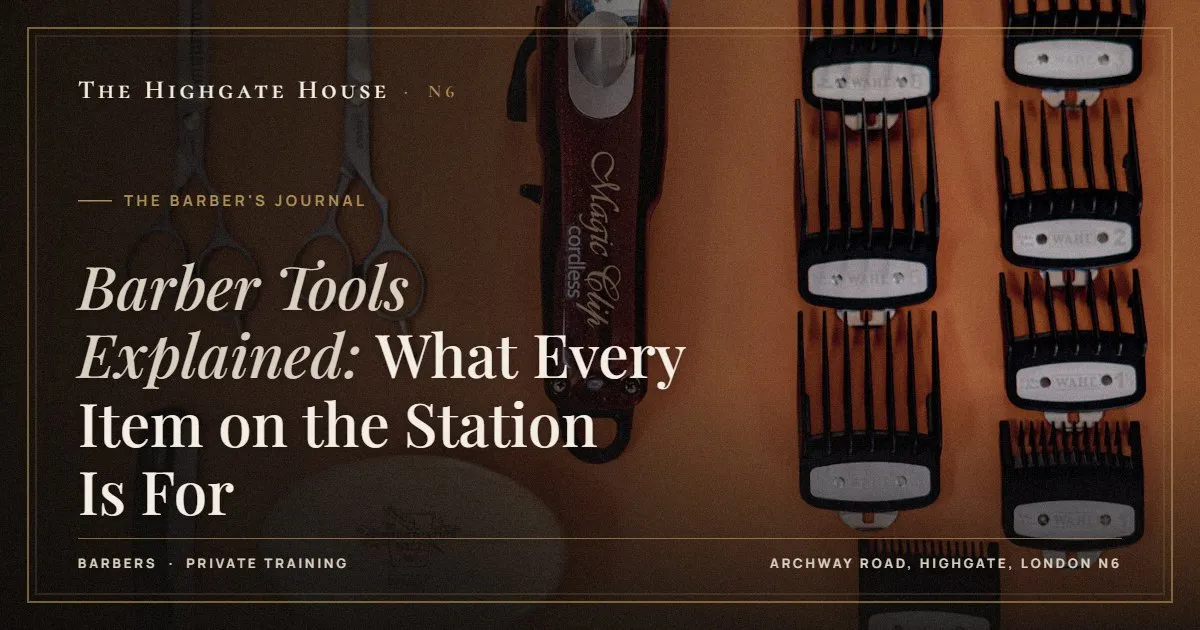
Barber Tools Explained: What Every Item on the Station Is For
A barber’s station usually holds four families of tools: clippers and trimmers for cutting with a motor, scissors and combs for cutting by hand, razors for shaving and outlining, and finishing kit such as brushes, sprays and powder. Each has a specific job. Clippers remove bulk and build fades, trimmers draw lines, scissors shape longer hair, razors take hair to skin, and the rest keeps the cut clean and comfortable. Knowing what each one does helps you understand what is happening behind your head, and what to ask for.
Here is the station, item by item, in roughly the order you would meet each tool during a cut.
The quick reference
| Tool | Main job |
|---|---|
| Clippers | Bulk removal, guard lengths, fades |
| Clipper guards | Set an even length for the sides and back |
| Trimmer (edger) | Outlines, necklines, around the ears, beard edges |
| Foil shaver | Taking a fade’s base to skin |
| Cutting scissors | Shaping the top and longer lengths |
| Thinning or texturising scissors | Removing weight, softening lines |
| Combs | Sectioning, lifting hair, guiding clippers or scissors |
| Shavette or straight razor | Shaves, neck cleanup, crisp lines |
| Neck duster and powder | Removing clippings at the end |
| Spray bottle | Dampening hair for scissor work |
Clippers and guards
Clippers are the workhorse of a barber shop. A motor drives a cutting blade across a fixed blade, shearing hair caught between the teeth. Most have a lever on the side that fine-tunes length between guard sizes.
Guards are the plastic attachments that clip over the blade and hold it a set distance from your scalp. The numbers roughly correspond to eighths of an inch, so a number two leaves about a quarter of an inch. Our guide to clipper guard numbers explains each size.
Many barbers keep more than one clipper set up: one for bulk, and one adjusted to cut very close for the base of fades. That second machine is often “zero gapped”, with its blades set to cut as close as possible.
Trimmers and edgers
A trimmer is a smaller machine with a narrower, finer blade. It cuts close and is precise, so it is used for the outline around the ears and temples, the neckline, beard lines and hair designs. It is not designed for removing bulk. If you buy only one tool for home, the difference matters: see clippers vs trimmers.
The foil shaver
An electric foil shaver, like a home shaver, appears at the end of a skin fade. After the clippers, it removes the last stubble at the base so the fade truly starts at skin. It is gentler than a razor for that job.
Scissors
Cutting scissors (shears)
Used for everything that is too long for clippers: the top of most cuts, longer styles, fringes, and refining shape. Barbers often use a technique called scissor over comb to blend the sides into the top, lifting hair with the comb and cutting what sits above it.
Thinning and texturising scissors
These have teeth on one or both blades, so they cut only some of the hair in each snip. They remove weight from thick hair, soften harsh lines and add texture so the hair moves naturally. Overused, they can leave hair frizzy or flat, so good barbers use them sparingly.
Combs and brushes
- Cutting comb: fine teeth on one end and wider teeth on the other. Used for sectioning and to hold hair for scissor work.
- Clipper-over-comb or tapered comb: thinner at one end, so the barber can cut close to the head when blending.
- Wide-tooth comb: for detangling and curly hair.
- Fade brush: a stiff brush that lifts short hair against the grain and reveals any lines in a fade.
- Neck duster: a soft brush for sweeping clippings from the skin, usually with a little powder.
Razors
Most barbers today use a shavette: a straight razor body that takes a disposable blade, changed for each client. It is used for hot towel shaves, neck cleanups, sharp hairlines and beard lines. A traditional straight razor with a fixed blade is less common in shops because it has to be honed, stropped and sterilised. Our comparison of shavettes and straight razors covers the differences.
Finishing and comfort kit
- Cape and neck strip: a fresh paper strip goes round your neck for each client, under the cape, to keep clippings off your collar.
- Spray bottle: water to dampen hair before scissor work, for an even cut.
- Sectioning clips: hold hair out of the way on longer cuts.
- Hairdryer: for styling, and a cool blast to clear loose clippings.
- Hot towels and lather: for shaves. Warm towels soften the hair and open up the skin before the razor.
- Products: clay, paste, pomade, sea salt spray or powder, chosen for your hair and the finish you want.
- Hand mirror: to show you the back before you leave.
Cleaning and maintenance tools
Behind the scenes, a well-run shop also has:
- Disinfectant for combs and tools between clients.
- Clipper spray that cleans, cools and lubricates blades.
- Clipper oil for regular blade maintenance.
- A small brush to remove hair from clipper teeth.
- A sharps bin for used razor blades.
A clean, organised station is one of the simplest signs of a careful barber. Our guide on barber hygiene lists what to look for.
What a typical cut looks like, tool by tool
- Assessment: the barber looks at your hair and what you need, then makes recommendations.
- Cape and neck strip on.
- Clippers with guards to set the sides and back.
- Closer clipper, trimmer and foil shaver to build any fade.
- Spray, comb and scissors for the top.
- Thinning scissors if the hair needs weight removed.
- Trimmer and razor for outline and neckline.
- Neck duster, then product and styling.
A hot towel shave uses fewer tools but more time: towels, lather, a shavette and a balm, over 20 to 30 minutes.
Questions we get asked
What is the most important barber tool?
It depends on the cut. For fades, the clippers. For longer styles, the scissors. The skill matters more than any single tool.
Why does my barber switch clippers during a fade?
Different machines are set up for different jobs: one for bulk, one cutting closer for the base.
Are razors reused between clients?
The razor handle is cleaned and disinfected; the blade itself should be fresh for each client.
Can I buy the same tools for home?
Yes, but home cuts are best kept to maintenance. A trimmer for the neckline is the most useful starting point.
To see the full range of services, visit the Highgate Cuts barber page or The Highgate House. For general hygiene standards in personal care businesses, see the Health and Safety Executive. When you are ready, the barbers on Archway Road are about five minutes from Highgate station.
Book with The Highgate House
Ready for a proper cut? Email us at [email protected] with the service and the day that suits you, and we will come back to you with times.
Visit The Highgate House · The barbers
The Highgate House, Archway Road, Highgate, London N6.
