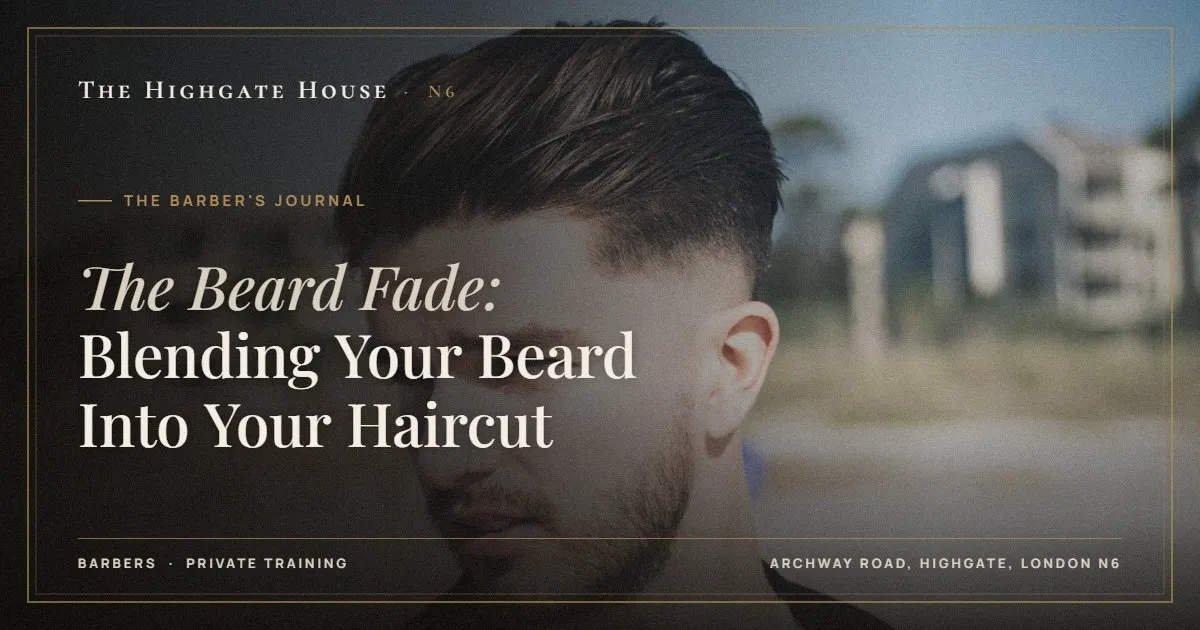
The Beard Fade: Blending Your Beard Into Your Haircut
A beard fade is the graduated blend that joins your haircut to your beard, so the short hair at the temple flows down through the sideburn and gradually gets longer into the cheek and jaw. Without it, a faded haircut and a full beard look like two separate decisions, with a visible step at the sideburn. The work happens across a band roughly from the top of the ear to the cheekbone. It is done with clippers and trimmers, takes a little extra time on top of the haircut, and stays clean for one to two weeks before the join starts to soften.
Why the join matters more than the beard
Most men spend their attention on the beard shape: the neckline, the cheek line, how full the chin is. Those matter, and we have covered them in our guide to the right beard shape for your face. But the part people actually notice from a distance is the side profile, and there the sideburn is doing the work.
If you have a mid or high fade and a beard at, say, a centimetre long, there is a gap of a centimetre of length between the bottom of the haircut and the top of the beard. Leave that untreated and you get one of three faults:
- A shelf: a hard line where short hair stops and the beard begins.
- A disconnect: a shaved sideburn with nothing linking hair and beard. Sometimes deliberate, usually not.
- A heavy sideburn: the beard length carried too high, so the side of the head looks bulky against the faded hair above.
A beard fade removes all three. The goal is one continuous gradient from the shortest point of the haircut to the fullest point of the beard.
How a barber builds a beard fade
The method varies by barber, but the sequence is broadly the same. Knowing it helps you understand why it takes the time it does.
- Assessment. Every visit at Highgate Cuts starts with the barber looking at your hair and beard and making recommendations. For a beard fade, the questions are how long the beard is now, how long you want it, where the hair grows densely and where it thins, and how high your haircut fade sits.
- Haircut first. The fade on the head is usually cut first, because it sets the starting point for the blend.
- Bulk off the beard. The beard is taken down to its finished length with a clipper guard, so the barber is blending into the right length.
- The bridge. Working down from the temple, the barber steps through progressively longer settings across the sideburn. Opening and closing the clipper lever gives the half-steps in between. This is the fade itself, typically across three to four centimetres of sideburn.
- Cheek and jaw. The blend continues onto the upper cheek so the top of the beard is slightly shorter than the jaw. This keeps the face from looking boxy.
- Edges. Finally the cheek line and neckline are set. Some men want them crisp, some want them left natural.
Where the transition should sit
The height of the blend should follow the height of your haircut fade. A practical rule:
| Haircut | Where the beard fade usually starts | Notes |
|---|---|---|
| Low fade or taper | Lower sideburn, near the ear lobe | Short, subtle bridge. Suits fuller beards. |
| Mid fade | Middle of the sideburn | The most common pairing. |
| High or skin fade | Top of the sideburn, near the temple | Longest bridge, most contrast. |
| Scissor cut, no fade | Often no fade needed | A tapered sideburn may be enough. |
If you are still choosing the haircut, our post on the mid fade covers who suits which height.
Beard length and density: what works
A beard fade works on almost any beard longer than heavy stubble, but the result varies.
- Stubble to 5 mm: there is very little length to blend. The fade is short and subtle, mostly about the sideburn not looking heavier than the beard.
- Short boxed beard (around 1 to 2 cm): the ideal length for a visible, clean fade. Most men asking for a beard fade are here.
- Longer beards: the fade usually sits only in the upper sideburn, with the beard below shaped by scissors. A long beard can look odd if the fade is carried too low.
- Patchy cheeks: a beard fade can help, because taking the upper cheek shorter disguises sparse areas. It will not create density that is not there. Our post on the patchy beard covers what can and cannot be done.
- Grey coming through: grey hair is often coarser and can look wiry at the join. Slightly shorter sideburns can tidy that up.
Keeping it clean between visits
The fade on the head and the beard grow at similar speeds, so the blend loosens evenly rather than breaking all at once. The first thing to go is usually the haircut side, which softens while the beard keeps its shape. After one to two weeks the join is less defined. After three, it looks like a normal beard and haircut again.
What you can sensibly do at home:
- Keep the beard at the same length with a trimmer guard, set to whatever the barber used. Ask for the number before you leave.
- Tidy the neckline and stray hairs below it. If the neckline itself needs resetting, that is a quick job for our barbers in Highgate.
- Brush or comb the beard down and slightly back each morning, so the hair at the sideburn lies in the direction of the blend.
- Use a light beard oil or balm if the hair is dry or wiry, and wash the beard regularly.
What to leave alone: the sideburn itself. Trying to re-create the graduated bridge with a home trimmer in a bathroom mirror nearly always leaves a step or takes the sideburn too short. If the fade is the part you care about, a short tidy visit is a better answer than a DIY attempt.
Skin irritation at the sideburn
Close clipper work on the face can irritate the skin, especially on men who get razor bumps or ingrown hairs. If you know this happens to you, say so at the start. The barber can stop the bridge at a very short clipper length rather than going to skin, and avoid going against the grain on the cheek. The NHS has useful general advice on ingrown hairs, including when a persistent problem is worth showing to a GP or pharmacist.
Booking a beard fade
When you email, ask for a haircut and beard together rather than a haircut on its own, so enough time is set aside to build the blend properly. You can see the services on our Highgate barber page. If you are combining it with a hot towel finish, allow longer again: a hot towel shave on its own takes 20 to 30 minutes.
Arrive with the beard at least at the length you want to keep. Barbers can take length off, but they cannot add it, and blending into a beard that is too short leaves very little room for the gradient.
Questions we get asked
Can I get a beard fade without a faded haircut?
Yes. With a scissor cut or longer sides, the barber tapers the sideburn so it narrows into the beard. It is less dramatic, but it still removes the shelf.
How long should my beard be for a beard fade?
At least a few millimetres more than the shortest point of your haircut, and ideally around a centimetre or more. Below that there is not much length to blend.
Does a beard fade make my face look slimmer?
It often makes the upper face look less wide, because the bulk at the sideburns and upper cheeks is reduced while the jaw keeps its length. How much depends on your face and beard.
How often should I have it redone?
Most men rebook every two to three weeks, usually at the same time as their haircut.
Book with The Highgate House
Ready for a proper cut? Email us at [email protected] with the service and the day that suits you, and we will come back to you with times.
Visit The Highgate House · The barbers
The Highgate House, Archway Road, Highgate, London N6.
