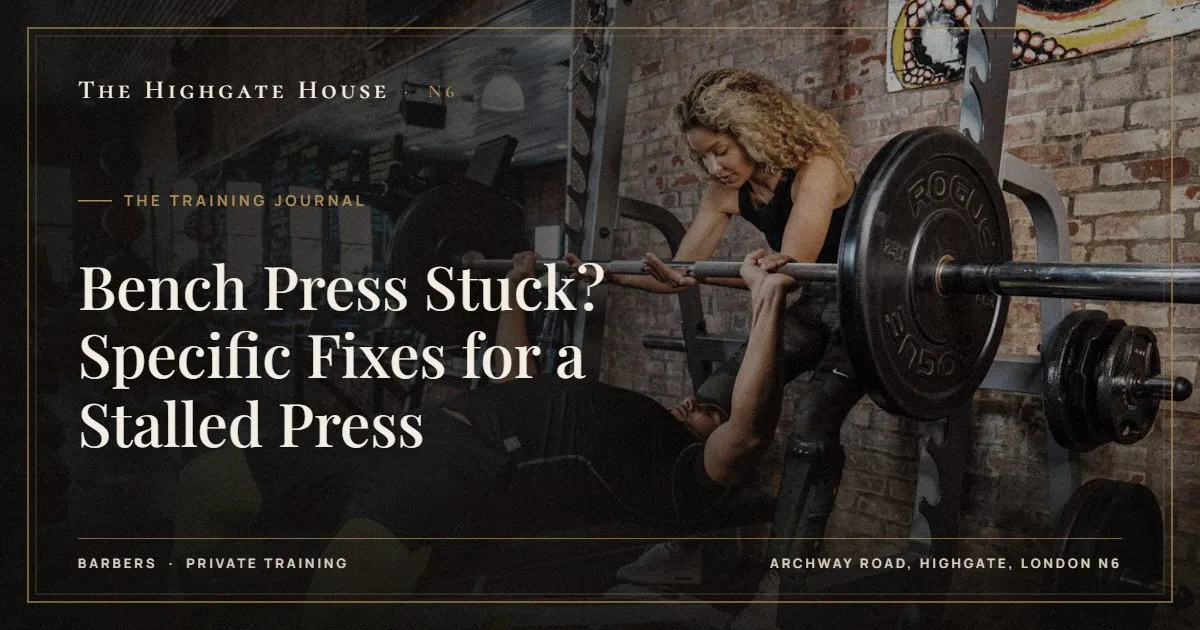
Bench Press Stuck? Specific Fixes for a Stalled Press
A stalled bench press usually has a specific cause you can find. Watch where the bar slows down: if it stalls just off the chest, you need more strength in the bottom position and a tighter setup; if it stalls halfway up or near lockout, your triceps are usually the weak link. The general fixes are the same for most people: tighten your setup, bench more often with less fatigue per session, use small weight jumps, and add one targeted variation for your sticking point. Most stalls start moving again within four to six weeks once you stop repeating the same heavy sets that stopped working.
First, rule out the obvious
Before changing the programme, check three things that quietly stall a lot of benches:
- Technique has drifted. Film a set from the side. If your shoulder blades are not pinned or the bar path wanders, fix that first. Our guide to bench press form covers the full setup.
- You are testing, not training. Going for a heavy single or a max set of five every week is a test. Tests do not build strength on their own.
- Weight jumps are too big. Going from 60 to 62.5 kg is a jump of about 4 percent. Asking for that every week on an upper-body lift is optimistic. Smaller plates, or adding a rep before adding weight, keeps progress moving.
Find your sticking point
Do a set of three at a weight that feels hard. Film it from the side and watch where the bar slows.
| Where it stalls | Usual cause | Variation that helps |
|---|---|---|
| Off the chest | Losing tightness at the bottom, weaker chest in the stretched position | Paused bench press, two-second pause on the chest |
| Halfway up | Transition from chest to triceps; elbows flaring early | Close-grip bench press; dumbbell press |
| Near lockout | Triceps strength | Close-grip bench, floor press, overhead triceps work |
| Bar drifts toward the face or feet | Inconsistent bar path | Lighter technique sets, tempo work |
The close-grip bench press is the single most useful accessory for most stalled presses, because it trains the same pattern with more triceps involvement.
Setup fixes that add kilos without more strength
- Feet. Plant them firmly and drive through the floor. Many people let their feet float, which leaks force.
- Upper back. Squeeze the shoulder blades together and down before unracking, and keep them there.
- Grip. Grip the bar hard, wrists stacked over the forearms rather than bent back.
- Breath. Take a big breath and hold it on the way down, so your chest stays high.
- Touch point. Lower to the lower part of the breastbone, with elbows tucked to roughly 45 to 70 degrees.
These sound basic. In practice, tightening them often adds a few kilos within a couple of weeks because more of your existing strength reaches the bar.
Change the structure of your week
If you bench once a week, heavy, the simplest change is to bench twice, with different emphases:
- Day 1, heavier: 4 sets of 4 to 6 reps, finishing each set with one or two reps left in reserve.
- Day 2, lighter and longer: paused bench or close-grip bench, 3 or 4 sets of 8 to 10.
Training a lift more often, with less fatigue each time, gives you more practice and more total weekly volume. Stopping a rep or two short of failure on most sets lets you recover for the next session. Our piece on reps in reserve explains how to judge that.
A four-week restart plan
This assumes you bench twice a week. Use a weight you can comfortably lift for 8 reps as your starting point for week 1.
- Week 1: Day 1: 4 x 6 at that weight. Day 2: 3 x 8 paused bench, lighter.
- Week 2: Day 1: add 1 to 2.5 kg, 4 x 6. Day 2: add a set or a little weight to the paused bench.
- Week 3: Day 1: add another small jump, 4 x 5. Day 2: close-grip bench, 3 x 8.
- Week 4: Lighter week. Day 1: 3 x 5 at week 1’s weight. Day 2: technique sets only.
Then retest a heavy set of three or five in week 5. If you are still stuck, the problem is probably outside the bench itself: food, sleep, total stress or body weight changes. Our deload week guide goes deeper on planning lighter weeks.
Supporting work that matters
- Rows and pulldowns: a strong upper back gives a stable base, and balancing pressing with pulling is kind to the shoulders.
- Triceps: cable pushdowns and overhead extensions, two or three sets, twice a week.
- Overhead pressing: builds shoulder strength that carries over to the bench.
The less obvious causes
You are losing weight. Upper-body strength often stalls in a calorie deficit. That is normal. Holding your bench while you lose weight is progress.
Sleep and stress. A run of short nights will flatten your strength. It usually returns when sleep does.
Niggling shoulders. If the front of the shoulder aches, address that first rather than pushing through. Check with your GP or a physiotherapist if you have pain at rest, sharp pain or weakness, and check with your GP before heavy lifting if you have a heart condition or high blood pressure.
Coaching a stalled press
A stalled bench is one of the most common reasons people book a session with me. Often the answer is in the first set: a setup detail or the wrong weekly structure. In 1-1 coaching in Highgate, we film the lift, find the sticking point and build a short block around it, in a private studio with nobody waiting for the rack. You can see how sessions are structured, and the prices, on the personal training page, or read more about The Highgate House.
Questions we get asked
How long can a bench press plateau last?
As long as the training stays the same. With a targeted change, most people see movement within four to six weeks.
Should I train to failure to break a plateau?
Not on heavy sets. Stopping a rep or two short lets you train the lift more often and recover between sessions.
Is it worth buying micro plates?
For the bench press, yes. Small increments make steady progress far easier on upper-body lifts.
Can dumbbells help my barbell bench?
Yes. Dumbbell pressing builds the chest and shoulders through a slightly different path and often carries over well.
Book with The Highgate House
Ready to start training properly? Email us at [email protected] with the service and the day that suits you, and we will come back to you with times.
Visit The Highgate House · Private personal training
The Highgate House, Archway Road, Highgate, London N6.
