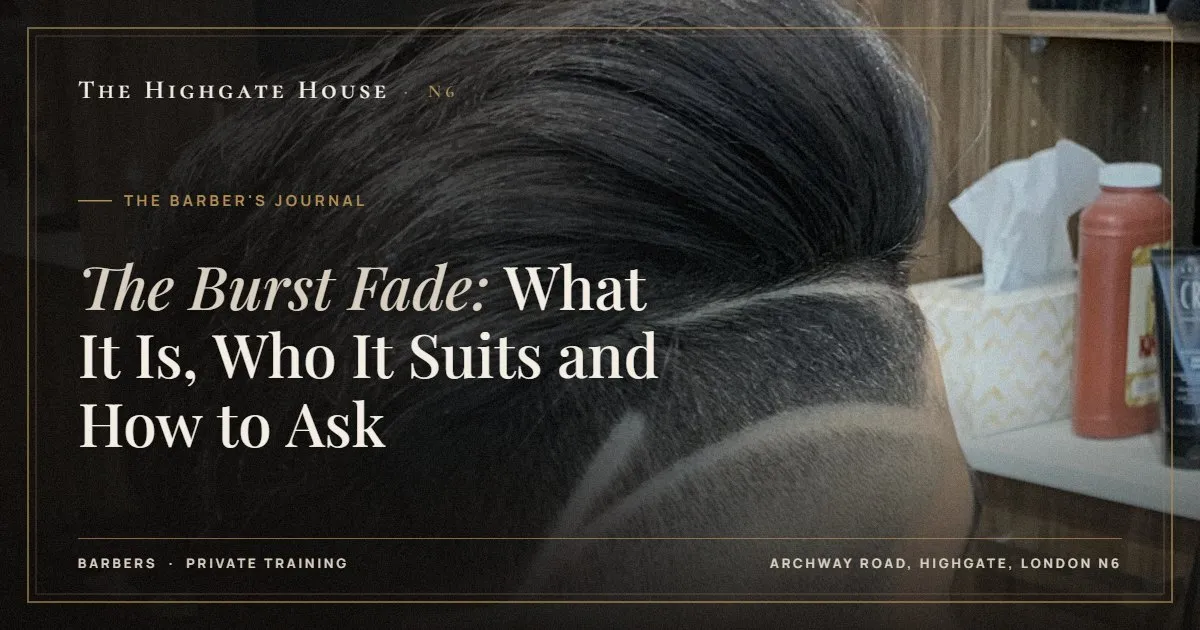
The Burst Fade: What It Is, Who It Suits and How to Ask
A burst fade is a fade that radiates around the ear in a half-circle, then stops. The hair behind the ear and across the nape is left longer instead of being faded away, so from the side the short area looks like a sunburst framing the ear. It suits textured, curly and wavy hair best, and it is the usual partner for a mohawk, a faux hawk or a modern mullet. To ask for one, name the fade, say how short the centre goes, and say how much length you want kept at the back. The rest of this piece is the detail behind those three choices.
How a burst fade differs from other fades
Most fades run in a band all the way round the head: the sides and back are graduated to the same height, so the back of the neck ends up short. A burst fade breaks that band. The barber fades only a curved zone centred on the ear, with the tightest point just above or around it, and lets the blend open outwards like a fan. Behind the ear the curve turns and climbs back into the length, leaving the nape untouched or only tidied.
That one change alters the whole silhouette. Viewed from behind, the head keeps weight and shape. Viewed from the side, there is a clean, rounded contrast around the ear. It is a more graphic look than a standard fade and a more contained one than a high skin fade.
| Fade | Shape of the short area | Back of the neck |
|---|---|---|
| Standard low/mid/high | A straight-ish band round the head | Faded short |
| Drop fade | Band that dips down behind the ear | Faded short, lower at the nape |
| Taper | Only the hairline edges graduated | Short only at the very edge |
| Burst fade | Half-circle centred on the ear | Left longer |
The drop fade is the one people mix up with it most often, because both curve around the ear. The difference is what happens behind it: a drop fade carries on round the back of the head, a burst fade stops. We cover the drop version in our guide to the drop fade if you want to compare.
Who a burst fade suits
The cut depends on having something worth keeping at the back and on top. In practice that means:
- Curly, coily and afro hair. Texture holds the shape on top and at the nape, and the contrast around the ear is crisp against dense hair. This is where the burst fade started and where it still looks most natural.
- Thick wavy hair. Waves give the back enough body to look intentional rather than overgrown.
- Anyone wearing a mohawk, faux hawk or mullet. The burst fade is the logical side treatment for all three, because each one needs length kept down the centre and at the back.
It is harder to carry with fine, straight hair. The longer section at the nape can lie flat and look like the cut is simply growing out, and fine hair shows the scalp more readily through the blend. That does not rule it out, but a barber may suggest a softer version with less contrast.
Two practical considerations. Your ears are on show, framed by the curve, so if you would rather draw less attention to them, a taper or a fade that sits higher may suit you better. And the look is distinctive: in a conservative office it reads as a deliberate style choice rather than a neutral one. A low-contrast version, finishing at a short clipper length instead of skin, tones that down a good deal.
The three decisions behind a good burst fade
1. How short the centre goes
The tightest point of the burst can be bare skin (a burst skin fade), a very short clipper setting, or a gentle taper. Skin gives the most contrast and the shortest life. A short guard length is easier to live with and grows out less obviously.
2. How big the burst is
The radius of the curve decides how much of the side is affected. A tight burst sits close around the ear and looks neat and contained. A wide one sweeps up towards the temple and back towards the occipital bone, which is more dramatic and pairs well with a mohawk. If you are unsure, start tighter; it is simple to widen on the next visit and impossible to put back.
3. What happens at the back
This is where most misunderstandings happen. “Leave the back” can mean anything from a tidied nape to several inches of mullet. Say plainly whether you want the nape squared, tapered at the edge or left long, and roughly how long.
How to ask for it in one or two sentences
Barbers deal with vague requests all day, and most of the frustration comes from the words, not the cutting. A brief that covers the three decisions takes about fifteen seconds:
- Name it: “A burst fade around the ears.”
- Give the centre: “Down to skin at the tightest point” or “Keep it at a short clipper length, not skin.”
- Give the size: “Fairly tight round the ear” or “Wide, up towards the temple.”
- Give the back: “Keep the length at the nape, just tidy the edge” or “Leave it long for a mullet.”
- Give the top: “Shape the curls but keep the height” or “Mohawk strip down the middle.”
A photo helps, especially one showing the side and the back, because the back is the part the word “burst” does not describe. Our note on what makes a useful reference photo explains which angles matter. Every visit at the Highgate Cuts barbers starts with an assessment, where the barber looks at your hair and what you are after and makes recommendations before the clippers come out. That is the moment to say if your growth pattern, a double crown or a cowlick near the ear might affect the curve.
What happens in the chair
The barber usually starts by marking the outline of the burst: a guide line or a guard-length pass that sets the curve on each side. Getting both sides symmetrical is the fiddly part, so expect checks from behind and in the mirror. Then the blend is built from the tightest point outwards, working through longer settings and finishing with detail work, often with trimmers and a foil shaver if the centre goes to skin.
The top is cut separately, with scissors or clippers depending on texture, and finally the edges around the ear and at the nape are cleaned. A careful burst fade takes longer than a straightforward fade because of that symmetry work, so it is worth allowing extra time rather than squeezing it into a lunch break.
How long it lasts and when to rebook
Like any fade, a burst fade looks sharpest in the first week. The skin or near-skin centre is the first part to soften, and because the shape is a defined curve, it loses its outline faster than a straight band does. As a rough rule:
- Skin centre, high contrast: rebook every two to three weeks if you want it crisp.
- Short guard centre, lower contrast: three to four weeks is usually fine.
- Mullet or mohawk versions: the length at the back and on top can go longer between visits, but the burst itself still blurs on the same schedule as the sides.
Some people book a quick tidy of the burst between full cuts. Ask your barber whether that makes sense for your growth rate.
Mistakes to avoid
- Tidying the curve at home. Taking trimmers to the outline almost always flattens the arc or makes one side higher. Leave the shape to the barber.
- Letting the back drift. If the nape is meant to be neat rather than mullet-length, it needs trimming on every visit, or the cut starts to look unplanned.
- Choosing skin when you rebook rarely. If you only get a haircut every six weeks, a skin burst will spend most of that time grown out. A taper burst is the better choice.
Questions we get asked
Is a burst fade the same as a mohawk?
No. The burst fade is only the shape of the sides. It is often worn with a mohawk or faux hawk, but it works just as well under a full head of curls or a textured crop.
Can I have a burst fade with straight hair?
Yes, though it is harder to make the back look deliberate. A lower-contrast version with a little texture added on top tends to work better than a skin burst.
Burst fade or drop fade: which is lower maintenance?
They are similar at the sides. The burst can be slightly easier to grow out because the nape was never short, so there is no stubbly back to wait through.
How do I book one?
Email us with the cut you want and the day that suits you, and we will reply with times. Details of the shop are on The Highgate House homepage, and the full list of services is on our Highgate barber page.
Book with The Highgate House
Ready for a proper cut? Email us at [email protected] with the service and the day that suits you, and we will come back to you with times.
Visit The Highgate House · The barbers
The Highgate House, Archway Road, Highgate, London N6.
