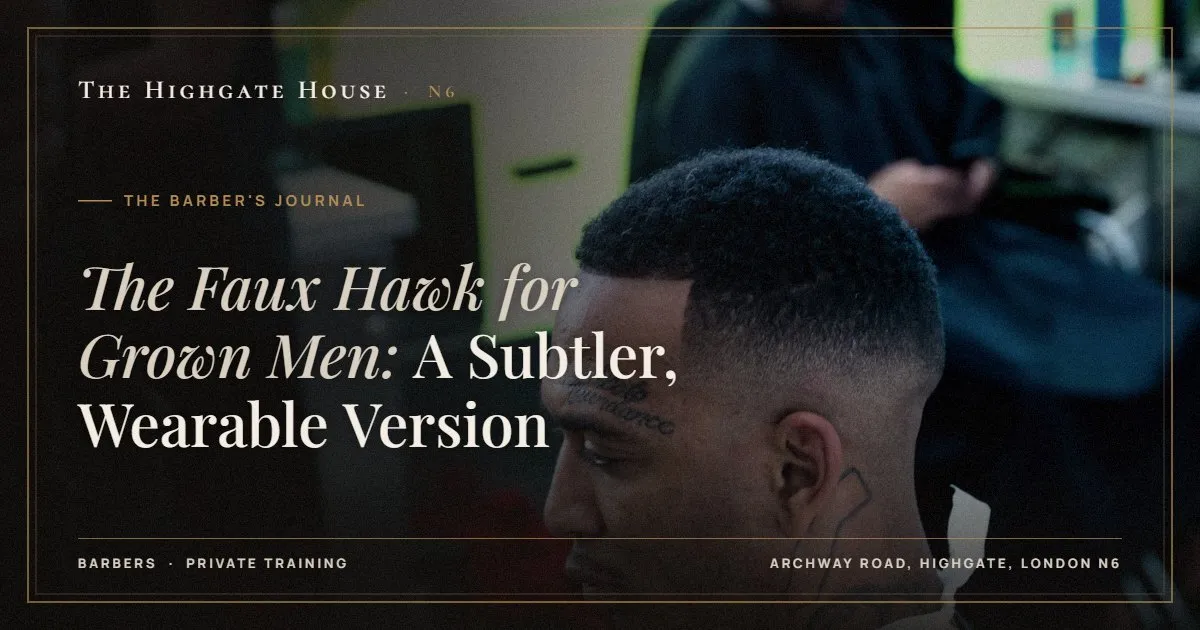
The Faux Hawk for Grown Men: A Subtler, Wearable Version
A grown-up faux hawk is a short haircut where the top is cut slightly longer through the centre than at its edges, so that with a little product the hair rises gently towards a ridge rather than standing in a spike. The sides stay tidy and close, but not shaved to a stripe. Done this way it reads as a textured short cut with some direction, not a statement, and it sits comfortably in a meeting on Monday and a pub on Saturday. The trick is in the proportions: how much longer the centre is, how wide the strip, and how soft the transition. Here is how to get those right.
What separates a wearable faux hawk from the 2008 version
The faux hawk most people picture had three features: sides taken very short, a narrow strip of long hair left on top, and enough gel to make it rigid. Each one shouts. The modern, quieter version reverses all three.
- The strip is wide. Instead of a band two fingers across, the longer section follows the natural width of the top of the head, roughly the area between your temples. That makes the shape look like it grew there.
- The length difference is small. The centre might be a centimetre or so longer than the edges of the top, not five. The rise comes from cutting and texture, not from height.
- The finish is matte. A clay or paste with movement, not a wet-look gel. Hair should look like hair you could run a hand through.
If someone across the table would describe your cut as “short and textured”, you have it about right.
Is it a good choice for your hair?
The faux hawk is friendlier than its reputation. It suits a fair range of hair types, with a few caveats worth knowing before you ask.
| Hair type | How it behaves | What to ask for |
|---|---|---|
| Thick, straight | Holds the shape easily but can look heavy | Texturising on top so it doesn’t sit as a solid block |
| Fine | Works well, as the centre ridge adds apparent volume | Keep the top shorter overall; length makes fine hair collapse |
| Wavy | Very good; the wave gives the rise for free | Cut a little longer and let the wave do the work |
| Tight curls or afro | Takes a sculpted shape well | Shape the top with clippers and a sponge or pick, with a soft fade on the sides |
| Thinning at the front | Can help, as the eye goes to the centre | Keep it short and avoid pulling hair forward to a point |
The one situation where we would talk you out of it is significant thinning at the crown. A faux hawk directs attention along the centre line of the head, and the crown sits right at the end of it. Our guide to haircuts for a thinning crown covers better options.
How to ask for it: the measurements that matter
“A faux hawk” means different things to different barbers, so give specifics. Every visit to Highgate Cuts starts with the barber looking at your hair and what you need, and that conversation is the place to agree these points:
- Top length at the centre. For a subtle version, somewhere around 5 to 7 centimetres through the middle of the top is a sensible range. Shorter than that and it becomes a textured crop; longer and it starts to flop.
- Top length at the edges. A little shorter than the centre, blended with scissors or point-cutting so there is no visible step.
- Sides. Choose between a scissor-over-comb finish, a taper, or a low or mid fade. The lower and softer the fade, the more conservative the overall look. A skin fade to the parietal ridge is the loudest option.
- Front. Decide whether the fringe should lift up with the rest or sit slightly forward. Lifting it is more classic; a forward front is softer and younger.
- Back. The ridge can carry through to the crown or fade out before it. Fading out earlier is quieter and grows out better.
- Neckline. Tapered is usually the right call here.
A clear photo of the back and side helps more than a front-on shot, because the shape is mostly about the profile. Our post on useful reference photos explains what to look for.
Which side option suits which life
Taper or scissor finish
The most conservative choice. The sides are short but never show skin, and the faux hawk shape is visible only when you style it. On a flat day with no product it looks like a regular short back and sides. Good for anyone in a formal workplace.
Low fade
Adds a little crispness around the ears and neck without drawing a line across the head. The most popular balance between tidy and current.
Mid or high fade
Increases the contrast between sides and top, which makes the ridge look taller. Sharper, more fashion-led, and needs more frequent visits to stay clean, typically every two to three weeks.
Styling it in two minutes
A good cut does most of the work. Your job is to give it a nudge each morning:
- Start with towel-dried hair, damp but not wet.
- If you have a hairdryer, dry the top while pushing it up and slightly inward with your fingers. Thirty seconds is enough.
- Take a pea-sized amount of matte clay or paste and warm it fully between your palms until it is almost invisible.
- Work it in from the back of the top towards the front, getting it to the roots rather than coating the ends.
- Use your fingertips to bring the hair from both sides of the top gently towards the centre. Do not pinch it into a point.
- Leave it slightly imperfect. Tidy is the enemy of this cut.
Most men use too much product. If your hair looks shiny or feels stiff, halve the amount next time. Our guide to using hair clay goes into more detail on texture and hold.
Common mistakes
- Pinching the ridge. Twisting the centre into a peak is what turns a grown-up cut into a teenager’s one.
- Too much gap between top and sides. If the sides are clippered very short and the top left long without blending, the top looks stuck on.
- Letting it grow too long. Past about eight centimetres, the top no longer stands and the shape disappears. Book before that happens.
- Using gel. Wet-look gel hardens the ridge and dates the cut instantly.
- Asking for it on the morning of an important event. Try the cut a few weeks before so you know how it sits and how you like to style it.
How often to book
With a taper or scissor finish, every four to five weeks keeps the shape. With a fade, the sides lose their crispness sooner, so every two to three weeks is typical. The top can usually go a little longer than the sides; if you’re stretching visits, ask the barber to take the sides back and only tidy the top.
When you want to move on, the faux hawk grows out gracefully into a quiff or a textured crop with no awkward stage, which is one of its underrated strengths. Our barbers on Archway Road can plan that transition over two or three visits.
Questions we get asked
What is the difference between a faux hawk and a mohawk?
A mohawk shaves the sides completely and leaves a distinct strip. A faux hawk keeps hair on the sides and simply gathers the top towards the centre with cutting and product. Brush it flat and a faux hawk disappears; a mohawk does not.
Can I wear a faux hawk in a formal office?
The subtle version with a taper or scissor finish, yes. Style it flatter on workdays and with more lift at the weekend. The cut is the same; the product changes.
How is it different from a quiff?
A quiff lifts the front and pushes it back. A faux hawk lifts the centre along its length and brings it slightly inwards. Our guide to the quiff explains that cut in detail.
How long does the appointment take?
Much like any short cut with scissor work on top. The barber will confirm timing when you book.
Book with The Highgate House
Ready for a proper cut? Email us at [email protected] with the service and the day that suits you, and we will come back to you with times.
Visit The Highgate House · The barbers
The Highgate House, Archway Road, Highgate, London N6.
