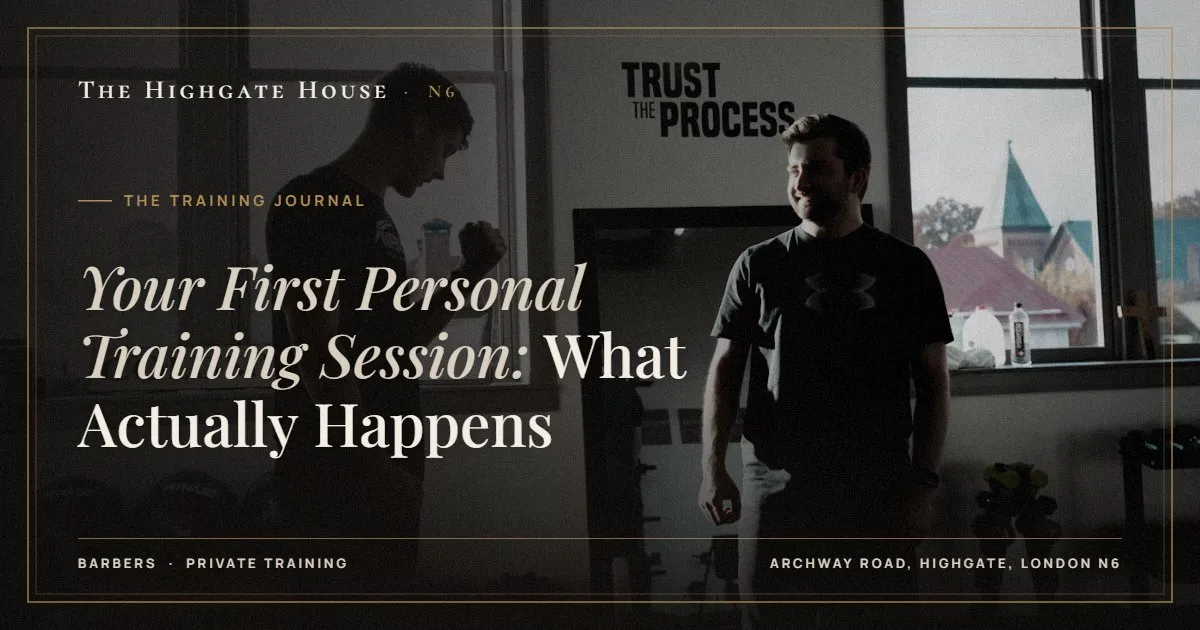
Your First Personal Training Session: What Actually Happens
A good first personal training session is mostly a conversation and an assessment, with a short, deliberately moderate workout at the end. Expect around fifteen minutes of questions about your history, goals and week, fifteen to twenty minutes watching how you move, an optional body composition scan, and then a first taste of the programme at loads well inside what you can do. You should leave with a clear plan, not crawling to the tube. If a trainer’s first move is to see how hard they can push you, that tells you something useful about them.
Before you arrive: what to prepare
Very little, but a few things make the hour more productive.
- A rough training history. What you have done in the past, roughly when, and what you stopped and why. “Ran a lot in my twenties, did some classes before the children, nothing structured for five years” is perfectly useful.
- Injuries and operations. Including the ones you think are irrelevant. An old ankle sprain can explain a lot about how someone squats.
- Medication and health conditions. Only what you are comfortable sharing, but blood pressure medication, for example, affects how we judge effort.
- Your real diary. Not your ideal week. The plan has to fit the week you actually have.
Check with your GP before your first session if you have not exercised for a long time, have a heart condition, high blood pressure or chest pain on exertion, are pregnant or recently postnatal, or are recovering from surgery or a significant injury. The NHS guidance gives the same advice: speak to your GP first if you have not exercised for some time or have medical concerns.
What to wear and bring
Comfortable clothes you can squat and reach overhead in. Trainers with a fairly flat, firm sole are better than thick running shoes for lifting. A water bottle. If you plan to have a body composition scan, the readings are more consistent if you have not just eaten a large meal or had a hard workout, so it is worth arriving in a similar state each time you are scanned.
Minute by minute: how the first hour runs
Here is how I structure a first session in the studio. Other good trainers will differ in detail, but the shape should be similar.
- Conversation (around 15 minutes). Goals, history, injuries, sleep, stress, work pattern, what has and has not worked for you before. I also ask what would make you stop coming. People are usually honest about this, and it is the most useful answer in the session.
- Body composition scan (around 5 minutes, optional). We use an InBody scanner, which estimates muscle, fat and water. It is a baseline, not a verdict. If you would rather not be scanned on day one, that is fine.
- Movement assessment (15-20 minutes). I watch you squat, hinge (bend from the hips), push, pull, lunge and hold a plank or carry. Bodyweight first, then light loads if it looks sensible. I am looking at range of movement, control, and where you compensate.
- First training block (15-20 minutes). Three or four exercises drawn from what we just saw, at moderate effort. This is where you start to learn the technique you will build on.
- Plan and next steps (5 minutes). What the first four weeks look like, how often you will train, and one or two small things to do between sessions.
What the movement assessment is really looking for
People sometimes feel they are being marked. You are not. The assessment exists because the same exercise can be excellent for one person and a poor choice for another.
A few examples of what it tells me:
- If your heels lift or your knees drift inwards in a squat, we may start with a box squat or a goblet squat holding a dumbbell, which make good positions easier to find.
- If you round through the lower back when picking something up, we will teach the hip hinge with a dowel or a light kettlebell before a barbell comes anywhere near you.
- If your shoulders are stiff overhead, pressing may start at an incline rather than vertically, while we work on the range.
- If one side is clearly weaker, single-leg and single-arm work will feature early.
None of this is a problem to be fixed before you are allowed to train. It simply tells us where to start.
How hard should the first session feel?
Moderate. A useful way to think about effort is how many more repetitions you could have done at the end of a set. In a first session, most sets should finish with three or four good reps still in the tank. You should feel that you have worked, and you will probably be a little stiff the next day or the day after, especially in the legs. That delayed soreness is normal when muscles do something unfamiliar and fades within a few days.
What is not normal: sharp pain, pain in a joint rather than the muscle, dizziness, or chest discomfort. Tell your trainer immediately if anything like that happens, and stop.
The reason for restraint is practical. If the first session leaves you unable to walk downstairs for three days, the second session gets postponed, and the habit never forms. Holding back early is how you end up training hard in month three.
Questions worth asking your trainer on day one
The first session is also your chance to assess the trainer. It is reasonable to ask:
- Why did you choose those exercises for me?
- What will we measure, and how often?
- What does the next month look like, session by session?
- What should I do between sessions, and what can I ignore?
- How do you handle a week when I am travelling or exhausted?
A trainer who can answer these plainly has a plan. One who answers with motivation rather than detail may not. If you are weighing up how training fits around a heavy work schedule, I cover that in more depth in personal training for busy professionals .
Mistakes people make in their first few sessions
- Underplaying injuries. “It’s fine now” often means “it hurts if I do this one thing”. Mention it.
- Trying to impress. Lifting more than you should in week one does not speed anything up. It just makes technique harder to learn.
- Training on an empty stomach after a bad night. A light meal or snack a couple of hours before helps most people.
- Judging progress after two sessions. Early sessions are about learning. The visible and measurable changes come later.
What is different in a private studio
The assessment is the part of personal training where people feel most self-conscious, because you are being watched while you move. Doing it in an open gym floor, next to strangers, is not ideal. Our studio on the lower ground floor of The Highgate House on Archway Road is booked to you alone during your session, so the first hour is just you, me and the kit: squat rack, dumbbells, cable station, lat pulldown, seated row, air bike and the InBody scanner. If nerves about the gym have kept you away until now, I have written about that separately in gym anxiety and private training .
You can see how sessions are set up on the personal training page.
Questions we get asked
Do I need to be fit before my first session?
No. The first session is designed around where you are now, and the loads are chosen during the session, not before it.
Do I have to be weighed or scanned?
No. The scan is useful as a baseline, but it is optional and you can start it later. Plenty of people prefer to track strength first.
How sore will I be afterwards?
Usually mildly, for a day or two, mainly in the legs. If you are very sore, tell me and the next session will be adjusted.
What happens if we are not a good fit?
Then it is better to know after one session than after ten. Say so, and there is no awkwardness about it.
When you are ready, the details of 1-1 personal training in Highgate are on the service page.
Book with The Highgate House
Ready to start training properly? Email us at [email protected] with the service and the day that suits you, and we will come back to you with times.
Visit The Highgate House · Private personal training
The Highgate House, Archway Road, Highgate, London N6.
