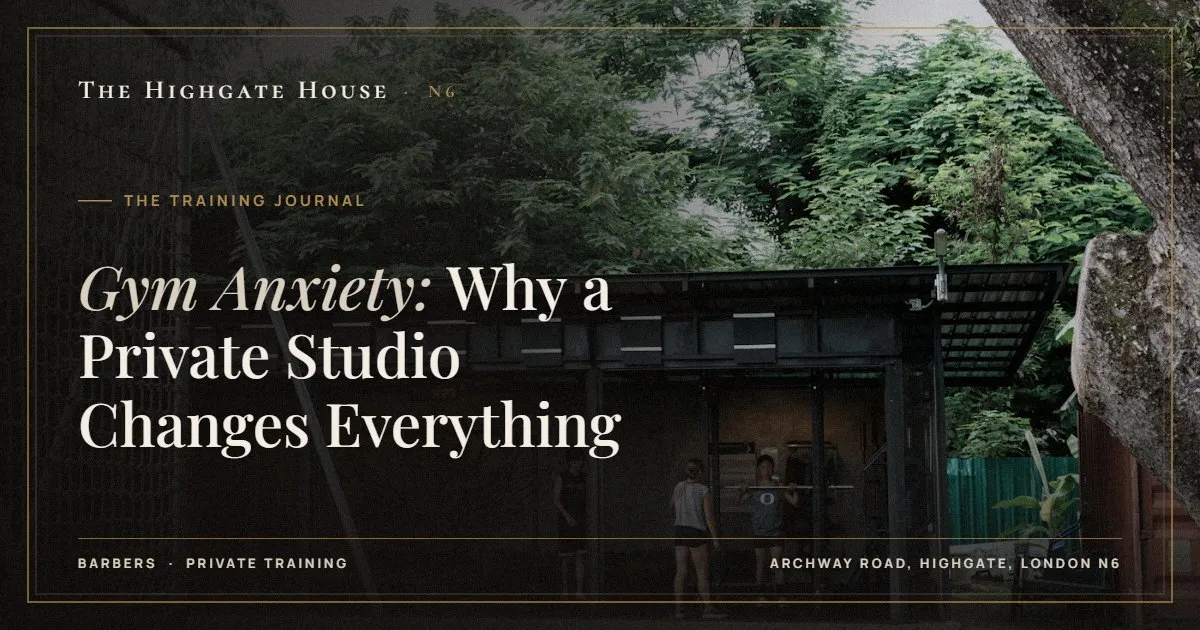
Gym Anxiety: Why a Private Studio Changes Everything
Feeling uneasy about the gym is common, and it is rarely about the exercise itself. It is usually about the room: being watched, not knowing how the equipment works, waiting for kit, the changing room, the sense that everyone else knows what they are doing. A private studio removes most of that at once. With the space booked to you alone and someone showing you exactly what to do, the problem shrinks to the part that is genuinely manageable: learning to train. This piece explains why, and how to make the first step easier.
What people actually mean by gym anxiety
When people tell me they “don’t do gyms”, the reasons tend to fall into a few groups:
- Being watched or judged. Mirrors everywhere, strangers waiting for your bench, the feeling that your technique is on display.
- Not knowing what to do. Unfamiliar machines, no plan, and the worry of looking lost.
- The social layer. Busy weights areas, unwritten rules about sharing kit, music you did not choose.
- Body self-consciousness. Particularly after a long break, weight gain, illness or pregnancy.
- A bad past experience. An injury, an unkind comment, or a trainer who pushed too hard on day one.
Plenty of capable, successful people feel some of this. Being comfortable in a boardroom does not automatically make you comfortable in a crowded weights room, and there is nothing odd about that.
Why a private studio removes most of the triggers
Most of the list above is about other people and uncertainty. Take away the other people and reduce the uncertainty, and much of the discomfort goes with it.
| Typical trigger | Busy commercial gym | Private 1-1 studio |
|---|---|---|
| Being watched | Strangers nearby throughout | Just you and your trainer |
| Not knowing what to do | Work it out yourself, or hope someone helps | Every exercise shown and set up for you |
| Waiting for equipment | Common at peak times | All the kit is yours for the hour |
| Noise and music | Fixed by the venue | One session at a time, so far quieter |
| Making mistakes | Feels public | Part of the process, and private |
Our studio is the lower ground floor of The Highgate House on Archway Road, about 1,000 sq ft, and it is booked to you alone for your session. The barbers are on the ground floor above and entirely separate. You come down, train, and leave, without crossing a gym floor.
What your first session involves
Knowing exactly what will happen removes a good deal of the dread. In short:
- We sit down and talk for around fifteen minutes about your history, what you want, and anything that has put you off before. You can be as candid as you like.
- If you want one, there is an optional body composition scan. Plenty of people prefer to skip it at first, and that is completely fine.
- I ask you to try a few simple movements, such as sitting back to a box or bench, or pulling a cable towards you, so I can see how you move. Nothing is a test.
- We finish with a short, moderate workout. You should leave feeling you could have done more.
The full detail is in what happens in your first personal training session .
Practical ways to make the first step smaller
- Email first. You can ask anything before committing to a session. What to wear, what the room is like, or if you would like to bring someone along the first time. Booking is by email, so there is no phone call to make.
- Choose a quiet time. Early mornings or the start of the evening suit people who would rather not see anyone on the way in.
- Tell your trainer what bothers you. Mirrors, a particular exercise, being weighed, a part of your body you are self-conscious about. A good trainer adjusts without fuss.
- Agree the rules in advance. For example, no scan for the first month, or no exercises lying on the floor. You set the limits.
- Arrive changed. If changing rooms are part of the problem, come in your training clothes.
- Commit to three sessions, not a lifetime. Most nervousness fades once the room, the routine and the person are familiar.
What a good trainer does when you are nervous
Explains before demonstrating, and demonstrates before asking you to try. Starts with movements you will succeed at. Keeps loads well inside your ability so the first experiences are good ones. Gives one coaching point at a time rather than a list of faults. Never comments on your body unless you have asked them to, and never uses embarrassment as motivation. If someone does, find someone else.
I have trained since I was 15 and coached for more than ten years, and a fair number of the people I work with started out saying they hated gyms. The usual turning point is not a big moment. It is a routine session where they realise they are not thinking about the room any more.
Building confidence for training elsewhere
Some people stay in the private studio for good. Others use it as a base to build skill and confidence, then enjoy training in a hotel gym, a club or a commercial gym on their own. Either is a perfectly good outcome. If you would like to train independently eventually, say so at the start and we will build in the things that make that easier: a written plan, set-up routines for common equipment, and sessions where you lead and I watch.
When it is more than nerves
A private studio helps with ordinary nervousness about gyms. It is not a treatment for anxiety, and I am not a mental health professional. If anxiety is affecting your sleep, work or daily life, or you are having panic attacks, speak to your GP. In England you can also refer yourself to NHS talking therapies for anxiety without going through a GP first. Training can sit alongside that support, but it should not replace it.
Check with your GP before starting training if you have a heart condition, high blood pressure, are pregnant, are recovering from injury or surgery, or have not exercised for a long time.
Questions we get asked
Will anyone else be in the studio while I train?
No. The studio is booked to you alone during your session.
I am very unfit. Is that a problem?
Not at all. Sessions start from where you are. Being unfit is the reason to start, not a reason to wait.
Can I bring someone with me the first time?
Email us beforehand and we will talk it through. Mention it when you book.
Do I have to be weighed or scanned?
No. It is optional, and many people choose to track strength instead.
You can read more about private personal training in Highgate, or if you want a sense of where twelve weeks of steady training can lead, see what a realistic transformation looks like . The training page also covers the studio and how sessions run.
Book with The Highgate House
Ready to start training properly? Email us at [email protected] with the service and the day that suits you, and we will come back to you with times.
Visit The Highgate House · Private personal training
The Highgate House, Archway Road, Highgate, London N6.
