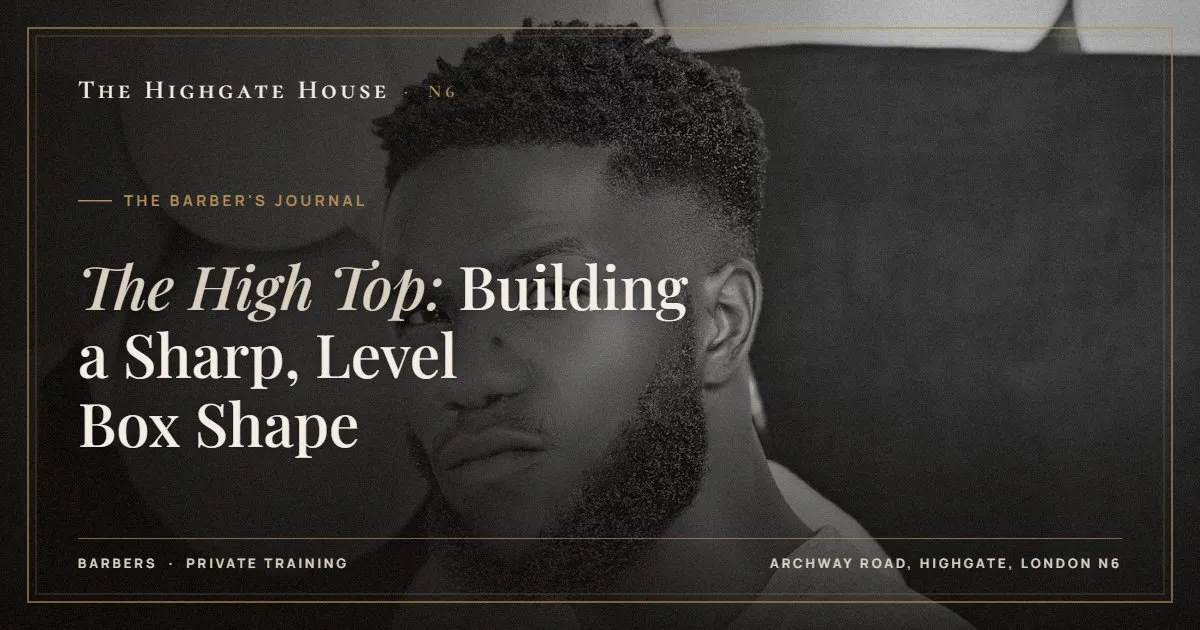
The High Top: Building a Sharp, Level Box Shape
A high top fade is Afro or tightly coiled hair grown long on top, picked out so it stands upright, then cut into a tall block with a flat, level top and squared corners, while the sides and back are faded or tapered short. To get one you need enough length on top to stand up (usually a good few inches, depending on how much your hair shrinks), a barber who is comfortable levelling by eye and with a flat-top comb, and a morning routine that keeps the hair lifted. The cut itself takes longer than an ordinary fade because the top is shaped in stages, and the box needs reshaping every few weeks to stay sharp.
What makes a high top different from a flat top
The two are related and often confused. A classic flat top is usually shorter, often worked on straighter or wavier hair that has to be trained or set to stand up, and the defining feature is the flat deck. A high top is a taller structure that relies on the natural density and spring of Afro hair to hold itself upright. The height is the point: the top block stands well above the head, and the fade at the sides makes it look taller still. If you want the shorter, more military version, our guide to the flat top covers how that one is built.
The style is tied closely to late 1980s and early 1990s hip hop, and it has come back in a cleaner, more tailored form. Today’s versions tend to be slightly shorter, with a tighter fade and crisper edges, and they read as deliberate rather than retro.
How much hair you need before you book
There is no single number, because Afro hair shrinks. A coil that looks two inches long when dry may stretch to well over that when picked or stretched. What matters is stretched length on top, not how it looks resting on your head. Our piece on Afro hair shrinkage explains why a cut can look shorter once it dries, and the same logic applies here.
A practical test: pick the top up and out with an Afro comb. If it stands on its own and holds a rough column taller than you want the finished height, you have enough. If it flops or splits, give it a few more weeks. Booking too early is the most common mistake, because the barber can only take away height, never add it.
While you grow it, keep the sides and back tidy with a taper and leave the top alone. Cutting the top “to keep it even” in the growing phase just resets the clock.
How a barber builds the box, step by step
- Assessment. Every visit to Highgate Cuts starts with the barber looking at your hair, the density on top, where it grows thinner and how your head is shaped, before recommending a height and fade.
- Picking out. The top is picked up and out from the root so every section stands at full length. Uneven picking is the root cause of a lopsided high top, so this is done thoroughly.
- Setting the sides. The fade or taper is usually cut first, or at least roughed in, so the barber can see the outline of the block against the sides.
- Levelling the top. Using clippers over a flat-top comb, or freehand with a level eye, the barber cuts the deck flat. Many barbers check it from several angles and in the mirror, because a top that looks level from the front can slope from the back.
- Squaring the corners. The edges where the top meets the sides are shaped into clean right angles. This is what turns a tall Afro into a box.
- Blending the fade into the block. The transition from the short sides to the vertical wall of the top is refined so there is no shelf or step unless you have asked for one.
- Line up. The front hairline, temples and neckline are edged. Our guide to the line up explains how barbers keep edges crisp without pushing the hairline back.
Choosing the height, the fade and the shape
Height
Taller is not automatically better. The height should suit your face length and neck. A very tall block on a long face can exaggerate the length, while a moderate height can balance a rounder face. If you wear glasses or a hat regularly, mention it, because both affect how the block sits day to day.
Fade height
A high or skin fade makes the block look taller and more dramatic. A low or mid fade, or a taper, gives a softer, more office-friendly result. Both are legitimate; it depends on how much contrast you want.
Shape of the block
| Variation | What it looks like | Who it suits |
|---|---|---|
| Classic box | Vertical walls, flat top, square corners | Dense hair, oval or round faces |
| Slanted top | Top cut at an angle, higher at the back or front | Anyone wanting a less formal look |
| Low high top | Same shape, noticeably shorter block | First-timers, workplaces that prefer restraint |
| Rounded edges | Softer corners where top meets sides | Longer faces, finer density |
Keeping it sharp between visits
A high top lives or dies by daily care, because the hair naturally wants to compress and coil back down.
- Pick every morning. Lift from the root, working evenly across the top, then pat the sides of the block lightly with your palms to restore the walls.
- Moisturise. Dry Afro hair breaks more easily, and breakage on top shows as gaps in the block. A light leave-in or moisturiser keeps it supple. Our Afro hair care routine covers a simple approach.
- Protect it overnight. A satin bonnet, scarf or pillowcase reduces friction and flattening. Expect to re-pick in the morning regardless.
- Do not trim the top yourself. Small home snips almost always create a dip that the barber then has to cut the whole deck down to match.
- Book the fade and the top together. The fade softens first; the top loses its edges a little later. Most people find a reshape every two to four weeks keeps the shape clean, depending on how fast their hair grows and how sharp they like it.
Mistakes that ruin a high top
- Uneven density. If one area grows thinner, the barber may need to set the height to the weakest section. Ask before the cut what height is realistic across the whole top.
- Tension. Constant tight pulling, such as very tight headbands or styles that drag on the hairline, can contribute to hair loss at the edges over time. If you notice thinning, the NHS guidance on hair loss explains when to see a GP.
- Cutting too soon. Covered above, but worth repeating: patience in the growing phase gives the barber material to work with.
- Skipping the pick. A high top cut on hair that was not fully picked out will look uneven the moment you pick it at home.
How to ask for it
Bring a photo of a high top you like, ideally side-on so the barber can see the height relative to the face. Tell them what fade you want at the sides, whether you want sharp or slightly softened corners, and how tall you would like it. Mention whether you are happy with a longer appointment, because a proper high top is built slowly. If you are unsure how much to say, our barber team on Archway Road will talk it through during the assessment before any hair comes off.
Questions we get asked
Can I get a high top if my hair is not very dense?
Often yes, but the height may need to be lower so the block looks solid rather than see-through. The barber will tell you honestly what will hold.
How long does a high top appointment take?
Longer than a standard fade, because the top is picked, levelled and checked from several angles. If you want an exact slot, email us and we will tell you what to allow.
Will it work with waves or twists on top?
Not really. A high top needs the hair picked out and standing, which is the opposite of the compression waves rely on. Twists can sit on top of a faded base, but that is a different style.
How do I grow one from a short cut?
Keep the sides tapered, leave the top completely alone and moisturise it. Book in once it stands on its own when picked.
Book with The Highgate House
Ready for a proper cut? Email us at [email protected] with the service and the day that suits you, and we will come back to you with times.
Visit The Highgate House · The barbers
The Highgate House, Archway Road, Highgate, London N6.
