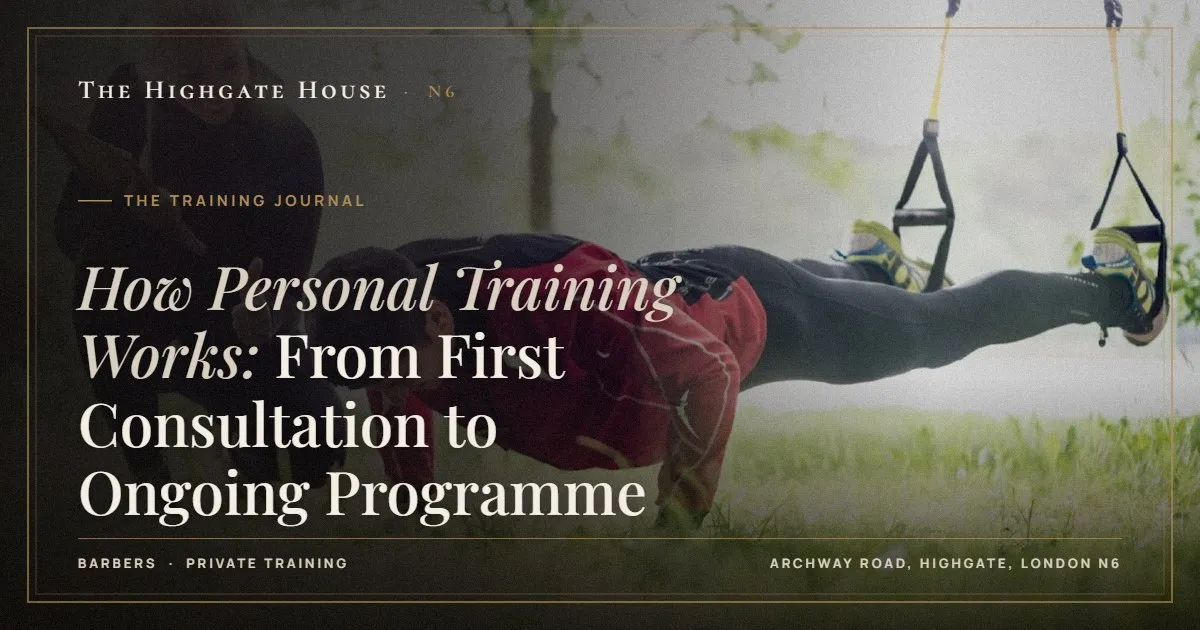
How Personal Training Works: From First Consultation to Ongoing Programme
Personal training works as a cycle, not a series of one-off workouts. You start with a consultation where the trainer learns your history, goals and diary, then assesses how you move. From that they write a programme in blocks of roughly four to eight weeks, coach you through it session by session, adjust the loads as you progress, and review the whole thing at set points. Between sessions you have a small amount of homework. Over months, the trainer’s job shifts from teaching you to train towards keeping you progressing, and eventually to making you more independent. That is the shape. The detail is where good and average training differ.
This post covers the whole arc. If you only want to know what happens on day one, I have written separately about your first personal training session.
Stage 1: the enquiry and the conversation before you commit
Before anyone books a block of sessions, there should be a short exchange about what you want and whether the trainer is the right fit. In practice this is an email or a brief call where you say what you are hoping to change, how much time you realistically have, and anything that might limit you: an old injury, a medical condition, a job with unpredictable hours.
A trainer worth hiring will be honest at this stage. If what you need is physiotherapy, a running coach or a dietitian, they should say so. If your diary only allows one session a fortnight, they should explain what that can and cannot achieve rather than taking the booking and hoping.
Stage 2: the consultation and assessment
This is the foundation everything else rests on. It usually takes most of the first session and covers three things.
Your history and your real week
Training background, injuries, operations, medication, sleep, work pattern, stress, and what made you stop last time. That last question matters more than goals, because most programmes fail for reasons that have nothing to do with exercise selection.
How you move
The trainer watches the basic patterns: squat, hip hinge, push, pull, lunge, carry and some form of trunk control. They are looking for range, control and where you compensate, not for a score. An ankle that will not bend far enough, for example, changes how you are taught to squat.
A baseline you can measure against later
This can be as simple as a few starting weights and how they felt. In our studio there is also an InBody body composition scanner, which gives an estimate of muscle, fat and water. It is optional and it is a reference point, not a judgement. The value is in comparing like with like a few months later.
Stage 3: building the programme
After the assessment, the trainer writes the plan. A sound programme for most adults is built from a short list of decisions:
- Frequency. How many times a week you will train, with and without the trainer. Two or three strength sessions a week is a common, workable range for busy people.
- Split. Full body each session, or upper and lower body on alternate days. For two sessions a week, full body is usually the better use of time.
- Exercise selection. A main lift or two per session (a squat or hinge variation, a press, a pull), then supporting work chosen to suit your body and goals.
- Sets, reps and effort. How hard each set should feel, usually expressed as how many reps you could still have done. Early on, sets finish well short of failure while technique beds in.
- Progression. How the programme gets harder: more weight, more reps, more sets, or better control, one variable at a time. This is progressive overload, and it is the reason a programme works rather than just tiring you out.
- Conditioning. Some form of cardiovascular work, which in our studio is often short intervals on the air bike at the end of a session.
The plan is written as a block, typically four to eight weeks, with a clear purpose. The first block for a beginner is mostly about learning the lifts and building tolerance. Later blocks push strength, muscle or fitness harder.
Stage 4: the sessions themselves
A typical hour in a private 1-1 personal training session runs roughly like this:
- Check-in (a few minutes). Sleep, soreness, stress, anything that has changed. This decides whether today goes to plan or gets adjusted.
- Warm-up (around 10 minutes). General movement, then specific preparation for the main lift.
- Main work (20 to 30 minutes). The lifts that matter most, coached closely, with loads recorded.
- Accessory work (10 to 15 minutes). Smaller exercises for weak points or balance.
- Finish (5 to 10 minutes). Conditioning or trunk work, and a note of what to do before next time.
The trainer is doing more than counting. They are adjusting the weight based on how the last set moved, cueing one thing at a time, and noticing when you are having an off day so they can pull back rather than force it.
Stage 5: what happens between sessions
Most of your week is spent away from the trainer, so a good arrangement accounts for that. Homework should be modest and specific: perhaps one extra short session you do alone, a daily step target, or a protein habit. Ten minutes of mobility done consistently beats an ambitious plan that lasts a fortnight.
It is worth agreeing at the start how you will communicate between sessions. A short message if a session goes badly or a knee starts complaining is better than waiting a week to mention it.
Stage 6: reviews and adjustments
At the end of each block, the trainer should step back and look at the evidence. The questions are simple:
| Question | What it tells us |
|---|---|
| Have the main lifts gone up? | Whether the programme is producing strength |
| Has the body composition scan moved? | Whether muscle and fat are changing in the direction you want |
| How many sessions were missed, and why? | Whether the plan fits your life |
| Any aches that keep returning? | Whether exercise choices or loads need changing |
| Is it still enjoyable? | Whether you will keep doing it |
Then the next block is written. Sometimes it is the same structure with heavier loads. Sometimes it changes substantially. A programme that never changes, or one that changes every week for novelty, are both signs the process is not being managed.
Stage 7: the long run
For most people, the first three months are about learning the lifts and building the habit. Months three to twelve are where meaningful strength and body composition change usually show up, provided training is consistent and food and sleep are roughly in order.
After that, people tend to go one of three ways. Some keep training at the same frequency because they value the structure. Some drop to fewer sessions and train alone in between, using the trainer for programming and technique checks. Some become fully independent. All three are reasonable outcomes. If you are thinking about how this might fit you, I have covered how long people typically work with a trainer in more depth.
Common mistakes that stop the process working
- Treating each session as a separate workout. Progress comes from the sequence, not from any single hour.
- Hiding the real diary. A plan built on your ideal week will break on your actual one.
- Not reporting pain. Mild discomfort mentioned early is usually a small adjustment. Ignored, it becomes weeks off.
- Measuring too often. Weekly scans and daily weighing mostly measure water. Review every block, not every session.
If you have not exercised for some time, have a heart condition, high blood pressure, are pregnant or recently postnatal, or are recovering from injury or surgery, check with your GP before starting. The NHS physical activity guidelines give the same advice.
Questions we get asked
How many sessions a week do I need?
Two a week with the trainer is a solid starting point for most adults, ideally with one short session alone. One a week can work for maintenance or for someone who already trains independently.
Do I need to follow a diet plan as well?
Not a rigid one. Most people do well with a few clear habits around protein, regular meals and alcohol. If you have a medical condition affecting diet, a registered dietitian is the right person.
Will the programme be written down?
It should be. You should be able to see what you did, what you lifted and what is planned next. That record is also what makes reviews honest.
Is the studio shared with other clients during my session?
No. At The Highgate House the lower ground studio is booked to you alone for the session, and it is used for coached training only. You can read more on the personal training page.
Book with The Highgate House
Ready to start training properly? Email us at [email protected] with the service and the day that suits you, and we will come back to you with times.
Visit The Highgate House · Private personal training
The Highgate House, Archway Road, Highgate, London N6.
