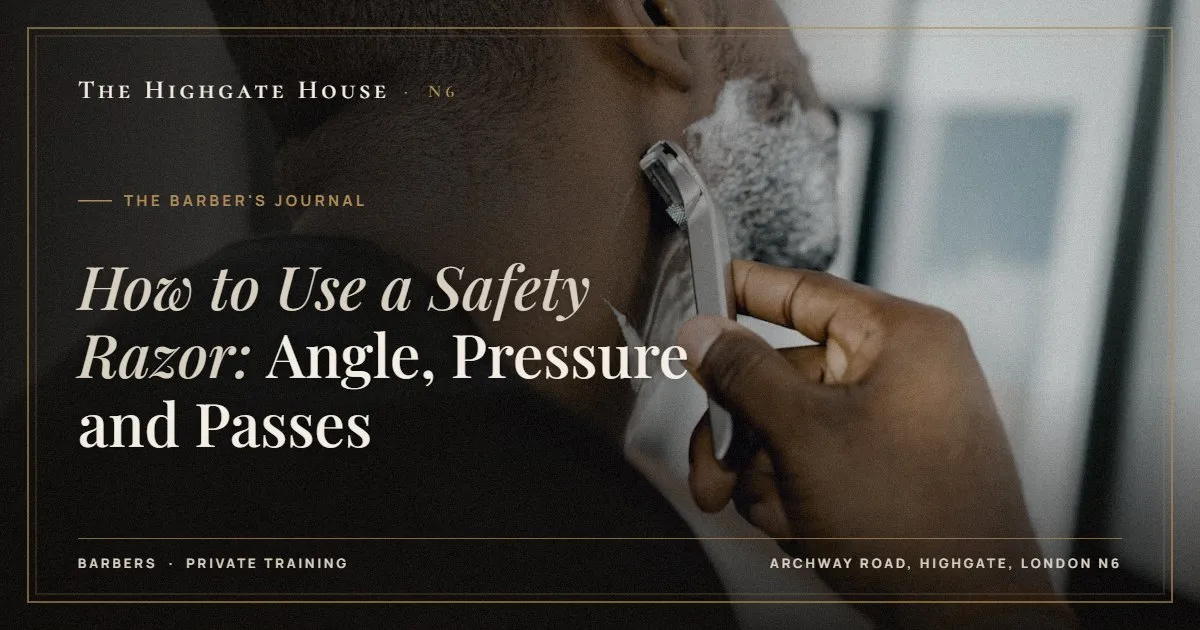
How to Use a Safety Razor: Angle, Pressure and Passes
To use a safety razor, hold the handle so the blade meets your skin at a shallow angle of roughly 30 degrees, let the weight of the razor do the cutting with almost no pressure from you, and shave in two or three separate passes: first with the grain, then across it, then against it only where your skin tolerates it. Use short strokes, relather between passes and rinse the head often. The main adjustment from a cartridge is the angle: a cartridge pivots to find it for you, a safety razor does not. Most men feel comfortable within two or three weeks.
Why a safety razor feels different
A cartridge razor has a pivoting head, a lubricating strip and several blades close together, all designed to forgive poor technique. A safety razor has one sharp blade in a fixed head. That simplicity is its strength: fewer blades dragging across the skin, a head that is easy to rinse, and blades that cost very little to replace. It is also why technique matters more. Press hard or tilt it wrongly and you will know about it. Our post comparing safety razors and cartridges covers whether the switch suits your skin.
Before you start: blade and razor
- Razor. A mild, closed-comb design is the easiest place to start. “Aggressive” razors expose more blade and are less forgiving.
- Blade. Blade brands vary noticeably in sharpness and smoothness, and what suits one face does not suit another. A sampler pack of several brands is worth buying once.
- Loading. Unscrew the head, place the blade on the base so it sits over the guide posts, put the top cap on and tighten until snug, not forced. Handle the blade by its short ends only.
The three things that matter
1. Angle
Place the top of the razor head flat against your cheek with the handle sticking straight out from your face. Now lower the handle slowly towards your face until you hear and feel the blade start to cut. That point, usually around 30 degrees, is your angle. Too steep and it scrapes; too shallow and it skates over the hair without cutting.
Keeping that angle as you move around the curve of your jaw and chin is the real skill. Move your wrist, not just your arm.
2. Pressure
Almost none. Hold the handle loosely, towards the bottom, and let the head’s weight rest on the skin. The urge to press harder when hair is not cutting cleanly is the commonest cause of irritation and cuts. If it is not cutting, check the angle and the lather first.
3. Passes
Do not try to get a close shave in one go. Reduce the beard gradually:
- With the grain (WTG). Shave in the direction the hair grows. This removes most of the length.
- Across the grain (XTG). Relather, then shave sideways to the growth.
- Against the grain (ATG), optional. Relather and shave against the growth only on areas that tolerate it. Many men skip this on the neck.
Hair often grows in different directions on different parts of the face. Before your first shave, let two or three days of stubble grow and rub your hand over it to map the directions. Our post on shaving with the grain shows how.
Step by step, the full shave
- Prepare. Shave after a warm shower, or hold a hot flannel to your face for a minute.
- Lather. A cream or soap whipped with a brush gives the most cushion. Our post on how to lather shaving soap covers the technique.
- First pass, with the grain. Short strokes of a few centimetres. Rinse the head every couple of strokes.
- Relather. Never shave a second pass on bare skin.
- Second pass, across the grain.
- Optional third pass against the grain on the cheeks and chin only.
- Rinse with cool water. Pat dry.
- Aftercare. An alum block or a gentle, alcohol-free balm. See our post on the alum block.
Expect the first few shaves to take 15 to 20 minutes. That drops to around ten as the movements become familiar.
Tricky areas
| Area | What helps |
|---|---|
| Upper lip | Pull the lip down over the teeth to flatten it; very short strokes |
| Chin | Work in small sections around the curve, adjusting the wrist constantly |
| Under the jaw | Tilt the head back; hair here often grows sideways or in swirls |
| Neck | With and across the grain only if it gets irritated; do not stretch hard |
First-week mistakes, and what to change
- Nicks along the jaw. Usually the angle opening up as you go round a curve. Slow down and make shorter strokes.
- Red, stinging neck. Too many passes or against the grain too soon. Stop at two passes for a fortnight.
- Patches left behind. Angle too shallow. Lower the handle a touch more slowly next time and listen for the cut.
- Buffing. Going back and forth over one patch with little lather. Touch up with a little fresh lather and a single stroke instead.
- Sideways strokes along the blade. Never move the razor in the direction of the blade edge. That is how bad cuts happen.
A small cut usually stops with cold water and gentle pressure. Our post on stopping a shaving cut bleeding covers the rest. If a cut is deep or will not stop, seek medical advice.
Blade changes and hygiene
Most men change blades after somewhere between three and seven shaves, depending on beard and blade. If the razor starts to tug, change it rather than pushing on. Rinse the head thoroughly, let it dry in the open air rather than a closed cabinet, and dispose of used blades in a sealed blade bank or a tin, not loose in the bin. Never share a razor.
Seeing it done properly
Watching a barber shave is one of the quickest ways to understand angle and pressure. Barbers use straight razors rather than safety razors, but the principles are the same: preparation, light touch, passes in order. A hot towel shave at Highgate Cuts takes 20 to 30 minutes and starts with an assessment of your skin and growth. Ask the barber about your growth directions while you are in the chair. You can find the shave on the Highgate Cuts barber page.
Questions we get asked
What angle should a safety razor be held at?
Roughly 30 degrees between the handle and your face, found by starting flat and lowering the handle until it cuts.
Is a safety razor better for sensitive skin?
For many men it is, because one sharp blade causes less friction than several. Technique decides it.
Can I use a safety razor on my head?
Yes, though it takes practice; work in small sections and use plenty of lather.
How long does a safety razor blade last?
Typically three to seven shaves. Change it as soon as it starts to tug.
See the shave and beard services on the barber page, or start at the homepage. For prices, see the barber menu or email us.
Book with The Highgate House
Ready for a proper cut? Email us at [email protected] with the service and the day that suits you, and we will come back to you with times.
Visit The Highgate House · The barbers
The Highgate House, Archway Road, Highgate, London N6.
