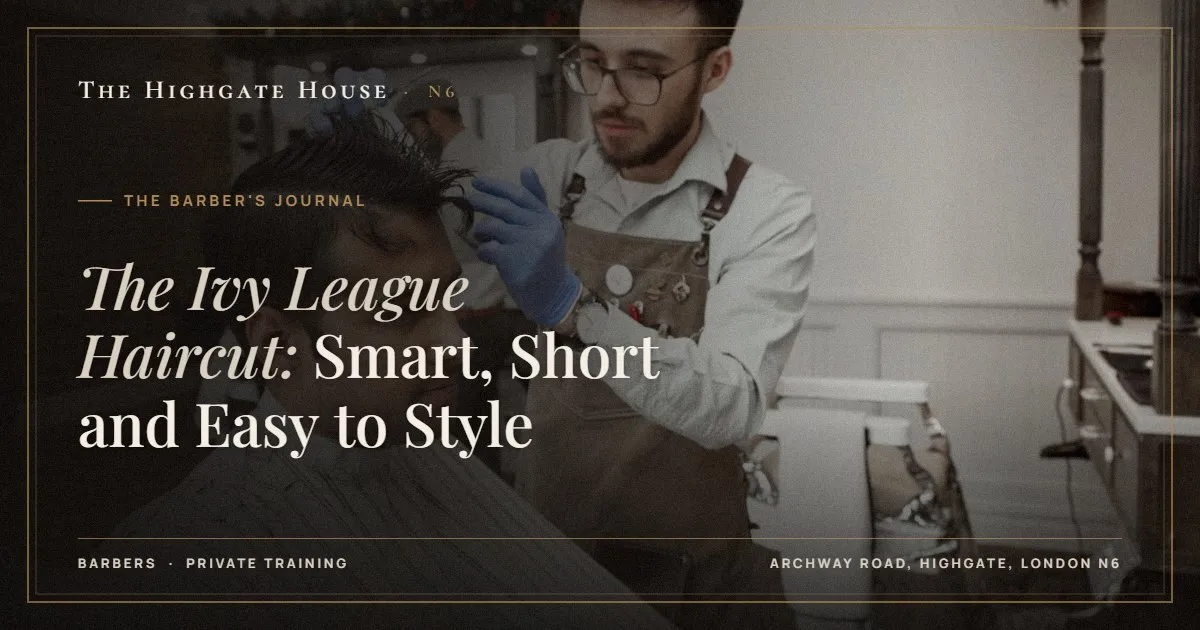
The Ivy League Haircut: Smart, Short and Easy to Style
The Ivy League is a crew cut left long enough on top to take a side parting. The sides and back are short and tapered, the top is usually around 3 to 6 cm at the front and shorter towards the crown, and the whole thing is combed to one side rather than pushed up. It looks deliberate in a suit and relaxed in a jumper, needs about a minute to style, and grows out more gracefully than most short cuts. To ask for one, say “Ivy League, tapered sides, enough length on top for a side parting”, and agree the top length with your barber in centimetres rather than guard numbers.
Where the name comes from
The cut became associated with American university campuses in the mid twentieth century, where it was sometimes called a Harvard clip or a Princeton. It sat between the military crew cut and longer, oiled styles: short enough to be practical, long enough to look groomed. That middle position is why it has lasted. It does not belong to a particular decade in the way a pompadour or curtains do, so it rarely looks dated.
Ivy League vs crew cut vs side parting
These three get confused, and the difference is mainly in the top.
| Cut | Top length (typical) | How it is worn |
|---|---|---|
| Crew cut | 1 to 3 cm | Brushed up or forward, no real parting |
| Ivy League | 3 to 6 cm at the front, shorter at the crown | Soft side parting, swept across |
| Classic side parting | 5 to 8 cm or more | Defined parting, often with more volume and product |
Think of the Ivy League as the bridge. If you have a crew cut and want something slightly more grown-up, it is the natural next step. If you have a full side parting haircut and want less to manage in the morning, it is the step down.
Who it suits
The Ivy League works on most face shapes because it keeps the sides close without exaggerating height. It is particularly good for:
- Straight or slightly wavy hair of medium thickness. The parting sits cleanly and the hair lies across without fighting.
- Men whose hair is thinning a little at the temples. A short, swept top with no hard parting line tends to draw less attention to a receding hairline than a longer, heavier top.
- Anyone with a formal working week. It looks tidy on a video call with no styling at all.
It is less straightforward on very curly hair, which tends to spring up rather than lie across, and on very fine hair, where 5 cm on top can look flat. Neither is a dealbreaker. A barber can adjust the length and how the top is cut to work with your texture.
How to ask for it
Bring a reference photo if you can, but also give these five details. They remove most of the guesswork.
- Top length at the front. Say it in centimetres, or show it with your fingers. 4 cm is a sensible middle.
- Graduation to the crown. The top on a proper Ivy League gets shorter as it moves back. Ask for it to be “tapered back to the crown”.
- Sides and back. Scissor over comb for a softer look, or clippers for something tighter. A low taper is classic; a fade makes it more modern.
- Which side you part. Most men part on the side where the hair naturally falls. Your barber will check your crown and hairline.
- Neckline. Tapered is traditional and grows out cleanly. Our piece on tapered vs blocked necklines explains the trade-off.
At Highgate Cuts, every visit starts with an assessment. The barber looks at your hair, the way it grows and what you want from the cut, then recommends lengths before anything is taken off. See our barber services in Highgate for what else we do.
How it is cut
Knowing the process helps you judge whether it is going well. Typically:
- The sides and back are taken down first, with clippers or scissor over comb, keeping the taper low and even.
- The top is cut with scissors, often finger by finger from front to back, leaving the most length at the front hairline.
- The barber blends the top into the sides so there is no visible shelf where the two meet. This is the part that separates a good Ivy League from a crew cut with a long fringe.
- The parting is found rather than imposed. A good barber combs the hair wet or dry and watches where it falls.
- The outline around the ears and neck is cleaned up, sometimes with a razor.
Styling it in about a minute
The appeal of this cut is how little it asks of you.
- Towel dry until the hair is damp, not wet.
- Rub a small amount of matte paste or cream, about the size of a pea, between your palms until it is barely visible.
- Work it through from the back of the top towards the front.
- Comb a soft parting on your usual side, then push the front across and slightly up with your fingers.
- If you want more hold, a quick blast with a hairdryer while pushing the front across sets it.
Avoid shiny, heavy products. The Ivy League looks best with a natural finish. A glossy pomade pushes it towards a slick side parting, which is a different look.
Keeping it sharp
The sides lose definition first. Most men find three to four weeks keeps the taper clean; the top can go five or six weeks if you are happy with it looking slightly softer. If you want the cut to look fresh for a specific event, book about five to seven days before so the edges have softened slightly. Between visits, resist trimming the neckline yourself unless you are confident; a slip at the back is hard to hide on a cut this short.
Common mistakes
- Top cut too short at the front. Below about 3 cm there is nothing to part, and you are back to a crew cut.
- No graduation. If the top is the same length all over, it sits heavy at the crown and can stick up.
- A hard parting line shaved in. That is a different cut, the hard part, and it changes the character completely.
- Too much product. It flattens the top and makes it look greasy by mid-afternoon.
Questions we get asked
Is the Ivy League the same as a Harvard clip?
Broadly, yes. The names are used interchangeably, though some barbers use Harvard clip for a slightly shorter version.
Can I have an Ivy League with a fade?
Yes. A low or mid fade on the sides gives it a more modern edge while keeping the parted top. Ask for the fade to stay low so the top still has enough weight.
How long does it take to grow into one from a buzz cut?
Hair grows roughly a centimetre a month on average, so from a very short cut you would usually need three to four months for enough length at the front, with tidy-ups to the sides in between.
Does it work with a beard?
Very well, particularly with a short, neat beard. Our Highgate barbers can shape both in one visit.
Highgate Cuts is on the ground floor of The Highgate House on Archway Road, about five minutes from Highgate tube. For prices, see the barber menu or email us.
Book with The Highgate House
Ready for a proper cut? Email us at [email protected] with the service and the day that suits you, and we will come back to you with times.
Visit The Highgate House · The barbers
The Highgate House, Archway Road, Highgate, London N6.
