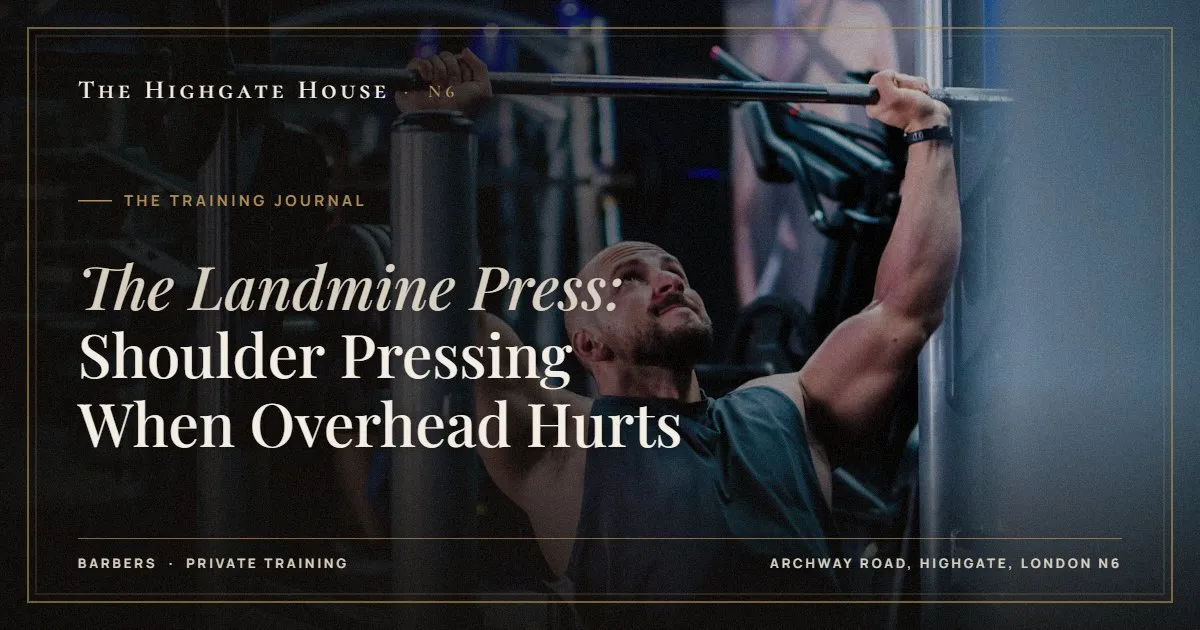
The Landmine Press: Shoulder Pressing When Overhead Hurts
The landmine press is a pressing movement where one end of a barbell is anchored to the floor and you push the other end up and forward on a diagonal. Because the bar travels in an arc rather than straight overhead, your shoulder blade can move freely and your arm never has to reach full overhead position. For many people whose shoulders grumble during a standard overhead press, that makes it the most comfortable way to keep training the shoulders, upper chest and triceps hard. It is also a useful lift in its own right, not just a stopgap, because it trains the trunk to resist rotation and suits anyone who spends their working day hunched over a laptop.
Why the angle helps
A strict overhead press asks for a lot of mobility at once: the shoulder must flex fully, the shoulder blade must rotate upward, and the upper back has to extend so the bar can pass the head. Desk posture, a stiff upper back or an old shoulder niggle can limit any of those, and people compensate by arching the lower back or pushing the ribs forward.
The landmine press removes the hardest part of that range. You press somewhere between horizontal and vertical, roughly where your arm wants to go anyway. The arc also lets the shoulder blade glide forward and around the rib cage at the top, which tends to feel smooth rather than pinched. In short, you keep most of the pressing benefit while asking less of the positions that commonly cause trouble.
That is not a diagnosis, and it will not suit every shoulder. If pressing of any kind causes sharp pain, pain that lingers into the next day, numbness or weakness, stop and get it assessed. Check with your GP first if you have had a recent injury, dislocation or shoulder surgery.
Setting it up
You need a barbell and something to stop the end sliding. A purpose-made landmine attachment is ideal. Without one, the end of the bar can be placed securely into a corner, with a towel wrapped around it to protect the wall and floor. Load the free end with plates, and keep them smaller than you think: the angled lever makes the lift feel heavier than the number suggests.
How to do a half-kneeling single-arm landmine press
This is the version I teach first. Kneeling removes the legs from the equation and makes it very obvious if your trunk is twisting or arching.
- Kneel facing the bar. If pressing with the right arm, put the right knee down and the left foot forward, knees at right angles. Squeeze the glute of the down leg gently.
- Hold the end of the bar at shoulder height, close to your chest, with the hand wrapped around the sleeve and the elbow tucked slightly in front of the body rather than flared out to the side.
- Set your trunk. Breathe in, ribs down, as if bracing for a light push in the stomach.
- Press up and forward along the line of the bar until the arm is straight. Let the shoulder blade reach forward at the top, as if you were pushing the bar a few centimetres further away.
- Lower under control back to the shoulder, over two or three seconds, without letting the torso turn towards the bar.
- Finish all reps on one side, then switch.
Start with something you can press for 10 to 12 clean reps, and stop each set when the next rep would cost you position rather than when you physically cannot move the bar.
Common mistakes
- Leaning back to press. The ribs flare and the lower back arches, turning it into a poor incline press. Lighten the load and keep the ribs stacked over the pelvis.
- Twisting towards the working arm. The bar should move; you should not. This anti-rotation demand is half the value of the exercise.
- Elbow flared wide. A slightly tucked elbow tends to be kinder to the front of the shoulder.
- Stopping short at the top. The final reach, where the shoulder blade moves forward, is a large part of why the lift feels good for shoulders. Do not cut it off.
- Loading too fast. Small jumps matter here. Adding a reps-first approach before adding plates keeps progress steady.
Which variation to choose
| Variation | Best for |
|---|---|
| Half-kneeling, single arm | Learning the movement, trunk control, sensitive shoulders |
| Tall kneeling, single arm | A tougher test of hip and trunk position |
| Standing, split stance | Heavier loading and transfer to sport and daily pushing |
| Standing, two hands | Moving the most weight, upper chest emphasis |
| Landmine push press | Power, using a small leg drive to start the bar |
Where it fits in a programme
Use it as your main vertical press on days when overhead pressing is uncomfortable, or as a second pressing movement after a bench press. Three or four sets of 6 to 12 reps per side, once or twice a week, is a sensible starting point. Because it is single-arm, it also shows up any difference between sides, which you can correct by always starting with the weaker side and matching its reps on the stronger one.
It pairs well with a horizontal pull such as a seated cable row, and with anti-rotation core work like the Pallof press. If the long-term goal is to return to strict overhead pressing, combine it with upper back and shoulder mobility work, such as the drills in shoulder mobility exercises for desk-bound shoulders, and test the overhead press again with a light bar every few weeks. Our guide to overhead press form covers what good looks like when you get there.
Learning it with a coach
The landmine press looks simple, and the setup is, but the details that make it shoulder-friendly are easy to miss on your own: rib position, elbow angle, the reach at the top, and whether the torso is quietly turning. These are exactly the things a coach watching from the side picks up in a couple of reps. In 1-1 personal training in Highgate, the studio is booked to you alone, so we can take time to find the version and angle that suit your shoulders rather than forcing a standard lift on them. If a shoulder is currently limiting your training, that is a good place to start, and you can read more about the private training studio here.
For general guidance on looking after a painful shoulder, the NHS page on shoulder pain sets out when self-care is reasonable and when to get it checked.
Questions we get asked
Is the landmine press as good as an overhead press?
It trains similar muscles through a different angle, with more upper chest involvement and less full overhead range. For many people it is the better choice at the moment; for others it is a useful companion lift.
What muscles does the landmine press work?
Mainly the front of the shoulder, upper chest and triceps, with the muscles around the shoulder blade and trunk working hard to keep you stable.
Can I do it without a landmine attachment?
Yes, if the end of the bar is wedged securely into a corner and protected with a towel. Make sure it cannot slip before loading it.
How heavy should I go?
Lighter than you expect at first. Choose a load you can press for 10 clean reps per side, then add reps before adding plates.
Book with The Highgate House
Ready to start training properly? Email us at [email protected] with the service and the day that suits you, and we will come back to you with times.
Visit The Highgate House · Private personal training
The Highgate House, Archway Road, Highgate, London N6.
