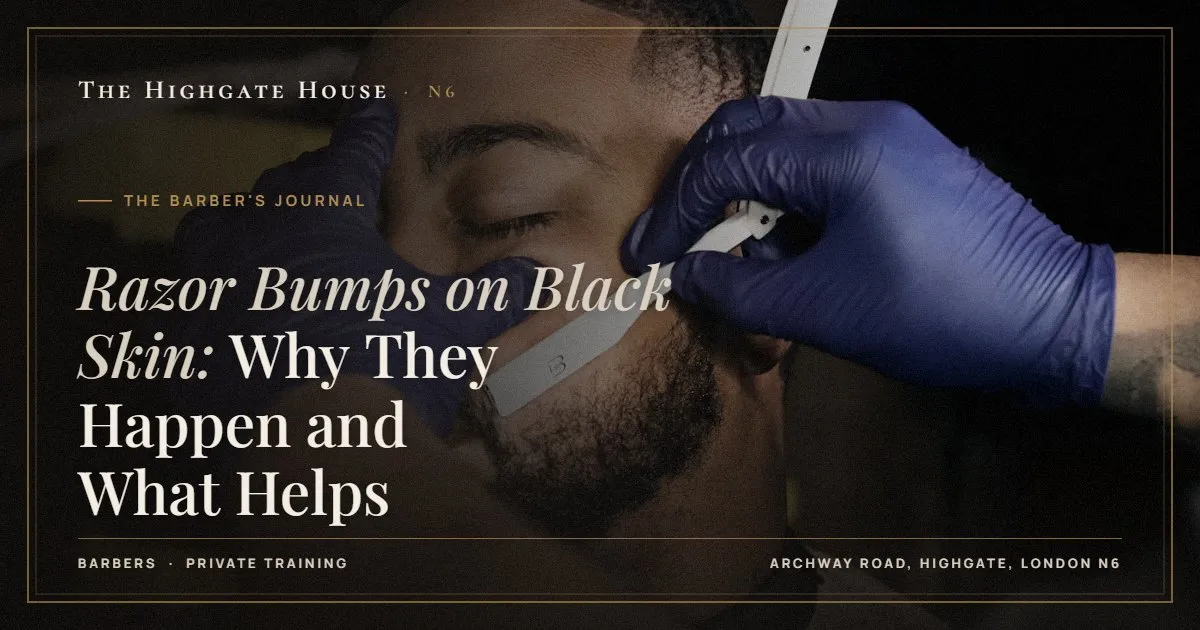
Razor Bumps on Black Skin: Why They Happen and What Helps
Razor bumps, known medically as pseudofolliculitis barbae, happen when a closely cut hair with a sharp tip curls back and grows into the skin, which then reacts as it would to a splinter. Tightly curled hair is far more likely to do this, which is why the condition is especially common in Black men who shave. It is not caused by poor hygiene and it is not usually an infection. What helps most is not cutting the hair so short: leaving a millimetre or so of stubble, shaving with the grain rather than against it, never stretching the skin, and giving inflamed skin time off. Here is why each of those works, and when to see a GP rather than a barber.
Why curly hair causes razor bumps
Hair that grows from a curved follicle emerges at an angle and keeps curling as it grows. Cut it at skin level and the new tip is sharp and angled. Within a day or two it can curve back and pierce the skin next to the follicle, or never fully leave the follicle at all. The body treats the hair as a foreign object: the result is a firm, raised bump, sometimes with a small pustule, often itchy or sore.
The closer the shave, the worse it gets. Shaving against the grain, or stretching the skin while shaving, cuts hair below the surface. When the skin relaxes, the hair tip is already under it. This is exactly what a “perfect” close shave is designed to do, and why advice that works for straight-haired skin can make things worse here.
Razor bumps are a distinct problem from razor burn, which is surface irritation from the blade itself, though the two often appear together. Our article on razor burn explains the difference, and the general mechanics of single ingrown hairs are covered in our ingrown hair guide. This piece is specifically about the persistent, recurring version that affects curly beard hair.
Why it matters more on darker skin
The bumps themselves are only part of it. On darker skin, inflammation often leaves dark marks behind (post-inflammatory hyperpigmentation) that can last for months after the bump has gone. In some people, repeated inflammation can lead to raised scarring, including keloids. That is why it is worth breaking the cycle early rather than shaving through it.
The most effective fix: stop cutting so close
The Primary Care Dermatology Society’s patient leaflet on pseudofolliculitis is clear that stopping shaving is the most reliable treatment, and that the skin often settles within four to six weeks once you do. Hair that is allowed some length tends to grow out of the follicle and curl away from the skin rather than back into it.
You do not need a full beard. The same leaflet suggests keeping beard hair at around 0.5mm to 1mm with clippers or an electric trimmer. That reads as a very close, even shadow, and for many men it is the point where the bumps stop. In practice:
- Use a trimmer with a guard or an adjustable blade, not a blade razor.
- Do not use a foil shaver on its closest setting without guards; some still cut too close.
- Trim every two to three days rather than letting it grow and taking it all back.
If you need to be clean-shaven
Some jobs require it, and some men simply prefer it. If you are going to shave with a blade, the method matters more than the razor.
- Prepare the skin. Wash with warm water, or shave after a shower. Soften the beard with a warm, damp cloth for a couple of minutes.
- Free any trapped hairs first. Gently, with a soft brush or clean flannel in small circles. Do not pick or tweeze.
- Use a proper lubricating shave cream or gel and let it sit for a minute.
- Shave once, with the grain. On the neck, curly hair often grows in several directions. Our guide to mapping your grain shows how to work it out.
- Do not stretch the skin and do not go back over the same area.
- Rinse with cool water and apply a fragrance-free, alcohol-free moisturiser or balm.
- Shave less often. Every other day, or every third day, gives the hair time to clear the skin.
Some men do better with a single-blade razor than a multi-blade cartridge, which is designed to lift and cut hair below the surface. It is worth trying if the method above helps but does not solve it.
If your employer requires you to be clean-shaven and the condition is persistent, the PCDS leaflet notes that a GP can provide a letter supporting a request not to shave.
What helps, and what makes it worse
| Helps | Makes it worse |
|---|---|
| Leaving 0.5mm to 1mm of stubble | Shaving against the grain |
| One pass, with the grain | Stretching the skin while shaving |
| Warm water and softening before shaving | Dry shaving or shaving on cold skin |
| Gently freeing trapped hairs with a soft brush | Plucking or digging hairs out with tweezers |
| Shaving every two or three days | Daily close shaving through active bumps |
| Fragrance-free aftercare | Alcohol-heavy aftershave on irritated skin |
Line-ups, necklines and the barber’s chair
Razor bumps often cluster on the neck, under the jaw and along the edge of the beard or hairline. The same areas a barber cleans up with a razor for a crisp line-up. If you are prone to bumps, tell the barber at the start. Every visit to Highgate Cuts starts with an assessment, where the barber looks at your hair and skin and what you want, and recommends from there. For someone with active bumps, that might mean:
- Shaping the neckline and edges with a trimmer rather than a blade, leaving the slightest stubble.
- Avoiding the razor altogether on inflamed areas until they settle.
- Keeping the outline a fraction softer, which also means it grows out more gracefully.
- Advising a beard length that sits comfortably above the point where bumps start.
A good barber will be relaxed about all of this. A sharp outline is not worth a week of sore skin. If you are looking for a shop that understands textured hair more generally, our guide to finding a barber who knows Afro hair lists what to ask. You can see the services we offer, including beard work and line-ups, on the Highgate Cuts barbers page.
When to see a GP or pharmacist
A pharmacist is a sensible first stop for mild, persistent bumps. See your GP if:
- The bumps are not improving after several weeks of the changes above.
- They become painful, hot, swollen or pus-filled in a way that is spreading.
- You notice raised, firm scars or keloids forming.
- Dark marks are building up and troubling you.
- It is affecting your work or your confidence.
Treatments a GP may consider include creams to reduce inflammation, treatments that help the skin turn over, and sometimes antibiotics where there is infection. Those are medical decisions, not barbering ones, and they work best alongside the shaving changes rather than instead of them.
The Highgate Cuts barbershop is on the ground floor of The Highgate House on Archway Road, about five minutes’ walk from Highgate tube. If you want a cut or beard shape that is kind to your skin, mention it when you book with our barbers.
Questions we get asked
Are razor bumps an infection?
Not usually. They are an inflammatory reaction to hair growing back into the skin. Bumps can become infected, especially if picked, which is one reason to leave them alone.
Will an electric shaver stop razor bumps?
Often it helps, because it does not cut as close as a blade. A trimmer with a short guard, leaving around 0.5mm to 1mm, is usually more reliable.
How long do razor bumps take to go?
Many people see clear improvement within four to six weeks of stopping close shaving. Dark marks left behind can take longer to fade.
Can I still get a sharp line-up?
Yes, though on bump-prone skin it is often better done with a trimmer than a razor. Tell the barber at the start and they can adjust.
Book with The Highgate House
Ready for a proper cut? Email us at [email protected] with the service and the day that suits you, and we will come back to you with times.
Visit The Highgate House · The barbers
The Highgate House, Archway Road, Highgate, London N6.
