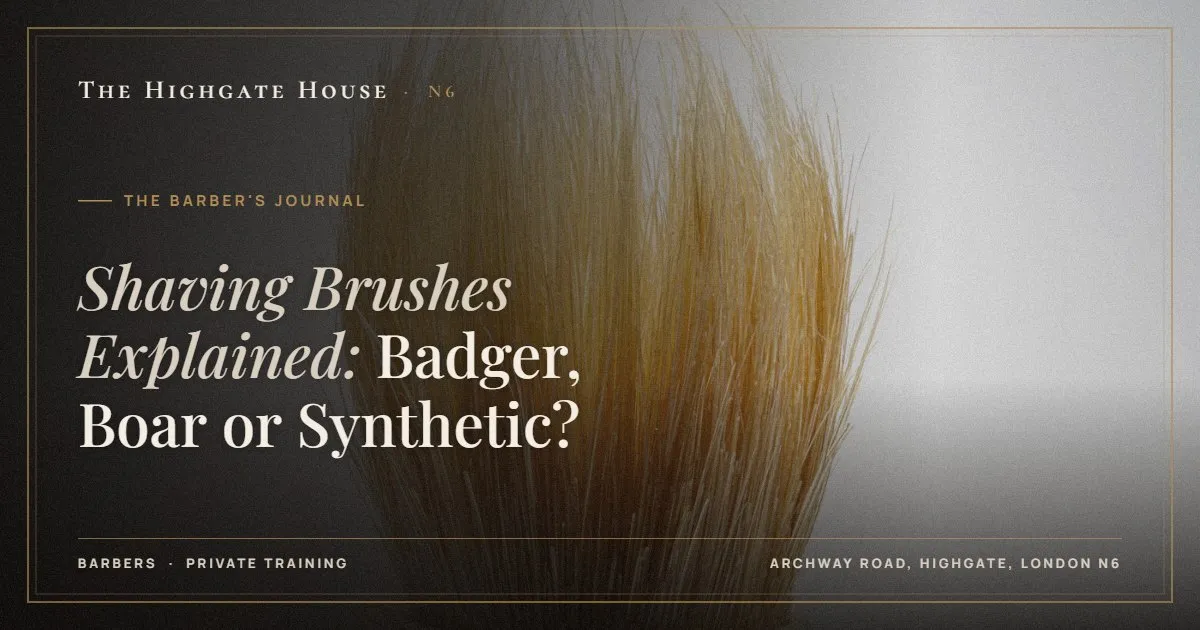
Shaving Brushes Explained: Badger, Boar or Synthetic?
There are three main shaving brush types: badger hair, boar bristle and synthetic fibre (horse hair exists but is less common). Badger is soft and holds a lot of water, boar is stiffer and cheaper and gets softer with use, and modern synthetics are soft, quick-drying and need no breaking in. For most men starting out, a good synthetic is the easiest choice. Boar suits hard shaving soaps and men who like a firm, scrubby feel. Badger is the traditional luxury option, pleasant to use but not necessary for a good shave. The bristle matters less than the knot size and shape, which most buyers ignore.
What a brush actually does
A brush is not just for spreading foam. It does three jobs that fingers cannot:
- Builds lather. Whipping soap or cream with water and air creates a dense, slick lather that cushions the blade far better than foam from a can.
- Lifts the hair. Swirling against the grain stands stubble up, so the blade meets it more cleanly.
- Works water into the hair. Softened stubble cuts with less tugging, which is a large part of why a brush shave feels smoother.
That is also why barbers use one before a straight-razor shave. If you want to see the whole sequence done professionally, our piece on the hot towel shave walks through it.
The three main types compared
| Type | Feel | Best with | Drying and care | Trade-off |
|---|---|---|---|---|
| Badger | Soft, dense, holds lots of water | Creams, bowl lathering | Slow to dry, needs airflow | Animal hair, higher cost |
| Boar | Firm, scratchy at first, softens over weeks | Hard soaps, face lathering | Moderate | Break-in period, can shed early on |
| Synthetic | Soft, consistent from day one | Everything, especially travel | Dries fast, very low maintenance | Holds less water than badger |
| Horse | Between boar and badger | Soaps and creams | Moderate | Harder to find |
Badger: the traditional choice
Badger hair brushes are sold in grades, and the names vary between makers. Broadly, the cheaper grades (often called “pure”) are darker and scratchier, the middle grades (“best” or “fine”) are softer, and the top grades (“super” or “silvertip”) have pale, very soft tips and plenty of backbone. The difference you feel is mostly at the tips. A good badger brush is a pleasure, but it is a luxury, not a requirement. Some men also simply prefer not to use animal hair, which is a perfectly good reason to skip it.
Badger holds a lot of water, so you will need to shake it out more before lathering a hard soap, or the lather turns thin and bubbly.
Boar: the working brush
Boar bristle is what many traditional shops used for decades. New boar brushes feel stiff and can smell faintly of the bristle until they have been used and washed a few times. Over the first few weeks the tips split and soften, and the brush gets noticeably better. That stiffness is an advantage with hard soaps: it loads soap from the puck quickly and scrubs lather into the stubble. It is also the cheapest of the natural options.
Breaking in a boar brush
- Soak it in warm water for ten minutes before the first few uses.
- Lather with it every shave, even briefly. Use is what softens the tips.
- Expect a few loose bristles in the first weeks. That usually settles.
- Give it a month before deciding whether you like it.
Synthetic: where most men should start
Older synthetic brushes earned a poor reputation: slippery, floppy and bad at holding water. Current synthetics are a different product. They are soft from the first use, do not shed, dry in hours rather than a day and do not mind being packed damp in a wash bag. If you shave three or four times a week at home and occasionally travel, a mid-priced synthetic is very hard to argue against. The one thing it does slightly less well is hold water, which simply means dipping the tips again while you lather.
Knot size, loft and shape: the overlooked part
Two brushes of the same bristle can feel entirely different because of how the knot is built.
- Knot diameter: smaller knots (around 20 to 22mm) are precise and good for face lathering and getting under the nose. Larger knots (26mm and up) hold more lather and suit bowl lathering, but can feel unwieldy.
- Loft: how far the hair stands out of the handle. A high loft is floppy and soft. A low loft is firm and scrubby.
- Shape: a bulb-shaped top concentrates on the tips and feels gentle. A flat top feels denser and spreads lather evenly.
- Handle: it should feel secure with wet, soapy hands. Heavy handles stand up better on a shelf.
If you have only ever used a brush that felt wrong, the knot is a more likely culprit than the bristle.
Soap or cream: matching the brush to what you use
Hard soaps need a brush with enough backbone to load from the puck. Boar and firmer synthetics do this best. Creams lather easily and suit softer badger or synthetic brushes. If you are still deciding between products, our comparison of shaving cream, soap and gel covers what each does. For the shave itself, from prep to aftercare, see how to shave properly.
Keeping a brush clean and long-lived
- Rinse thoroughly in warm (not hot) water after every shave until the water runs clear. Leftover soap stiffens the knot.
- Squeeze gently, then flick out the water. Do not twist or wring the hair.
- Dry it somewhere with airflow, never in a closed cabinet or a sealed bag. A stand that hangs it upside down helps natural hair, though many makers say upright drying is fine too.
- Every few weeks, wash it with a little mild shampoo to remove soap build-up and hard-water deposits, which London’s water leaves behind.
- Do not share it. A brush is personal kit, and for anyone prone to irritated skin a clean, dry brush matters.
If you get repeated bumps after shaving, the NHS page on ingrown hairs has sensible general advice, and it is worth asking your barber to look at your growth direction next time you are in.
Learning from the barber’s chair
The quickest way to understand what a well-built lather feels like is to have one applied for you. During a hot towel shave at Highgate Cuts, which takes 20 to 30 minutes, you can see how much water goes into the lather and how the brush is worked against the grain. Plenty of clients go home and change how they lather. You can find our shave and beard services on the Highgate barber page, and if you want to ask about technique, just ask in the chair. We would rather you shave well at home.
Questions we get asked
Is a badger brush worth the money?
Only if you enjoy the ritual. It feels lovely, but a good synthetic gives an equally good shave for far less, and needs less care. If you would like a recommendation for your skin and stubble, ask during any shave or beard appointment.
How long does a shaving brush last?
With proper rinsing and drying, a decent brush lasts years. Brushes that die early are usually stored wet or left full of soap.
Can I use a brush with shaving gel?
You can, but most gels are designed to foam by hand and gain little from a brush. Brushes come into their own with soaps and creams.
Do I need a lathering bowl?
No. Many men lather directly on the face, which is quicker. A bowl gives you more control over water and is easier for beginners with creams.
Book with The Highgate House
Ready for a proper cut? Email us at [email protected] with the service and the day that suits you, and we will come back to you with times.
Visit The Highgate House · The barbers
The Highgate House, Archway Road, Highgate, London N6.
