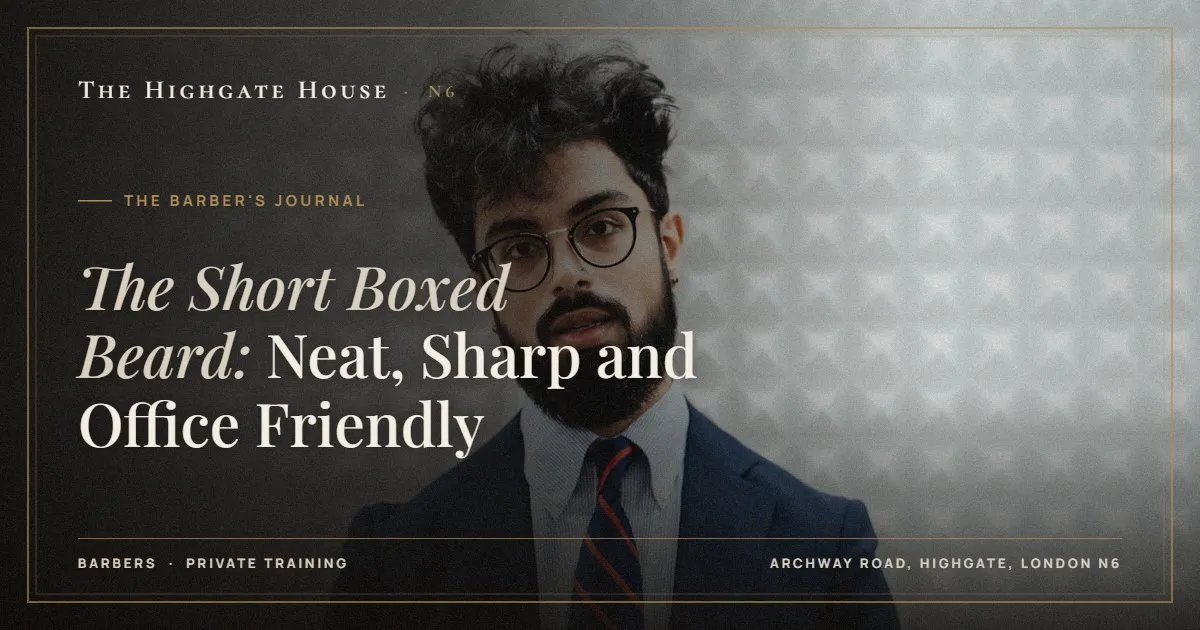
The Short Boxed Beard: Neat, Sharp and Office Friendly
A short boxed beard is a full beard kept short and even, with a defined cheek line, a clean neckline and sideburns that connect smoothly to the haircut. It is longer than stubble but short enough that the jaw still shows through, which is why it reads as groomed rather than grown. It suits most face shapes, works in conservative offices and takes about five minutes a week to keep in shape once a barber has set the lines. The trick is that “short” is not one length: the sides, chin and moustache are usually cut to slightly different lengths, and that is what stops it looking like a uniform carpet.
What makes a beard “boxed”?
The word refers to the outline rather than the length. A boxed beard has four edges that are set on purpose:
The cheek line, running from the sideburn towards the corner of the moustache. It is tidied rather than left to wander up the cheekbone.
The neckline, sitting roughly a finger or two above the Adam’s apple, so the beard finishes under the jaw rather than halfway down the throat.
The sideburns, blended into the haircut, often with a short fade so there is no visible join.
The moustache, trimmed clear of the top lip.
Inside those edges, the hair is cut short and close to even. Take away the edges and you have a short full beard that looks unattended. Keep the edges and the same hair looks like a decision. If you only learn one of these lines properly, make it the neckline: our guide to where your beard neckline should sit explains why a line set too high is the most common mistake we see.
How short is short?
Most short boxed beards fall somewhere between heavy stubble and about a centimetre and a half. Rather than one guard all over, a barber will usually work in zones:
Area | Typical approach | Why |
|---|---|---|
Sideburns | Shortest, faded into the haircut | Avoids a hard step where hair meets beard |
Cheeks | Slightly shorter than the chin | Keeps the face from looking wide |
Jaw and chin | Longest part of the beard | Gives shape and a stronger jawline |
Under the jaw | Tapered down towards the neckline | Stops the beard looking heavy from the side |
Moustache | Trimmed off the lip, often by scissor | Comfort, eating, and a cleaner mouth line |
The difference between zones is small, often a single guard size, but it is what gives a short beard its shape. If you trim at home and want to know what each setting actually leaves, our beard trimmer length guide runs through it.
Who it suits, and where it needs adjusting
The short boxed beard is forgiving, but a few adjustments make a real difference:
Round faces: keep the cheeks tighter and leave a little more length at the chin. That lengthens the face rather than widening it.
Long or narrow faces: do the opposite. A touch more fullness at the sides and a shorter chin stops the face looking longer still.
Soft jawlines: a well-placed neckline does more than any length choice. It draws a clean line where the jaw should be.
Patchy cheeks: a short boxed beard can work, but the cheek line usually needs lowering to sit under the sparse area, and the overall length kept a little longer so gaps fill in.
Grey coming through: shorter beards show grey as an even salt-and-pepper texture, which most men find more flattering than a longer beard with grey streaks.
Why it works in an office
Most workplaces that have any view on beards are really objecting to beards that look unkempt. A short boxed beard answers that by looking finished from every angle: no stray hairs on the cheeks, nothing creeping down the neck, a clear mouth. It also photographs well on video calls, where a longer beard can lose its shape against a dark background. If you wear a collar and tie, the neckline matters doubly: a beard that disappears into a shirt collar is the version that reads as untidy.
What happens when a barber builds one
Every visit at Highgate Cuts starts with an assessment, and for a beard that means looking at your growth pattern, density, any patches or cowlicks, and how the beard sits against your haircut. Then, broadly:
Bulk reduction. The beard is taken down to roughly the right length with clippers, working with the direction of growth.
Shaping in zones. Cheeks, jaw and chin are cut to slightly different lengths, with the barber checking from the front and both sides.
Setting the lines. The neckline and cheek line are defined with a trimmer, and on some clients finished with a razor for a sharper edge.
Blending. Sideburns are faded into the haircut so beard and hair read as one.
Moustache detail. Usually by scissor over comb, so the lip line is clean without looking shaved.
Done alongside a haircut, this is where a barber earns their keep, because the beard and the sides of the cut have to be balanced together. You can read more about beard work and cuts at our Highgate barbers.
Keeping it sharp between visits
A short beard shows growth quickly. A week of neglect is visible in a way it would not be on a longer beard. The routine below keeps it in shape without needing to touch the lines the barber set.
A five-minute weekly routine
Wash and fully dry the beard first. Damp hair cuts unevenly.
Run a trimmer over the cheeks and jaw at the length you were left with, against the direction of growth for an even result.
Go one guard shorter just under the jaw to keep the taper.
Clean only the hair that has grown below the existing neckline and above the existing cheek line. Do not redraw the lines.
Trim any moustache hairs touching the lip with small scissors.
Mistakes that wreck the shape
Creeping the neckline upwards. Each week a few millimetres higher, until the beard looks like a chinstrap.
Using one guard everywhere. The beard loses its shape and the face can look wider.
Trimming straight after a shower. Wet hair looks longer than it is, so you take off too much.
Ignoring the skin underneath. A short beard sits close to the skin, so dryness and flakes show. A light beard oil or moisturiser helps.
If you get red, sore bumps along the neckline after edging with a razor, those are often irritated or ingrown hairs. The British Association of Dermatologists' guidance on folliculitis is a sensible place to start, and switching to a trimmer for the edge often helps.
How often to book
For most men, every three to four weeks keeps the lines exactly where they should be. If you are having your hair cut on the same rhythm, booking the two together is the most efficient arrangement, and it keeps hair and beard growing out at the same pace. Men with very fast or dense growth sometimes prefer a quick beard tidy between full cuts. Not sure which suits you? Our barber page lists the services, and we are happy to advise on timing at your first visit.
Questions we get asked
Can I go from a long beard to a short boxed beard in one visit?
Yes. It is one of the more satisfying cuts to do. Expect the barber to take it down in stages and check the shape as it goes, because a jawline you have not seen for a while sometimes changes the plan.
Should the cheek line be natural or sharp?
For an office look, a tidied natural line usually ages better than a hard razor line, which needs more frequent upkeep and can look severe as it grows out.
How long should I grow it before the first proper shape?
Three to four weeks of growth gives the barber enough to work with on most men. Any less and the lines have little to define.
Does a short boxed beard need oil?
It needs less than a long beard, but a few drops of oil or a light balm keeps the skin underneath comfortable and the hair from looking dry.
Book with The Highgate House
Ready for a proper cut? Email us at [email protected] with the service and the day that suits you, and we will come back to you with times.
Visit The Highgate House · The barbers
The Highgate House, Archway Road, Highgate, London N6.
