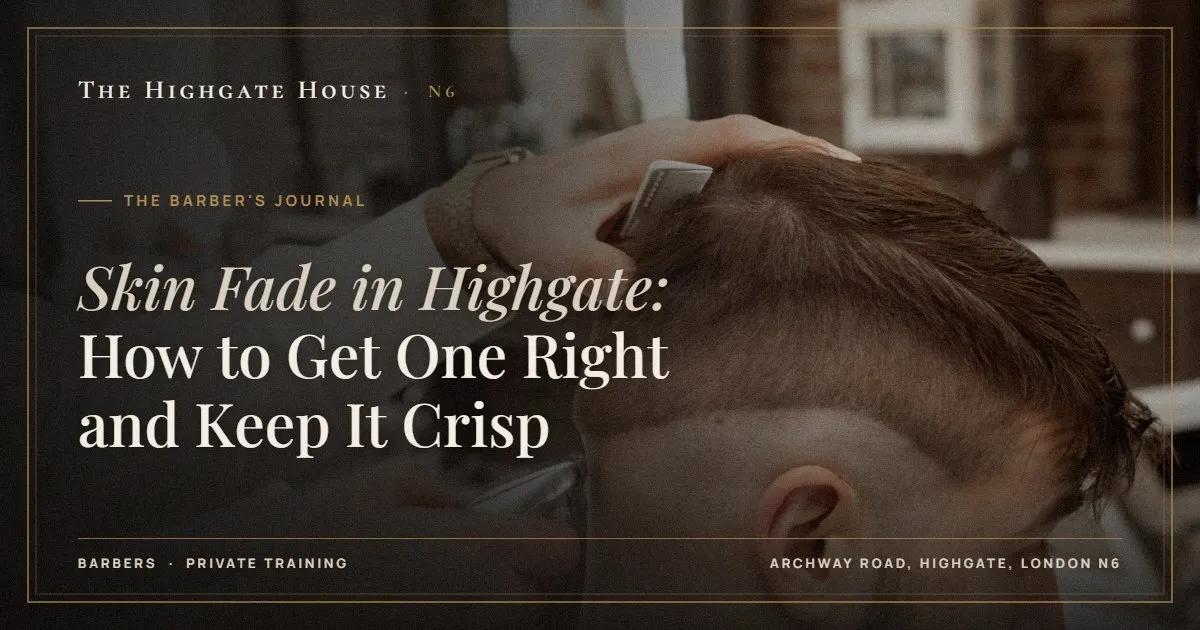
Skin Fade in Highgate: How to Get One Right and Keep It Crisp
A skin fade is a haircut where the sides and back are taken down to bare skin at the bottom and graduate, without a visible line, into longer hair above. Getting a good one comes down to three decisions: where the fade starts (low, mid or high), how quickly it climbs into the length on top, and how the edges are finished. It looks sharpest for about a week and most people rebook every two to three weeks. Below is how to make those decisions before you sit down, so the cut you leave with is the one you pictured.
What a skin fade actually is
Every fade is a gradient. A skin fade simply starts that gradient at zero: the lowest band is shaved with a foil shaver or razor, or taken with clippers closed down as tight as they go. From there the barber works upward through progressively longer settings, blending each band into the next so that no step is visible.
That blending is where the skill sits. The difference between a fade that looks expensive and one that looks home-made is the transition zone where skin becomes stubble. Done well, it reads as a soft shadow. Done badly, you see a ring. Two neighbours are often confused with it:
- Taper. Only the hairline is graduated, usually around the ears and at the nape. The rest of the sides keep some length. Quieter, grows out more gracefully.
- Standard fade. Same shape as a skin fade, but the shortest band is a short clipper length rather than bare skin. Less contrast, less upkeep.
Low, mid or high: choosing the height
The height is the point where the shortest part of the fade ends and the blend begins. It changes the whole character of the cut far more than most people expect.
| Height | Where the skin stops | Reads as | Worth knowing |
|---|---|---|---|
| Low | Just above the ears and along the nape | Clean but conservative | The easiest to wear in a formal office and the most forgiving as it grows |
| Mid | Around the temple, roughly level with the top of the ear | Balanced, noticeably sharp | The default for most people; works with a crop, a side parting or textured length |
| High | Up near the parietal ridge, where the side of the head turns into the top | Strong contrast, more athletic | Shows head shape, scars and any unevenness in the skull; grows out fastest visually |
A drop fade follows the curve of the head, higher at the temple and lower behind the ear, which flatters most profiles. To choose, start with your head shape and your working week. If the back of your head is flat or has a pronounced ridge, a high fade will advertise it; a mid or drop fade will hide it. If you are in front of clients most days, a low fade earns its keep by still looking deliberate in week three.
How to ask for a skin fade without being misunderstood
“Skin fade, short on top” leaves too many decisions to someone who met you ninety seconds ago. Arrive with answers to these:
- Height. Low, mid, high or drop. Point to where you want bare skin to end, and mention any cowlick at the crown.
- Length on top. Give it in centimetres or with your fingers, and say whether it should be scissor cut or clipper cut. Scissors keep more movement; clippers are tidier and quicker to style.
- The line-up. Should the front hairline and temples be sharpened with a razor, or left natural? A crisp line-up looks superb for a few days and then grows back as visible stubble. Natural lasts longer.
- The neckline. Faded to nothing, or squared off? A faded nape grows out better.
- Your beard, if you have one. Ask for the fade to carry through the sideburn into the beard with no hard break.
- A photo of someone with your hair type. Texture changes how a fade looks more than anything else.
If you quote clipper numbers, say the millimetres too. On the most common guard sets a 1 is about 3mm, a 2 about 6mm and a 3 about 10mm, but brands vary.
Ask to see the back in the mirror before the cape comes off. Uneven blending is easy to correct in the chair.
How long a skin fade stays crisp
The honest arc, assuming average growth:
- Days 1 to 4. The skin zone is genuinely bare, the blend is at its sharpest and any razor line-up is clean. This is the version in photographs.
- Days 5 to 10. A shadow comes through on the shaved band. The contrast softens; many people prefer it here.
- Days 10 to 21. The bottom band has visible length and the gradient compresses. From a distance it reads as a short back and sides.
- Beyond three weeks. The shape has gone and the hair on top starts to look heavy against the sides.
Dark, coarse hair shows regrowth sooner because the shadow contrasts more with the skin. Fair or fine hair can stretch an extra week.
How often to book
Match the interval to how sharp you want to look, not to how long the cut technically survives:
- Every 1 to 2 weeks if the skin fade is the point and you want it close to day-one condition most of the time.
- Every 2 to 3 weeks for most people. This keeps the shape without turning the barber into a standing appointment you resent.
- Every 4 weeks or more and a taper or standard fade will serve you better.
For what our chair offers, see the Highgate Cuts barber menu. The easiest way to keep the rhythm is to book the next one before you leave; our guide to booking a barber in Highgate without the wait covers how that works.
Upkeep at home between cuts
Most of what ruins a fade between visits is well-meant self-maintenance.
What helps
- Tidying only below the fade. Stray hairs on the neck under the nape line can be taken off with a trimmer. Keep strictly below where the barber’s work starts.
- Moisturising the shaved skin. Newly exposed scalp dries out, particularly with the heating on. A light, unfragranced moisturiser stops flaking.
- Sun protection. Skin that has been under hair for months burns easily. On sunny days, put sunscreen on the faded area; the NHS sun safety guidance recommends at least SPF 30 with a 4-star or higher UVA rating.
- Matte product on top. Shine against bare sides looks dated; a clay or paste does not.
What does not
- Running your own clippers over the fade. You will flatten the blend into a single length and the next cut has to start lower to repair it.
- Re-shaving the line-up yourself. The temples drift backwards a millimetre at a time.
- Ignoring bumps at the nape. Close shaving on the neck can cause ingrown hairs, especially in curly hair. If they are a regular problem, ask for a fade that stops just short of skin at the nape. The NHS page on ingrown hairs covers prevention and when to see a GP.
Mistakes worth avoiding
Going high on your first skin fade is the commonest. Start mid or low; you can go higher next time, but you cannot add hair back. The second is copying a photograph rather than working with your own hair: very fine hair can look patchy at the transition, and a slightly longer bottom band often solves it. The third is a first-ever skin fade the morning of a wedding. Book it three or four days before.
If you would rather keep more length and movement, a full scissor cut may suit you better, and if you wear a beard, read our beard shaping guide before your appointment so both are planned together.
Getting a skin fade on Archway Road
The Highgate Cuts team works from the ground floor of The Highgate House, a corner building on Archway Road, N6, about five minutes’ walk from Highgate tube, and easy from Archway, Crouch End, Muswell Hill and Hampstead. Fades, scissor cuts, beard work and hot towel shaves are on the barber services page. For prices, see the barber menu or email us.
Questions we get asked
Is a skin fade bad for your scalp?
For most people, no. The usual issues are dryness, sunburn and ingrown hairs at the neck; moisturiser, sunscreen and a slightly longer nape deal with all three.
Can you get a skin fade with thinning hair?
Often, yes, and it can help. Taking the sides very short reduces the contrast with a thinner top. A mid or high fade with a textured crop is a common choice. Ask the barber to look at the crown before deciding.
Skin fade or taper for an office job?
A low skin fade or a taper. Both look deliberate in a suit and both survive three weeks between cuts better than a high fade.
How long does a skin fade take in the chair?
Longer than a standard clipper cut, because the blend is built by hand. Allow more time than you would for a simple trim and do not book it with ten minutes to spare before a meeting.
Book with The Highgate House
Ready for a proper cut? Email us at [email protected] with the service and the day that suits you, and we will come back to you with times.
Visit The Highgate House · The barbers
The Highgate House, Archway Road, Highgate, London N6.
