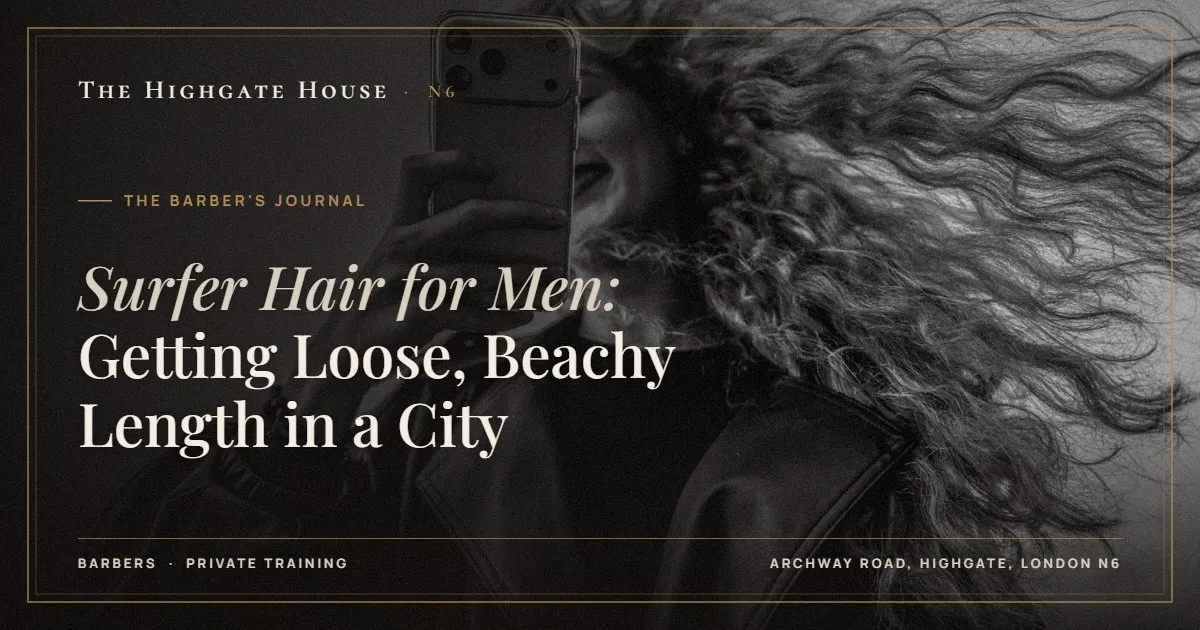
Surfer Hair for Men: Getting Loose, Beachy Length in a City
Surfer hair is medium-to-long hair, usually somewhere between the ears and the collar, that looks as if it dried in the wind: loose, a little uneven, with movement and a dry, salty texture rather than shine. Getting it in a city comes down to three things. First, enough length, typically several months of growth from a short cut. Second, a scissor cut with internal layering and soft, broken ends so the hair falls apart rather than sitting as one heavy block. Third, a light routine: sea salt spray or a matte cream, rough drying, and no heavy product. The cut does most of the work. Product only finishes it.
What separates surfer hair from just long hair
Long hair that has simply been left alone tends to go one of two ways. Straight hair hangs flat and parts itself in odd places. Wavy or thick hair puffs out at the sides and becomes triangular. Neither looks like the relaxed shape people mean when they say “surfer”.
The look depends on weight being taken out in the right places. The hair needs layers inside the shape so pieces can separate, ends that are cut softly rather than in a hard line, and sides that sit close enough to the head that the outline stays narrow. It should look unfussy, which takes a fair amount of deliberate cutting.
It is also slightly different from a bro flow, where the hair is swept back and trained to sit behind the ears. Surfer hair is messier, falls forward or to the side, and is happy to have pieces across the forehead.
Does your hair suit it?
| Hair type | How it behaves | What helps |
|---|---|---|
| Wavy, medium thickness | The natural fit; waves give the movement for free | Layering, a little salt spray, air drying |
| Thick and straight | Holds volume but can look heavy and blunt | More internal texturising, rough drying with a diffuser or fingers |
| Fine and straight | Falls flat and separates too much | Fewer layers, a slightly shorter length, texture spray for grip |
| Tight curls | Grows up and out rather than down | A different shape suits better; talk it through with your barber |
A receding hairline is not a barrier. Longer pieces falling forward and to the side can soften a high forehead better than a short cut does. Very thin hair on top is harder, because length tends to show the scalp through the gaps.
How long it takes to grow
From a standard short back and sides, you are usually looking at around six to nine months before there is enough length to call it surfer hair, and longer for collar length. The usual rule of thumb is that hair grows roughly half an inch a month, though it varies from person to person.
The mistake is to stop visiting the barber altogether. The back and sides grow at the same rate as the top, so without shaping you reach a stage where the sides stick out and the back curls over the collar long before the top has caught up. A trim every eight to ten weeks that only tidies the sides and neckline, while leaving the top alone, keeps you presentable through the in-between months. We cover that stage in detail in growing your hair out without the awkward stage.
What happens in the chair
Every visit at Highgate Cuts starts with an assessment. The barber looks at your hair dry, checks where it grows, where it is thick, where any cowlicks or crown swirls sit, and how it falls, then makes recommendations before anything is cut. For a surfer cut that conversation matters, because the shape is built around how your hair naturally wants to move.
A typical approach for this style:
- Establish the length you want to keep. Usually the longest pieces at the front and crown are left almost untouched.
- Bring the sides in. Scissors over comb or point cutting to reduce bulk above the ears, without going short enough to look like a disconnected undercut.
- Layer the interior. Shorter pieces underneath and longer ones on top, so the hair separates and moves.
- Soften the ends. Point cutting or slide cutting so nothing ends in a hard line.
- Check it dry. Wavy hair shrinks as it dries, so the barber will look at the finished shape dry and refine it.
Expect this to take longer than a clipper cut, because it is mostly scissor work. If you would like to know more about the service, the Highgate Cuts barber page covers what we offer.
What to say to your barber
- “I want to keep the length, just take out the weight.” This is the single most useful sentence.
- Say whether you tuck it behind your ears, push it back or let it fall forward.
- Say how much time you spend styling it. If the answer is none, the cut has to dry well on its own.
- Bring a photo of someone with a similar hair type, not just a similar look.
- Mention if you swim, cycle in a helmet or wear hats, since all of these change how the hair sits by the end of the day.
Getting the texture without the sea
The real thing is salt water, wind and sun drying the hair. The city version is simpler.
- Wash with a gentle shampoo two or three times a week rather than daily. Very clean hair is soft and slippery and will not hold texture.
- Towel dry until damp, not wet.
- Spray a few pumps of sea salt spray through the roots and mid-lengths. Our guide to sea salt spray for men covers how much to use.
- Rough dry with your fingers, or with a hairdryer on low heat, scrunching rather than brushing.
- Finish, if needed, with a pea-sized amount of matte cream on the ends only.
Avoid gels, shiny pomades and anything that sets hard. The look depends on hair that moves when you move.
Salt spray can dry the hair out if you use it every day, so a light conditioner on the ends after washing helps. If you are actually outdoors a lot, remember that a parting and a thinning crown can catch the sun. The NHS advice on sun safety applies to the scalp as much as the face.
Keeping it from going scruffy
The line between relaxed and neglected is mostly the edges. Every eight to ten weeks, a barber can tidy the neckline, the area around the ears and any bulk at the sides while barely touching the top. Split ends at the tips also make long hair look dry and frizzy, so taking off a small amount from the ends helps. If you have stubble or a beard, keeping that shaped stops the whole look tipping into unkempt. If you are local to Highgate, Archway or Crouch End, a shaping trim at our Archway Road barbers can be booked by email.
Questions we get asked
How long does my hair need to be for surfer hair?
Enough on top to reach roughly the eyebrows when pulled forward, and enough at the sides to cover the tops of the ears. Collar length at the back is common but not essential.
Can I get surfer hair with straight hair?
Yes, though it relies more on layering and texture spray. It will look more swept and piecey than wavy.
Is it suitable for the office?
With neat edges and a clean neckline, most offices accept it easily. The tidier the outline, the more relaxed the top can be.
How often should I see a barber while growing it?
Roughly every eight to ten weeks, for a shaping trim that leaves the top length alone.
Book with The Highgate House
Ready for a proper cut? Email us at [email protected] with the service and the day that suits you, and we will come back to you with times.
Visit The Highgate House · The barbers
The Highgate House, Archway Road, Highgate, London N6.
