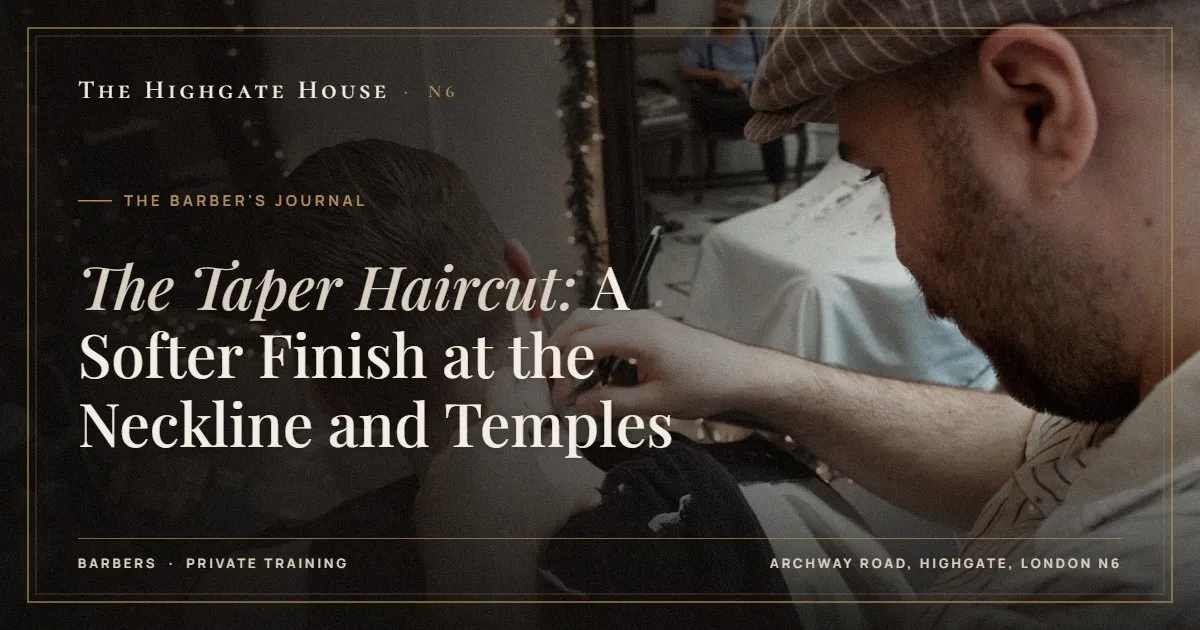
The Taper Haircut: A Softer Finish at the Neckline and Temples
A taper haircut is one where the hair gets gradually shorter towards the natural hairline, at the nape, around the ears and at the sideburns, while the rest of the sides keep visible length. Unlike a fade, which carries the graduation high up the head and often takes it down to skin, a taper only shortens the edges. The result looks neat and finished without the contrast of a fade, and it grows out gracefully, so it suits people who want to look tidy in week four, not just week one. It works with almost any length on top.
Taper vs fade: the real difference
Both are gradients from short to long. The difference is where the gradient happens and how far it travels.
| Taper | Fade | |
|---|---|---|
| Where the graduation sits | At the hairline edges only: nape, around the ears, sideburns | Across the sides and back, often up to the temple or higher |
| Shortest length | Usually a short guard; skin only at the very edge, if at all | Often skin or very close |
| Contrast | Low | Medium to high |
| Grow-out | Gradual; still looks deliberate after a month | Visible after one to two weeks |
The “taper fade” is the hybrid you will hear about: a fade kept low and confined to the edges, so it behaves like a taper with a bit more sharpness. Our guide to taper fade vs low fade unpicks those two in more detail. This post is about the classic taper.
Low, mid and high tapers
- Low taper. Only the last centimetre or two at the nape and around the ears is graduated. The quietest version and the most office-friendly.
- Mid taper. The graduation climbs a little higher, to around the middle of the ear at the side. Neater looking without being sharp.
- High taper. Taken higher at the temples and nape, giving a cleaner frame. Starts to overlap with a low fade, but keeps more length through the sides.
Most people asking for “a taper” want a low taper with a neat, natural neckline. If you want more definition, a mid taper is the next step.
Why the taper grows out so well
The taper’s real advantage is time. A fade’s appeal is the contrast between skin and hair, and contrast disappears fast as stubble returns. A taper never relies on that contrast. It follows the natural hairline, so as hair grows, the outline stays in the same shape, just slightly longer.
That makes a taper the practical choice if you:
- book every four to six weeks rather than every two or three
- work in an environment where a high-contrast fade looks too much
- have a natural neckline that sits low or uneven and would show quickly on a sharper cut
- want to grow your hair longer without passing through an awkward stage
If you are growing out a fade, a taper is often the bridge. Our post on growing out a fade uses it at exactly that point.
The neckline: tapered or blocked
The nape is where a taper shows most. A tapered neckline graduates to nothing at the hairline, following its natural shape. A blocked or squared neckline is cut straight across. A taper haircut nearly always pairs with a tapered neckline, and for good reason: a blocked line grows out as a fuzzy shelf within a week or two, while a tapered one simply looks a little longer. Our guide to tapered vs blocked necklines covers the exceptions.
How to ask for a taper
- Say taper, not fade. And say you want length kept through the sides. Many barbers default to a fade if the word is mentioned at all.
- Choose the height. Low, mid or high, or point to the level on your ear.
- Give the side length. A guard number or a scissor length for the sides above the taper.
- Describe the top. Length, how you wear it, and whether it is scissor cut.
- Edges. Natural or tidied sideburns, and whether you want a razor finish at the very edge.
A taper often works best when the sides are scissor cut and blended into the top with scissor over comb, then finished at the edges with clippers. It takes longer than a clipper-only cut, but the shape is softer and more natural. At Highgate Cuts, every visit starts with an assessment, so the barber looks at your hair, how your neckline grows and how often you plan to come in before suggesting a height.
What the taper suits
Almost everything on top, which is the point:
- side partings and classic short back and sides
- longer, swept-back styles that need a tidy edge
- curly and Afro hair, where a taper frames the shape without taking the sides to skin
- grey and fine hair, where low contrast flatters more than a sharp fade
It is less useful if you want the graphic, high-contrast look of a skin fade. That is a different cut and should be asked for by name.
Between visits
- Leave the taper itself alone. If stray hairs appear below the neckline, tidy only those, well below the barber’s line.
- Keep sideburns even by checking them in a mirror rather than by feel.
- On short hair, the back of the neck and the tops of the ears catch the sun. The NHS sun safety guidance recommends sunscreen of at least SPF 30 on exposed skin.
Getting a taper on Archway Road
The Highgate Cuts team is on the ground floor of The Highgate House, a corner building on Archway Road, about five minutes from Highgate tube. Tapers, fades, scissor cuts and beard work are all on our Highgate barber services page. For prices, see the barber menu or email us.
Questions we get asked
Is a taper more professional than a fade?
It is lower contrast and stays neat for longer, which is why it is a common choice for formal workplaces. A low fade can look just as professional when it is fresh.
How often should I get a taper cut?
Every four to six weeks suits most people. If you like the edges crisp, three to four.
Does a taper go down to skin?
Usually not. It finishes with a short guard, with skin only at the very edge if you ask for it.
Can I get a taper with long hair?
Yes. A taper at the nape and around the ears keeps longer styles tidy without changing the overall length.
Book with The Highgate House
Ready for a proper cut? Email us at [email protected] with the service and the day that suits you, and we will come back to you with times.
Visit The Highgate House · The barbers
The Highgate House, Archway Road, Highgate, London N6.
