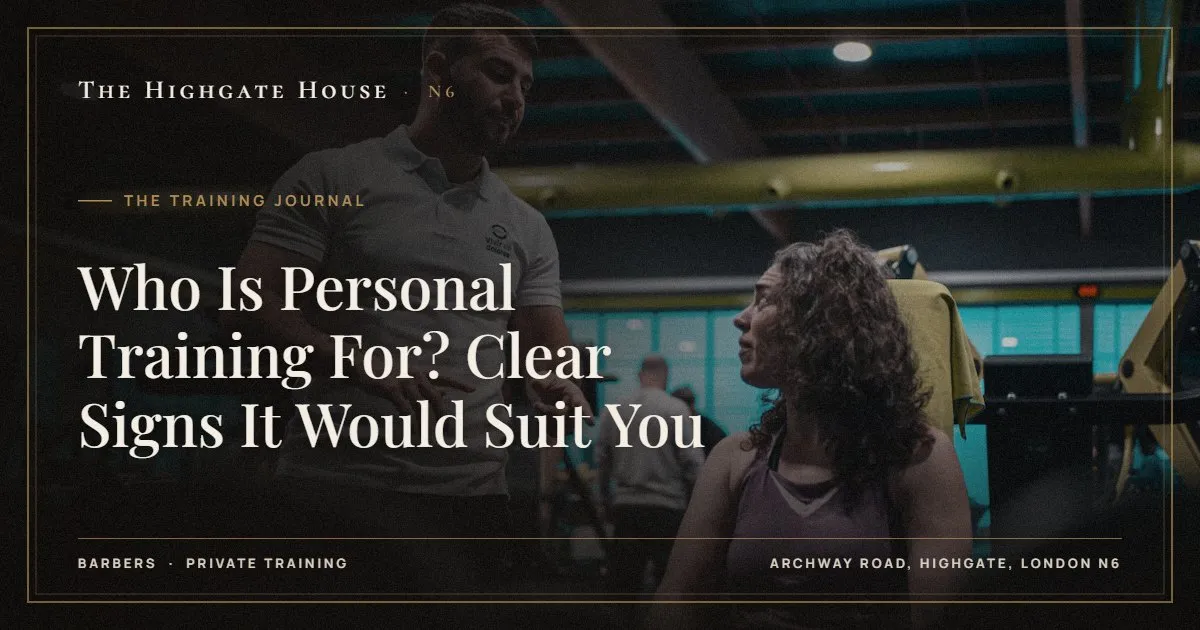
Who Is Personal Training For? Clear Signs It Would Suit You
Personal training is for people who want to get stronger and healthier but are held back by one of four things: they do not know what to do, they cannot make themselves do it consistently, they have a physical issue that makes self-coaching risky, or their time is too limited to waste. It is not reserved for athletes, the very fit or the very unfit. The people who get least from it are those who already train well and consistently, and those who cannot commit to coming regularly. If you recognise yourself in two or more of the signs below, it is likely to suit you.
This is a different question from whether training is worth the money. Here I am only concerned with fit: the kind of person who tends to do well in 1-1 coaching, and the kind who tends not to.
Eight signs personal training would suit you
1. You have not trained properly in years, or ever
Starting out is where coaching makes the biggest difference. You learn the main movement patterns (squatting, hinging at the hips, pushing, pulling, carrying) correctly from the beginning, and you avoid the common beginner traps of doing too much in week one or following a programme designed for someone else. If this is you, personal training for beginners goes into more detail.
2. You keep starting and stopping
Plenty of people know broadly what to do. They have had memberships, downloaded apps and bought kettlebells. The pattern is a strong fortnight, then work or family takes over, then nothing for months. If that sounds familiar, the missing ingredient is not information. It is a fixed appointment with someone who notices when you are not there.
3. You are over 30 and noticing the difference
Getting off the floor feels less automatic. Your back complains after a long day at the desk. Recovery from a game of football or a long walk takes longer. Strength training is one of the most effective responses to this, and the UK Chief Medical Officers’ physical activity guidelines recommend muscle-strengthening activity on at least two days a week for adults, with balance and strength becoming more important as we age. Most of the people I coach are busy professionals over 30, for exactly this reason.
4. You carry an old injury or a body that needs managing
A knee you do not fully trust, a shoulder that clicks, a lower back that flares up. These are reasons to train carefully, not to avoid it. A trainer can choose exercises and loads around the problem and progress them gradually. Note that a trainer is not a substitute for diagnosis: if something is acutely painful, see your GP or a physiotherapist first.
5. Your time is scarce and fixed
If you can give two hours a week and no more, you need those hours to count. A planned session, with no time spent deciding what to do or waiting for equipment, gets more done than a longer, unstructured visit.
6. You find commercial gyms uncomfortable
Some people are put off by crowded floors, loud music, mirrors and the sense of being watched. That is not a character flaw, and it is a common reason people stop. A private studio removes most of it. I have written about this separately in gym anxiety and private studios.
7. You have a specific goal with a date
A ski trip, a wedding, a trek, a return to a sport. A defined goal and deadline benefits from a programme that works backwards from it and is adjusted as you go.
8. You want to learn to train independently
Not everyone wants a trainer forever. Some people want a few months of proper coaching so they can then train on their own with confidence. That is a perfectly good reason to start, and a good trainer will plan for it.
Who usually does better without a trainer
- Experienced, consistent lifters. If you have trained for years, progress steadily and enjoy it, an occasional programme review may be all you need.
- People who cannot attend regularly. If your schedule allows a session every few weeks at best, 1-1 coaching will be frustrating. A written programme you can follow alone is a better fit.
- People who mainly want company and variety. Group classes or a running club may suit you better and keep you more engaged.
- People who need medical rehabilitation. After surgery or with an undiagnosed injury, a physiotherapist should lead. A trainer can take over once you are cleared.
A quick self-assessment
Answer yes or no to each:
- Have I stopped and restarted exercise more than twice in the past two years?
- Am I unsure whether my technique on basic lifts is safe?
- Do I have an injury or physical limitation I work around?
- Can I realistically commit to at least one fixed session a week for three months?
- Would an appointment make me more likely to turn up than a membership does?
- Do I have a goal I have not made progress on alone?
If question four is a yes and at least two others are yes, personal training is likely to suit you. If question four is a no, solve the scheduling first, because no trainer can coach you through sessions you cannot attend.
Before you start: a sensible health check
Most adults can begin strength training without medical clearance. Check with your GP first if you have a heart condition, high blood pressure, chest pain or dizziness on exertion, diabetes managed with medication, are pregnant or recently postnatal, or are returning after major surgery or a long period of inactivity. The NHS gives the same advice. Tell your trainer about any of these at the first conversation.
What it looks like in our studio
At The Highgate House, personal training takes place in the lower ground floor studio on Archway Road, about five minutes from Highgate tube. The studio is booked to you alone during your session and is used for coached training only, not solo hire. It has a squat rack, barbell, dumbbells, a cable station, lat pulldown, seated row, an air bike and an InBody scanner for tracking body composition. Sessions are with me, Artem Olekhnovych. I have coached for more than ten years and trained since I was fifteen. You can read what’s involved on the personal training page.
Questions we get asked
Am I too unfit to start personal training?
No. Training is scaled to where you are. The first sessions are deliberately moderate, and the starting point is whatever you can do well today.
Am I too old for personal training?
There is no upper limit. Strength training is recommended for adults of all ages, and the programme is adjusted for joints, recovery and any health conditions.
Is personal training only for weight loss?
No. Common goals include getting stronger, moving without pain, improving fitness, preparing for an event, or simply building a habit that lasts.
Do I need to be a member of a gym?
No. Our sessions are self-contained in the studio. See private personal training in Highgate or visit The Highgate House.
Book with The Highgate House
Ready to start training properly? Email us at [email protected] with the service and the day that suits you, and we will come back to you with times.
Visit The Highgate House · Private personal training
The Highgate House, Archway Road, Highgate, London N6.
