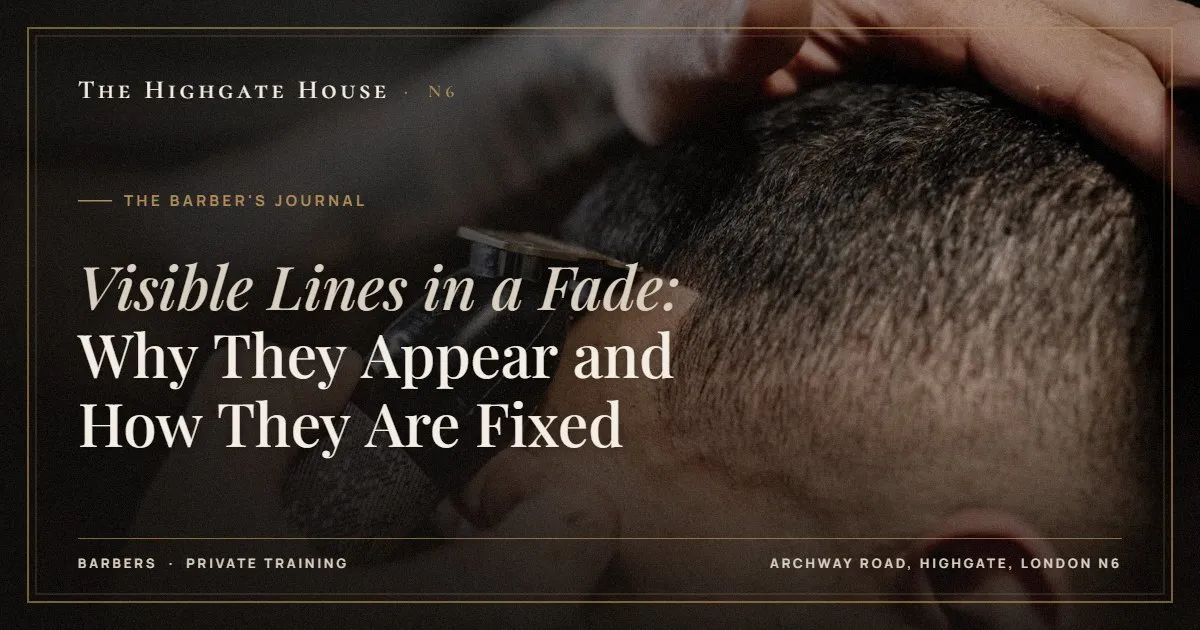
Visible Lines in a Fade: Why They Appear and How They Are Fixed
Lines in a fade appear where one clipper length meets the next and the transition has not been fully softened. Each guard leaves a shelf of hair at its own length, and blending is the work of erasing those shelves with in-between lengths, the clipper lever and careful flicking movements. Lines are easier to see on dark, dense hair over lighter skin, under strong overhead light, and around the crown and behind the ears. A barber fixes them by going back through the transition zones with half-steps and detail work. Most can be fixed in a few minutes if you mention them in the chair.
Here is what is actually going on, so you know what to look for and what to ask.
How a fade is built
A fade goes from very short at the bottom to longer further up. The barber sets guidelines at a few heights, usually with progressively longer guards, then blends between them. Our guide on what a fade is and how the blend is built walks through it step by step. The important point here is that each guideline is, by design, a line. A finished fade is a series of lines that have been made to disappear.
Why lines are visible
Jumps that are too big
Going from a zero straight to a number two leaves a lot of length to blend in a small space. Barbers use half-guards and the clipper lever to fill the gap. If the jump is too large or the in-between steps are rushed, you see a band where one length stops and the next begins.
The lever not used through the transition
Most clippers have a lever that opens and closes the blade, changing the cutting length slightly. Working the lever as you move up the head creates a gradient. Missing it leaves a clean step instead.
Straight lines instead of flicked ones
Running the clipper straight up the head and lifting off at the same height every time leaves a uniform edge. Blending relies on a slight scooping or flicking motion so the cut finishes at slightly different points, which softens the line.
The head shape and growth patterns
The back of the head curves, and hair around the crown and behind the ears often grows in different directions. A guard that sits flat on one part of the head may lift away on another, leaving patches that are longer. This is why lines often show behind the ears and at the occipital bone, the bump at the back of the skull.
Hair and skin colour
Contrast shows everything. Dark, thick hair on pale skin makes every change in length obvious. Fair or grey hair on a similar skin tone hides small inconsistencies. That is not about the quality of the cut, it is about how forgiving the canvas is.
Light
Overhead office lighting and the bathroom mirror throw strong shadows down the side of the head. A fade that looked seamless in the shop can show a faint band at home. Check it in daylight before deciding something is wrong.
Blades and tools
For skin fades, many barbers adjust the blades so they cut extremely close, often called zero-gapping. A blade set slightly differently, or a dull blade, can leave uneven lengths at the very bottom. Our piece on zero-gapped clippers explains the detail.
Lines that appear a week later
Sometimes a fade looks perfect on the day and develops a visible band after a week or so. Hair grows at slightly different rates around the head, and the shortest areas show change first. A skin fade that was blended down to bare skin starts to show a darker shadow at the bottom as the hair returns. This is normal, and it is why fades are usually refreshed every two to three weeks rather than every six.
Home touch-ups are the other common cause. Going over the bottom of the fade with a trimmer to tidy it often sets a new line where the trimmer stopped.
How a barber fixes visible lines
- Find the line in good light. Usually by checking from several angles with a hand mirror and turning the head.
- Identify the two lengths either side. The fix depends on how big the jump is.
- Bridge with a half-step. A guard between the two lengths, or the same guard with the lever partly open, run into the line with a flicking motion.
- Detail with trimmers or a foil shaver. At the very bottom of a skin fade, a foil shaver or trimmer can smooth the shortest section.
- Clipper over comb or scissor over comb where needed. On curved areas or where hair grows in different directions, working off a comb gives more control than a guard.
- Check again with the hair dry and styled. Some lines only show once the top is styled and the sides are fully dry.
If the line is high and the barber is limited by how short the hair above already is, the fix may mean taking the whole fade slightly higher, or leaving it a few days to grow before blending again. Either is better than chasing it lower and lower.
How to avoid lines next time
- Speak up in the chair. Check the back and sides in the hand mirror and point to anything you can see.
- Ask for the blend to be checked behind the ears and around the crown, the usual trouble spots.
- If you have very dark, dense hair, consider a slightly softer fade, such as a low or shadow fade, which is more forgiving. Our comparison of skin fade versus shadow fade explains the difference.
- Do not tidy the fade at home between visits.
- Book refreshes at a sensible interval, usually two to three weeks for a skin fade.
At Highgate Cuts
Every visit starts with an assessment, where the barber looks at your hair and what you need, then makes recommendations, including which fade will suit your hair type and how often it will need refreshing. If you see a line before you leave, tell us. We would much rather fix it on the spot. You can find details of our fades and other cuts on the Highgate barber services page.
Questions we get asked
Is a line in my fade a sign of a bad cut?
Not always. Lighting, hair colour and growth can all make a good blend look uneven. A clearly visible band in good daylight on the day of the cut is worth mentioning, though.
Can I fix a fade line myself?
It is rarely a good idea. Without seeing the back of your head, it is easy to create a new line higher up. Book a quick tidy instead.
Why are lines always worse behind the ears?
The head curves sharply there and hair often grows in several directions, so guards do not sit evenly. It takes more detailed work to blend.
How do I book a fade?
By email, with online booking coming soon. See our barber page for the services. Prices are not published yet, so see the barber menu or email us.
Book with The Highgate House
Ready for a proper cut? Email us at [email protected] with the service and the day that suits you, and we will come back to you with times.
Visit The Highgate House · The barbers
The Highgate House, Archway Road, Highgate, London N6.
