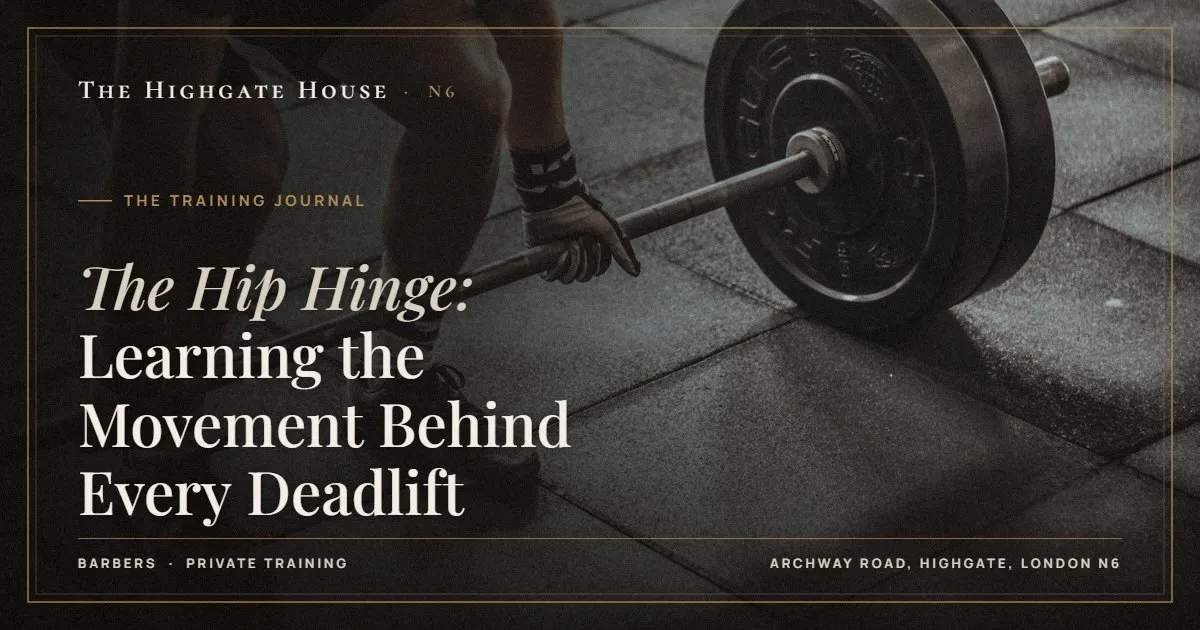
The Hip Hinge: Learning the Movement Behind Every Deadlift
A hip hinge is bending forward by pushing your hips back while your spine stays long and your knees bend only slightly. The movement comes from the hip joint, not from curling the lower back. It is the pattern behind every deadlift, Romanian deadlift, kettlebell swing and good morning, and behind picking a suitcase off a luggage belt without wincing. You can learn it in a single session with a broom handle and a wall, then build strength in it over months. Below are the drills I use to teach it, the cues that tend to click, and the faults to watch for.
What a good hinge looks like
Picture someone closing a car door with their backside while carrying shopping. The hips travel backwards, the chest tips forward as a counterbalance, the shins stay nearly vertical and the back stays roughly as straight as it was standing up. That is a hinge.
The key checkpoints:
- Hips move back first, not down.
- Knees soften but do not travel forward much.
- Spine stays neutral: no rounding through the lower back, no exaggerated arch.
- Weight sits through the middle of the foot, slightly towards the heel.
- Tension builds in the hamstrings as you go down. That stretch is your signal to stop and stand back up.
Hinge vs squat: the difference that confuses people
Both involve bending the hips and knees, which is why people blur them. The distinction is which joint leads.
| Hinge | Squat | |
|---|---|---|
| Leading joint | Hips, travelling back | Hips and knees together, travelling down |
| Knee bend | Slight | Large |
| Torso | Tips well forward | Stays more upright |
| Main muscles | Hamstrings, glutes, back extensors | Quads, glutes, adductors |
| Examples | Romanian deadlift, swing, good morning | Goblet squat, back squat, leg press |
A conventional deadlift from the floor sits somewhere between the two, which is partly why it is harder to learn than people expect. Getting the pure hinge first makes the deadlift far easier. Our separate guide on how to deadlift properly takes it from there.
Four drills to learn the hinge
Work through these in order. Most people need two or three of them before the pattern feels natural.
1. The wall tap
- Stand with your heels about a foot’s length in front of a wall, feet hip-width apart.
- Soften the knees slightly and keep them there.
- Push your hips back until your backside touches the wall, letting your chest tip forward.
- Stand tall by driving the hips forward.
- Once it is easy, shuffle a few centimetres further away and repeat.
This teaches “back, not down”. If your knees bend a lot to reach the wall, you are squatting.
2. The dowel hinge
Hold a broom handle or dowel vertically along your spine, one hand at the back of your neck, the other at the small of your back. The stick should touch three points: the back of your head, between your shoulder blades and your tailbone. Hinge forward while keeping all three in contact. If the stick leaves your lower back, you are rounding. If it leaves your head, you are craning your neck. It is the fastest feedback tool I know, and it costs nothing.
3. The hands-down-thighs hinge
Stand tall with your palms on the front of your thighs. Slide your hands down towards your knees by pushing your hips back. Stop when your hands reach just below the kneecaps or when you feel a firm hamstring stretch, whichever comes first. This gives most people a sensible range for their first Romanian deadlifts.
4. The light kettlebell or dumbbell Romanian deadlift
Once the pattern is clean unloaded, hold a light weight in front of your thighs and repeat the hands-down-thighs hinge, keeping the weight close to your legs. This is where learning becomes training. Our guide to Romanian deadlift form covers progressing it with a barbell.
Cues that tend to work
Different people respond to different instructions. These are the ones I find most reliable:
- “Close the car door with your hips.”
- “Show your chest to the floor, not your shoulders.”
- “Keep your shins still.”
- “Push the floor away to stand up” (rather than “pull with your back”).
- “Long neck, eyes a couple of metres ahead on the floor.”
Common faults and quick fixes
- Rounding the lower back. Usually from going too deep. Stop at the point the hamstrings feel tight, and brace before you move. Our guide on how to brace your core helps.
- Squatting the movement. Knees drift forward and hips drop. Go back to the wall tap.
- Over-arching at the top. Leaning back to “finish” the rep. Stand tall and squeeze the glutes; stop when you are vertical.
- Weight on the toes. Shift towards the mid-foot and heel. If you can wiggle your toes at the bottom, you are about right.
- Letting the weight drift away from the body. Keep a dumbbell or bar brushing the thighs. Distance from the body makes everything heavier on the back.
How long it takes to own the hinge
Most adults can perform a clean unloaded hinge within one session. Making it automatic under load usually takes several weeks of practice, two or three times a week. Building real strength in it is a project of months and years, which is the good news: it keeps rewarding you. Hamstring stiffness may limit range at first, but that typically improves with the hinging itself rather than with endless stretching.
If you have current back pain, a recent disc injury, or are returning to lifting after a long break, check with your GP or a physiotherapist before loading the hinge.
Learning it in the studio
The hinge is one of the first patterns I teach in 1-1 personal training at The Highgate House. With the studio booked to you alone, there is room and quiet to work through the drills without self-consciousness, then progress to dumbbells, the cable station and the barbell when you are ready. If your back has put you off deadlifts in the past, a supervised start is the sensible route. Details of how coached sessions work are on the training page.
Questions we get asked
Is the hip hinge bad for your back?
A well-performed hinge, loaded gradually, is a normal and useful movement. Problems tend to come from poor technique, too much weight too soon, or going beyond your controlled range.
How far down should I go?
Until you feel firm hamstring tension or your back starts to lose its position, whichever comes first. For many people that is around the knees to mid-shin.
Should my knees be straight?
No. A slight, fixed bend is right for a Romanian deadlift. Locked knees put unnecessary strain on the back of the knee.
Can I practise at home?
Yes. The wall tap and dowel drills need no equipment beyond a broom. A few sets of ten on most days speeds learning.
Book with The Highgate House
Ready to start training properly? Email us at [email protected] with the service and the day that suits you, and we will come back to you with times.
Visit The Highgate House · Private personal training
The Highgate House, Archway Road, Highgate, London N6.
