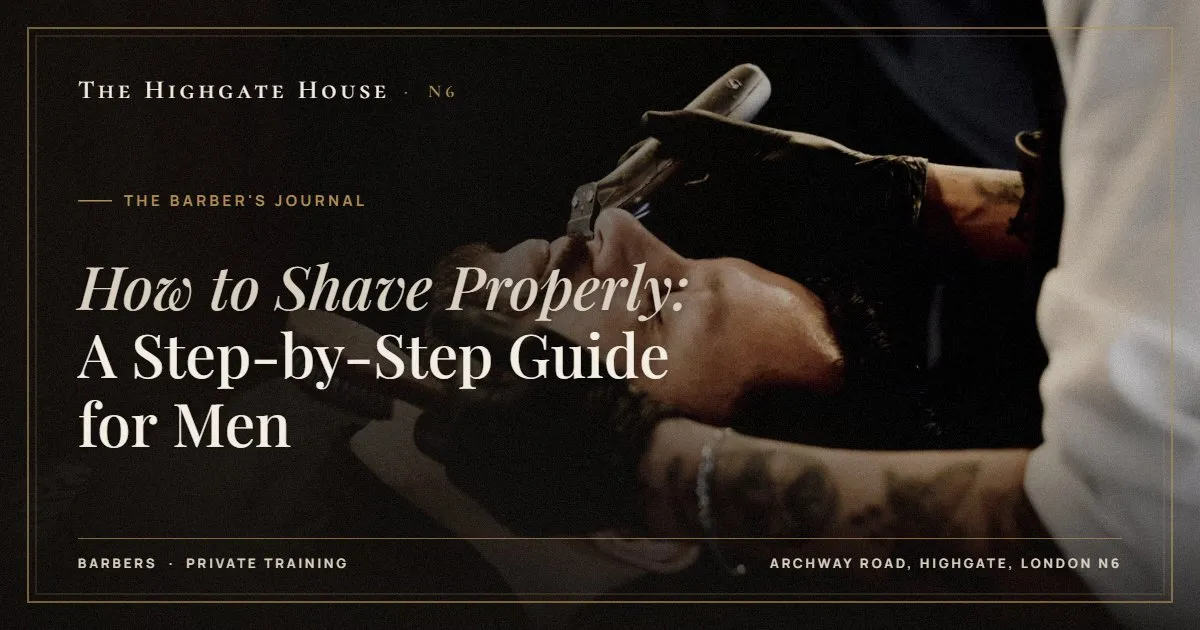
How to Shave Properly: A Step-by-Step Guide for Men
To shave properly, soften the hair with warm water for a couple of minutes, apply a proper lather, shave with the grain using light pressure and a sharp blade, re-lather, then go across the grain only if your skin tolerates it. Rinse with cool water and finish with an unscented moisturiser or balm. Most irritation comes from three things: dry hair, too much pressure, and too many passes over the same spot. Fix those and most men find their shave improves within a week. The detail below is what we would show you if you sat in the chair and asked.
What you need, and what you don’t
You do not need an expensive kit. You do need:
- A sharp blade. Cartridge, safety razor or electric all work. Whichever you use, a dull blade is the biggest single cause of drag and redness.
- A lather that cushions. Shaving cream or soap whipped with a brush, or a non-foaming cream. Aerosol foam is mostly air and dries quickly.
- Warm water and a clean towel.
- An alcohol-free balm or plain moisturiser.
A brush is optional but useful: it lifts the hairs and works the lather in around each one. If you are choosing between products, our post on shaving cream, soap or gel explains the differences.
Step 1: Map your growth first
Before anything else, know which way your hair grows. It is rarely uniform. On most men it grows downward on the cheeks, but on the neck it often grows sideways or upward, sometimes in a swirl under the jaw. Let two or three days of stubble grow, then run your fingers over each area. The direction that feels smooth is with the grain; the direction that feels rough is against it.
Spend five minutes doing this once and draw it if you have to. It changes every shave you do afterwards. We go into this further in shaving with the grain or against it.
Step 2: Prepare the skin and hair
Hair absorbs water and softens noticeably after a couple of minutes of warmth. That is why barbers use hot towels, and why shaving straight after a shower works so well.
- Wash the face with warm water and a gentle cleanser to remove oil and dead skin that clog the blade.
- Keep the beard area warm and wet for two to three minutes: in the shower, or with a flannel soaked in hot (not scalding) water and held on the face.
- If you use a pre-shave oil, apply a few drops now to the wet stubble.
Step 3: Lather properly
Use a small amount of cream or soap and work it with a damp brush in circles until it is thick and glossy, with no large bubbles. Apply it in circular strokes against the grain to lift the hairs, then finish with a few strokes in the direction of growth to lay the lather smooth. It should be a layer you cannot see skin through, not a thick white beard.
Step 4: The first pass, with the grain
This pass removes most of the hair with the least irritation.
- Pressure: almost none. Let the blade’s weight do the work. With a cartridge razor, the pivoting head is designed for light contact; pressing down pushes the blades into the skin.
- Angle: with a safety razor, about 30 degrees. Start with the handle nearly flat against the cheek and tilt it until the blade just begins to cut.
- Stretch the skin: use your free hand to pull the skin flat, especially on the neck and under the jaw.
- Short strokes: two or three centimetres at a time, rinsing the blade often.
- Order: cheeks first, then the neck, then the upper lip and chin last. The coarsest hair on the chin and lip gets the longest contact with the lather.
Step 5: Decide whether you need a second pass
For many men, one pass with the grain is a perfectly good, comfortable shave. If you want closer, re-lather the area and shave across the grain. Only go against the grain if your skin has tolerated across-the-grain for a while without bumps. Against the grain cuts the hair below the skin surface, which is closer but is also how ingrown hairs start, particularly with curly or coarse hair.
Never shave over a dry patch. If the lather is gone, the shave is finished for that area. Rubbing the blade over bare skin to “catch the last bits” is the most common cause of razor burn we see.
Step 6: Rinse and finish
- Rinse with cool water. It feels better and removes lather residue.
- Pat dry with a clean towel. Do not rub.
- Apply an alcohol-free balm or unscented moisturiser. Alcohol-based splashes sting because they dry the skin; if you like the ritual, use them sparingly.
- If you nick yourself, press a cold, clean damp cloth on it for a minute or two. Our note on stopping a shaving cut bleeding covers the rest.
Common mistakes and the fix
| Mistake | What it causes | Fix |
|---|---|---|
| Shaving dry or after a quick splash | Drag, redness | Two to three minutes of warmth first |
| Pressing down | Razor burn, cuts | Lighter grip, hold the handle lower |
| Going against the grain first | Bumps, ingrown hairs | With the grain first, every time |
| Using a blade too long | Tugging, irritation | Change it as soon as it pulls |
| Rushing | Patchy shave, nicks | Allow ten minutes; shave in the evening if mornings are tight |
If your skin still reacts
Some skin simply does not enjoy daily blade shaving. Options worth trying: shave every other day, stick to one pass with the grain, or use an electric shaver or trimmer that leaves a very short stubble. If you get persistent bumps, particularly with curly hair, the NHS page on ingrown hairs explains the causes and when to see a pharmacist or GP. Skin that is broken, infected or very sore is a reason to stop shaving for a few days and get advice.
When to let a barber do it
A barber’s hot towel shave is not just a treat. It is a useful reset: you see what a properly prepared shave feels like, and the barber can tell you how your growth runs and where you are going wrong. With us it takes 20 to 30 minutes, and every visit starts with an assessment of your skin and hair before the razor comes out. Some men book one before an event; others come in once and use what they learn at home.
The Highgate Cuts team does hot towel shaves, beard work and haircuts on the ground floor of The Highgate House on Archway Road, near Highgate tube. You can see the full list on the Highgate Cuts barber page, and if you would rather leave the razor to a professional, book a hot towel shave by email. Prices are not published yet: see the barber menu or email us. More about the building is on The Highgate House homepage.
Questions we get asked
Should I shave in the morning or at night?
Whichever gives you ten unhurried minutes. Evening shaves give skin overnight to settle, which helps if you are prone to redness.
How often should I change my blade?
When it starts to tug, not on a fixed schedule. It depends on how coarse your hair is and how often you shave.
Is shaving against the grain bad?
Not for everyone, but it is the main cause of ingrown hairs. Build up to it, and skip it if you get bumps.
Do I need aftershave?
You need moisture, not alcohol. A plain balm or moisturiser does the job.
Book with The Highgate House
Ready for a proper cut? Email us at [email protected] with the service and the day that suits you, and we will come back to you with times.
Visit The Highgate House · The barbers
The Highgate House, Archway Road, Highgate, London N6.
