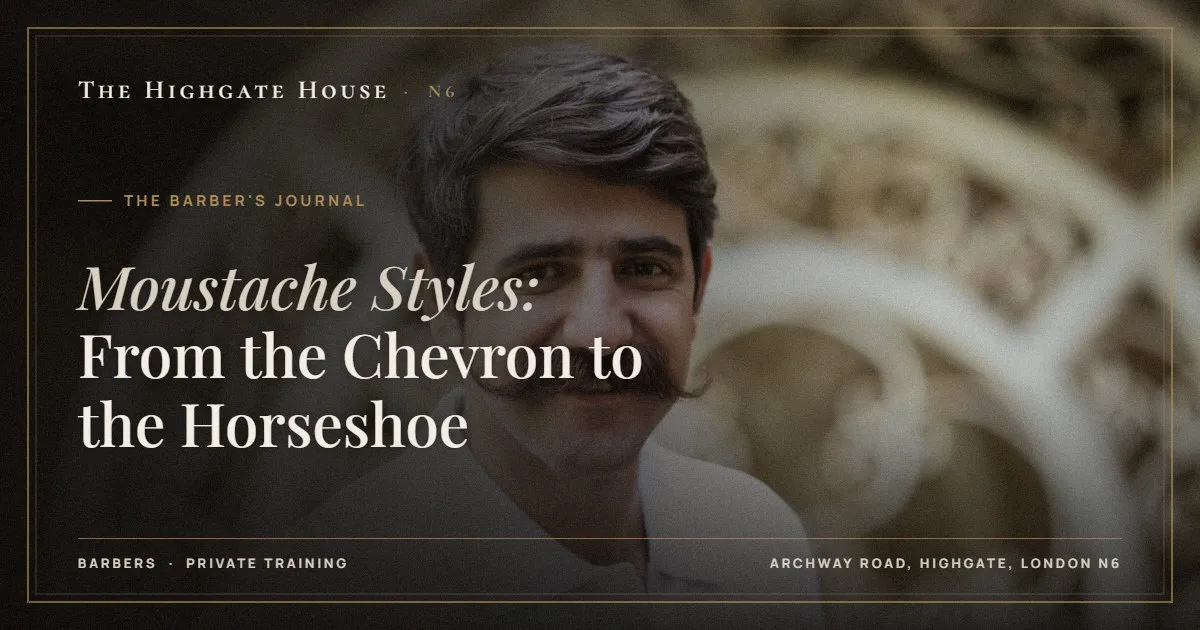
Moustache Styles: From the Chevron to the Horseshoe
Most moustache styles are variations on three decisions: how far the hair extends past the corners of the mouth, how much of the top lip it covers, and whether the ends are left natural or trained into a shape. The chevron is thick, wide and covers the lip line. The horseshoe runs down past the mouth to the jaw in two vertical bars. Between them sit the pencil, the English, the handlebar, the walrus and a handful of others. The right one depends less on fashion than on your upper lip, your hair growth and how much maintenance you will actually do. Here is how each works.
The three questions that decide every style
Before picking a name, look in the mirror and answer these honestly.
- How tall is your upper lip? A tall upper lip (a long gap between nose and mouth) can carry a heavy, full moustache. A short one is easily swamped; neater, narrower shapes sit better.
- How does it grow at the corners? Many men have thin or patchy growth where the moustache meets the cheek. Styles that depend on those corners, such as the horseshoe and the handlebar, need decent density there.
- Will you use wax? Several classic styles only exist because of wax. If you know you will not use it every morning, choose from the low-maintenance end of the list.
Natural, low-maintenance styles
The chevron
Thick, wide and slightly angled at the outer edges, like the stripe on a sergeant’s sleeve. It covers the top lip, or most of it, and stops roughly at the corners of the mouth. The chevron suits longer faces and stronger jaws, and it is the most forgiving style to grow because it uses the densest hair, directly under the nose. Upkeep is a trim along the lip line every week or so and a tidy of the outer edges.
The pencil
A thin, precise line sitting a few millimetres above the lip, with the skin between it and the nose shaved clean. It looks sharp on smaller, finer features and on men with sparse growth, because it does not need density. The cost is time: it needs shaving above and below the line every day or two, or the outline blurs.
The lampshade and the painter’s brush
Two close relatives of the chevron. The lampshade is trimmed short and narrower at the top, wider at the bottom, ending above the lip. The painter’s brush is fuller and blunt-cut straight across. Both are good office moustaches: tidy, clearly intentional, and easy to keep.
Styles that reach past the mouth
The horseshoe
A full moustache that continues straight down from the corners of the mouth to the jawline in two parallel bars, with the chin and cheeks shaved. It is heavily associated with 1970s bikers and wrestlers, and it reads that way: deliberately rough. It needs thick growth on the strips running down beside the mouth, which is where many men are thinnest. It also takes the longest of the short styles to grow, often two to three months before the bars look solid.
The Fu Manchu
Often confused with the horseshoe. The difference is that the Fu Manchu grows from the corners of the lip and hangs down as long, narrow tendrils, while the area around them, including the sides of the chin, is kept clean. The horseshoe is a frame; the Fu Manchu is two loose ends. It takes many months and is mostly worn for effect.
The walrus
Very full and long enough to droop over the mouth entirely. It is the natural end point of simply not trimming a chevron. It suits big features and larger faces, and it is the least practical style here: it catches food and drink, and it needs combing and a light trim to stay off the teeth.
Shaped and waxed styles
The English
Narrow and long, parted at the centre and pulled out sideways along the lip, with the ends trained horizontally rather than curled. The area beneath the outer ends is kept shaved so the shape reads clearly. It needs length beyond the corners of the mouth, which usually means three months or more, and a firm wax.
The handlebar
The English with the ends curled upwards. A small handlebar can be done with moderate length and a light curl; a full one needs plenty of length and strong wax every morning. It is the most theatrical style here and suits men who will enjoy the ritual. Our guide to moustache wax covers which holds work and how to apply them without clumping.
The imperial
A moustache that joins the cheek whiskers and sweeps up, usually waxed. Rare in day-to-day life, but it is what most people mean by a Victorian moustache.
Quick comparison
| Style | Rough time to grow | Daily effort | Needs dense corners? |
|---|---|---|---|
| Chevron | 4 to 6 weeks | Low | No |
| Pencil | 1 to 2 weeks | High (shaving the outline) | No |
| Lampshade / painter’s brush | 3 to 5 weeks | Low | No |
| Horseshoe | 2 to 3 months | Medium (shaving chin and cheeks) | Yes |
| Walrus | 3 months or more | Medium (combing) | Helpful |
| English / handlebar | 3 to 6 months | High (wax every day) | Yes |
The growth times are rough guides. Facial hair grows at different rates from man to man, and the awkward middle stage is where most attempts are abandoned. If you are at that stage now, our post on growing a moustache through the first weeks is the one to read.
Matching the style to your face
Face-shape rules are overstated, but a few are reliable enough to use.
- Round face: styles with some vertical line, such as a horseshoe or a neat chevron with slightly angled edges, lengthen it. A very wide, flat moustache emphasises the width.
- Long or narrow face: horizontal styles help. A full chevron or a modest English balances height.
- Small features: keep it in proportion. A pencil or a short lampshade will look deliberate; a walrus will look like it is wearing you.
- Strong nose: a fuller moustache balances it. A thin pencil line underneath tends to draw the eye upwards.
- Glasses: heavy frames and a heavy moustache compete. One of the two should be lighter.
How a barber helps, and when
You can grow almost any of these at home. Where a barber earns their keep is at two points. The first is around week three or four, when the shape is still undecided and the temptation is to trim it too short. A barber can set the outline, the lip line and the outer edges so you are growing towards a specific style rather than away from an accident. The second is once it is established, when the edges and the line where moustache meets beard (or bare skin) need resetting every few weeks.
At Highgate Cuts every visit starts with an assessment, so the barber will look at your growth, your face and what you have in mind before touching anything. If the style you want will not work with your growth pattern yet, you will be told, along with what to do in the meantime. Beard and moustache work is part of the barber service on Archway Road, either on its own or alongside a haircut.
Mistakes that ruin a good moustache
- Trimming the lip line with the mouth closed and tense. Relax your mouth and trim with it in its normal resting position, or you will cut it short and it will sit too high.
- Chasing symmetry hair by hair. Trim one side, then match the other in small passes. Going back and forth is how a chevron becomes a pencil by accident.
- Skipping the comb. Comb the hair down before trimming so you are cutting it at the length it actually lies.
- Using too much wax. A rice-grain amount, warmed between the fingers, is enough for most styles.
If you would rather hand the outline over entirely, a regular beard and moustache trim at Highgate Cuts keeps the edges sharp between your own tidies. For the trimming technique in detail, see how to trim a moustache so it sits above the lip.
Questions we get asked
What is the easiest moustache style to grow?
The chevron. It uses the densest hair under the nose and needs nothing more than a weekly trim of the lip line.
Can I grow a horseshoe if my beard is patchy?
Possibly, but the vertical bars beside the mouth are where patchiness shows most. Give it eight weeks before deciding, and have a barber look at the density at that point.
Do I need a beard to wear a moustache well?
No. Most of the styles above are worn clean-shaven. The cleaner the surrounding skin, the more the moustache’s shape matters, so keep the outline sharp.
How often should a moustache be trimmed by a barber?
Every three to five weeks for most styles, usually at the same visit as a haircut. Waxed styles need less cutting and more shaping.
Book with The Highgate House
Ready for a proper cut? Email us at [email protected] with the service and the day that suits you, and we will come back to you with times.
Visit The Highgate House · The barbers
The Highgate House, Archway Road, Highgate, London N6.
