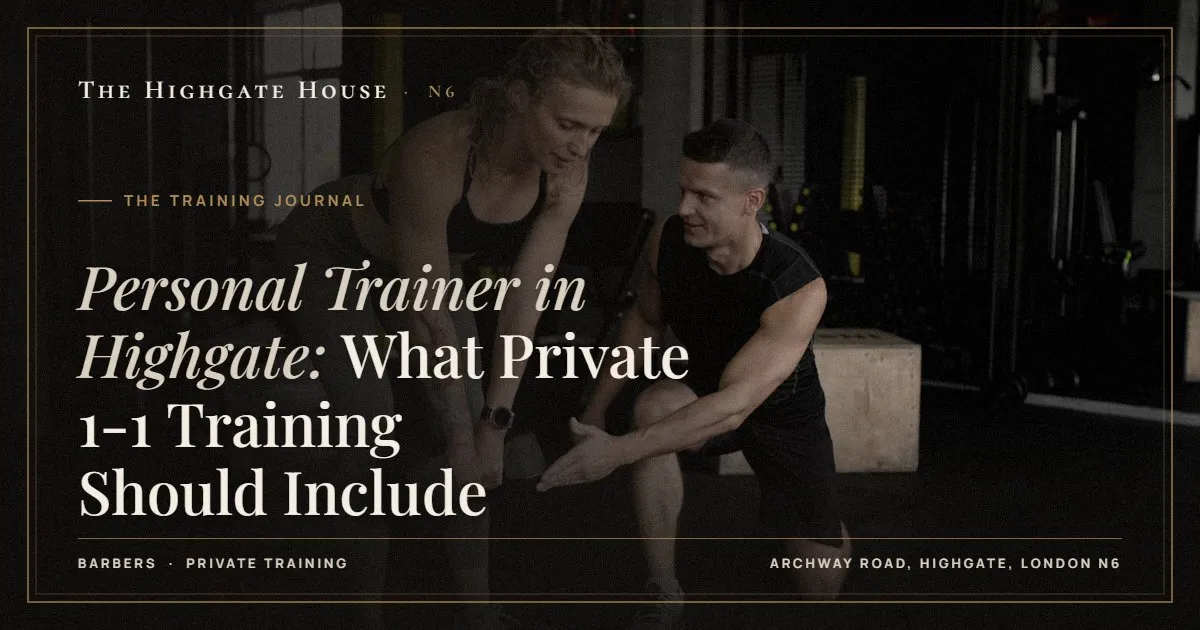
Personal Trainer in Highgate: What Private 1-1 Training Should Include
Good private 1-1 training should include five things: a proper assessment before any hard work, a written plan built around your goal and your diary, sessions where every set is coached rather than counted, a record of what you lifted so progress can be proved, and a review every few weeks that changes the plan when the numbers say it should. If a personal trainer in Highgate cannot show you how each of those happens, you are paying for supervision, not coaching.
Below: what each element looks like in practice, what to ask before you commit, and where good intentions go wrong.
What should happen before the first real session?
An assessment, and it should take longer than most people expect. A useful first meeting covers three areas.
Your history
Old injuries, operations, current aches, medication that affects heart rate or blood pressure, sleep, work hours and how much you have trained before. A trainer who skips this is guessing. If you have a heart condition, are pregnant, are recovering from injury or surgery, or have not exercised for a long time, the NHS advice is to speak to your GP first. A good trainer will ask about this and will not mind waiting for the answer.
How you move
A squat to a box, a hinge, a push, a pull, a single-leg stance, and a look at how your shoulders move overhead. The point is to find what you can load safely now, and what needs to be built first. Desk-bound people over 30 usually have something here: stiff hips, a shoulder that does not quite reach, a back that does the legs’ work.
A baseline you can measure against
In our studio that includes an InBody body composition scan, which estimates muscle and fat mass rather than giving you a single number on a bathroom scale. Readings shift with hydration and with what you have eaten, so the useful habit is to scan under similar conditions each time and watch the trend, not the decimal point. Baseline strength matters just as much: what you can do for a set of eight on a few key lifts.
What does a proper training plan look like?
It is written down, and it has a shape over weeks rather than a list of exercises for today. Expect to see:
A small number of main lifts that you will repeat and progress: a squat or leg press pattern, a hinge such as a deadlift variation, a horizontal and vertical push, a horizontal and vertical pull.
Accessory work chosen for your weak points, not for variety.
Some conditioning that suits your joints. An air bike, for example, lets you work very hard with no impact.
Planned progression: how weight, reps or sets will rise, and when a lighter week is built in.
The plan should also fit the rest of your week. The NHS guidelines for adults, which follow the UK Chief Medical Officers’ advice, recommend strengthening activities that work all the major muscle groups on at least two days a week, alongside 150 minutes of moderate or 75 minutes of vigorous activity. Two good 1-1 sessions cover the strength side for most people. The walking, cycling or tennis you do around them covers much of the rest, and your trainer should ask about it so the two do not collide.
What should happen inside a 1-1 session?
Here is a typical hour, for someone training twice a week with a strength and body composition goal.
Time | What happens | Why |
|---|---|---|
0-5 min | Check-in: sleep, soreness, anything new | Decides whether today’s plan stands or is adjusted |
5-15 min | Warm-up targeted to the day’s main lift | Rehearses the movement, not just raises heart rate |
15-35 min | Main lift, worked up to the planned sets | The part that drives most of the progress |
35-50 min | Two or three accessory exercises, often paired | Fixes weak links, adds useful volume |
50-60 min | Short conditioning finish, then notes | Fitness work, and a record for next time |
Two things separate coaching from supervision. First, the trainer is watching and correcting each rep, not scrolling a phone between sets. Second, they are setting the load from your effort on the day. A common method is reps in reserve: if the plan says finish with two reps left and the bar moves quickly, the weight goes up. If it is grinding, it stays.
How should progress be measured?
With numbers that you can see, on a schedule you agreed at the start. Weight lifted for a given number of reps on the main lifts. Body composition scans at sensible intervals, usually every four to six weeks rather than every session. Waist measurement and photos if you want them. And quieter markers: better sleep, a back that no longer aches after long flights.
Strength usually moves first. In the first weeks much of the improvement is your nervous system learning the movements, which is why beginners often add weight quickly. Visible change in the mirror takes longer, and anyone promising a dramatic result on a fixed date is selling, not coaching. We wrote separately about what a realistic 12-week change looks like .
What about nutrition?
A personal trainer can reasonably help with the basics: enough protein, a sensible calorie target for your goal, how to eat around training, and how to handle restaurants and travel without abandoning the plan. That is a large part of the result for most people. What a trainer should not do is prescribe diets for medical conditions or offer meal plans that sit in the territory of a registered dietitian. If you have diabetes, a digestive condition or a history of disordered eating, the right advice comes from your GP or a dietitian, and a good trainer will say so.
Questions to ask before you book
Use this as a checklist with any personal trainer in Highgate or elsewhere. Vague answers are an answer.
What qualifications and insurance do you hold, and can I see them?
What does the first session involve, and how long is it?
Will I get a written plan, and how often is it reviewed?
How will we measure progress, and how often?
Who else is in the room while I train?
What happens if I have to cancel or travel for work?
What do you do if something hurts during a session?
The fifth question is worth more than it looks. In a busy commercial gym your trainer is negotiating for the rack and you are training in front of strangers. Our studio on Archway Road is booked to you alone for your session, which changes how much coaching happens in an hour. There is more on that trade-off in our piece on training in a private gym in north London .
Where 1-1 training usually goes wrong
Too much, too soon. Leaving every session wrecked feels productive and usually ends in a missed fortnight. Mild soreness is normal early on. Being unable to walk downstairs is a programming error.
Constant novelty. New exercises every session keep things entertaining but make progress impossible to track.
No record. If nobody wrote down last week’s weights, this week’s are guesswork.
Training around the diary instead of with it. A plan that assumes three sessions when you can reliably do two is a plan you will fail.
How it works at The Highgate House
The training studio is the lower ground floor of The Highgate House, a corner building on Archway Road, about five minutes from Highgate tube. It is roughly 1,000 sq ft, with a squat rack, barbell and plates, a dumbbell rack, a two-stack cable station, lat pulldown, seated row, an air bike and the InBody scanner. All sessions are with me. I have coached for over ten years and trained since I was 15, and most of the people I work with are busy professionals over 30 from Highgate, Archway, Crouch End, Muswell Hill and Hampstead. You can read the details of private personal training in Highgate on the service page, and if you want to know exactly how the first hour runs, see what happens in a first session .
Questions we get asked
How many sessions a week do I need?
Two is the sweet spot for most people. It meets the NHS recommendation for strength work on at least two days, allows proper recovery, and fits a working week. One session a week still helps, especially if you do some training on your own between visits.
Do I need to be fit before I start?
No. The assessment exists so the starting point matches where you are. If you have had a long break, an injury or a medical condition, check with your GP first.
How soon will I notice a difference?
Most people notice movements feeling easier and loads rising within the first few weeks. Changes in body composition take longer and depend heavily on food, sleep and consistency.
When can I train?
Training runs early mornings and evenings. Exact hours will be announced at opening, and for now booking is by email, with 1-1 sessions with Artem arranged around your diary.
Two related guides: what a personal trainer costs in London, and how a private studio compares with gym-based PT.
Book with The Highgate House
Ready to start training properly? Email us at [email protected] with the service and the day that suits you, and we will come back to you with times.
Visit The Highgate House · Private personal training
The Highgate House, Archway Road, Highgate, London N6.
