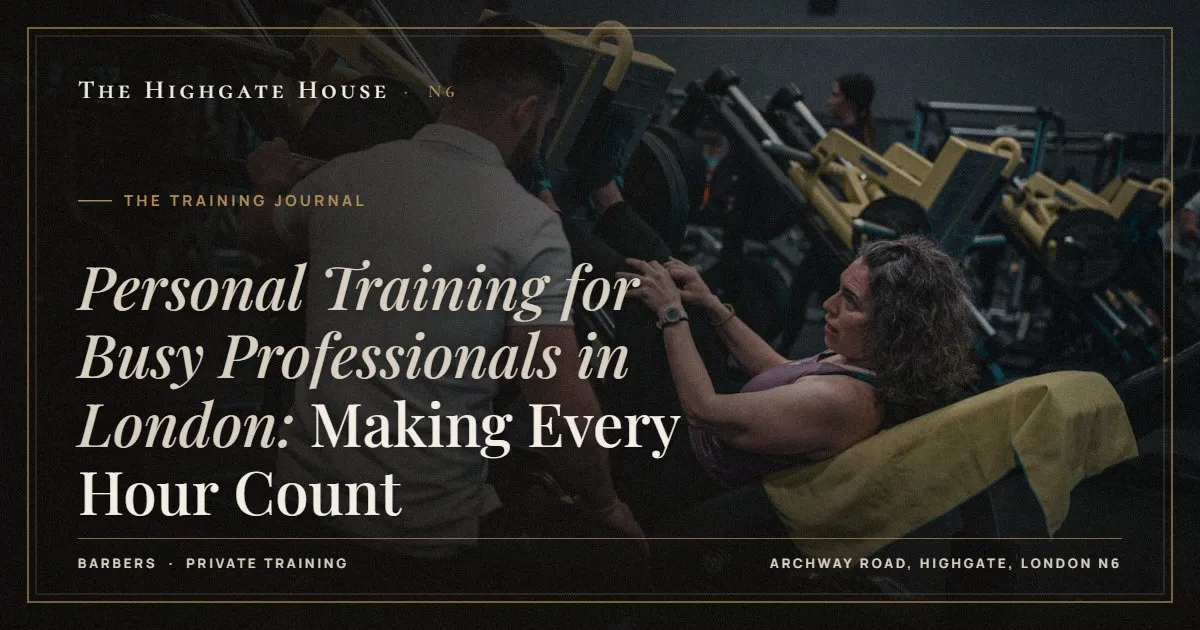
Personal Training for Busy Professionals in London: Making Every Hour Count
If you have a demanding job, personal training works when it removes decisions rather than adding commitments. Two well-run strength sessions a week, built around a handful of big movements, scheduled at the same times and close to where you live, will do more for you than five rushed gym visits you have to plan yourself. The trainer’s job is to make each hour dense, safe and progressive, and to keep the plan alive in the weeks when work wins. The rest of this piece covers how that works in practice.
How much training is actually enough?
Less than most people fear. The NHS physical activity guidelines ask adults for at least 150 minutes of moderate activity or 75 minutes of vigorous activity a week, plus muscle-strengthening work on at least two days that covers the major muscle groups.
That second requirement is the one most professionals miss. Walking to the station and the odd weekend run can cover a good share of the cardio. Very few people do proper strength work twice a week without someone holding them to it. Two supervised sessions take care of the strengthening target outright and contribute vigorous minutes on top. Add brisk walking on the days in between and you are meeting the guidance without rearranging your life.
So the realistic minimum is two sessions a week. Three is better if your diary allows it. One is maintenance at best.
What a time-efficient session looks like
The difference between a productive hour and a wasted one is mostly structure. In a busy commercial gym, a surprising amount of time disappears into waiting for kit, walking between areas and deciding what to do next. In a private studio, where the room is booked to you alone, that friction goes. Here is roughly how an hour is spent with me:
| Block | Time | Purpose |
|---|---|---|
| Check-in | 2-3 min | Sleep, stress, soreness, anything that changes today’s plan |
| Warm-up | 8-10 min | Raise temperature on the air bike, then rehearse the day’s main lift with light loads |
| Main lift | 15-20 min | One compound movement (squat, deadlift variation, press) worked progressively |
| Paired accessories | 15-20 min | Two exercises alternated, such as a row with a split squat, so rest periods are not idle |
| Finisher | 5 min | Short, hard intervals on the air bike or a loaded carry |
| Notes | 2 min | Record loads and agree what you do before the next session |
Pairing exercises is the single most useful time-saver. While your legs recover from a set of split squats, your back works on the seated row. Nothing is skipped, and the session finishes on time.
The kit matters less than people think, but it helps to have the right basics within a few steps of each other: a squat rack and barbell, a full dumbbell rack, a cable station, a lat pulldown and seated row, and an air bike. That covers every movement pattern you need, and is what we have in the private training studio in Highgate.
Fitting training around a London diary
The professionals who keep training for years almost all do the same thing: they fix their sessions to the same slots each week and treat them like a standing meeting. Floating sessions get cancelled. Fixed ones get protected.
A few practical points that make that easier:
- Train early if your evenings are unpredictable. Late meetings, client dinners and children’s bedtimes rarely touch a 7am slot. Evening sessions suit people whose mornings are the volatile part. We run early mornings and evenings for exactly this reason, with full hours announced at opening.
- Keep travel time under fifteen minutes. A gym near the office sounds efficient until you work from home two days a week. For most people in Highgate, Archway, Crouch End, Muswell Hill and Hampstead, training near home is the version that survives. We are on Archway Road, about five minutes’ walk from Highgate tube.
- Book a block, not a session. Agree the next four to six weeks of slots in one go, so rescheduling becomes the exception rather than a weekly negotiation.
Travel, deadlines and the weeks that go wrong
Every client has bad weeks. A deal closes, a child is ill, you are in Frankfurt for three days. A good programme assumes this will happen and has a fallback ready, rather than treating a missed session as a failure.
What I give clients for those weeks is a short “minimum session”: twenty to twenty-five minutes, no equipment beyond a hotel gym’s dumbbells or your own bodyweight, built from the same movement patterns as the main plan. Split squats, push-ups, single-arm rows, a hinge, a plank. It will not move you forward much, but it keeps the habit and the joints ticking over, which makes the return far easier.
The other rule: if you miss a week, come back at slightly lower loads rather than trying to make up for lost time. Most training injuries I see in professionals come from the “catch-up” session, not the training itself.
Sleep, stress and why your trainer should ask
Training is a stress your body adapts to. If you arrive after four hours’ sleep and a week of late nights, the same session that would normally build you up can simply dig the hole deeper. That is why the check-in at the start of each session is not small talk. If you are depleted, I will keep the movements and cut the volume or intensity. You still train, you still leave feeling better, and you do not lose a week to a cold or a tweaked back.
It also works the other way. On days you arrive rested and sharp, we push. Adjusting to the person in front of you is most of what you are paying a trainer for.
What to ask before you commit to a trainer
You would not appoint an adviser without a conversation. Treat a trainer the same way. Useful questions:
- How will you assess me in the first session, and what will you measure over time?
- What happens to my programme in a week when I can only train once?
- How do you adjust sessions around old injuries, poor sleep or a high-stress period?
- Will I be training alone in the space, or alongside other clients and members?
- What do you expect me to do between sessions, and how much of it is optional?
- How far in advance can I book, and what is your rescheduling policy?
Vague answers to the first two are the clearest warning sign. If you want a sense of what a proper first appointment involves, I have written a separate piece on what actually happens in your first personal training session .
Common mistakes busy people make
- Starting with five sessions a week. It feels decisive, and it rarely lasts past week three. Start with two you can keep.
- Treating every session as a test. Progress comes from accumulated good sessions, not from exhausting yourself each time.
- Ignoring the 23 hours outside the studio. Daily walking, sleep and a sensible amount of protein do much of the heavy lifting. A trainer should help you with these, briefly and practically.
- Expecting visible change in a fortnight. Strength improves quickly at first; shape changes take months. For a sober view of the timeline, see what a realistic 12-week transformation looks like .
Check with your GP before starting if you have not exercised for a long time, have a heart condition or high blood pressure, are pregnant, or are recovering from an injury or surgery. It rarely stops you training; it usually just shapes how we start.
Questions we get asked
Is twice a week really enough to see results?
For most people starting out or returning after a break, yes, provided the sessions are progressive and you stay reasonably active between them. It meets the NHS strengthening guidance, and strength usually improves noticeably within the first couple of months.
Can I train in the morning before work?
Yes. Early sessions are a core part of how we run training. Exact hours will be confirmed at opening, so email us with the times you are hoping for and we will tell you what is available.
Do I need to be fit before I start?
No. The first sessions are built around where you are now. That is the point of 1-1 coaching rather than a class.
Will other people be in the studio during my session?
No. The training studio is booked to you alone for your session. The barbers are upstairs on the ground floor and are entirely separate.
You can read more about the building and the rest of The Highgate House, or go straight to the 1-1 personal training page for how sessions are set up.
Book with The Highgate House
Ready to start training properly? Email us at [email protected] with the service and the day that suits you, and we will come back to you with times.
Visit The Highgate House · Private personal training
The Highgate House, Archway Road, Highgate, London N6.
